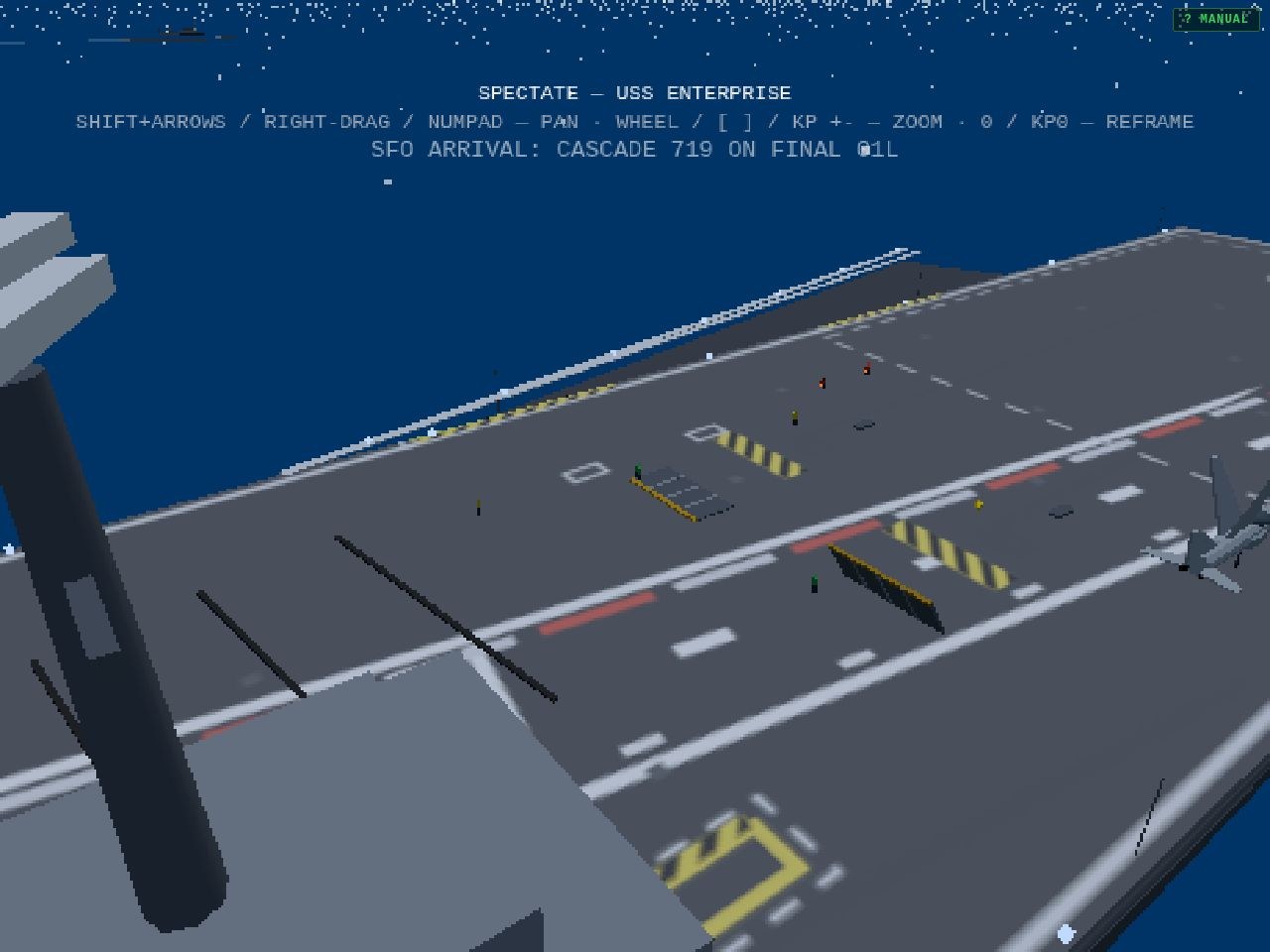
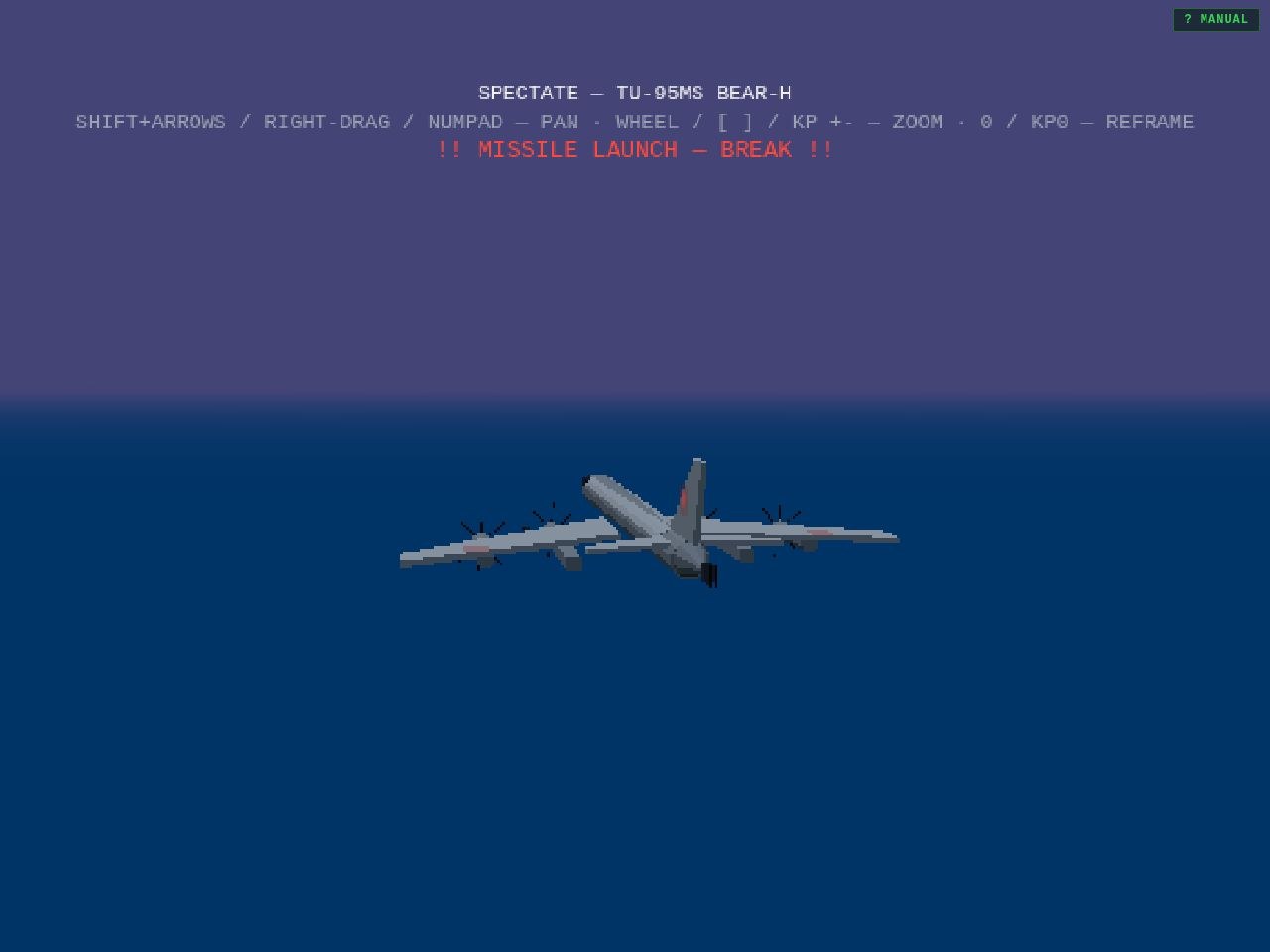
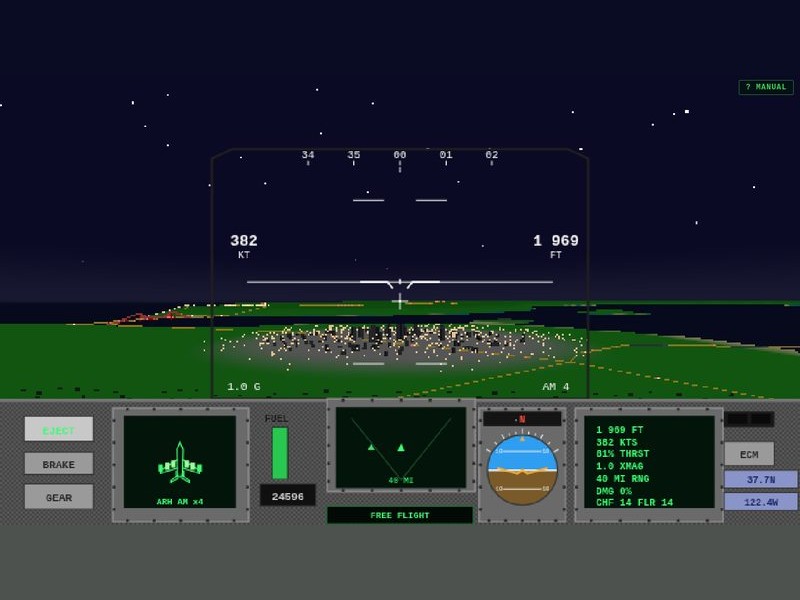
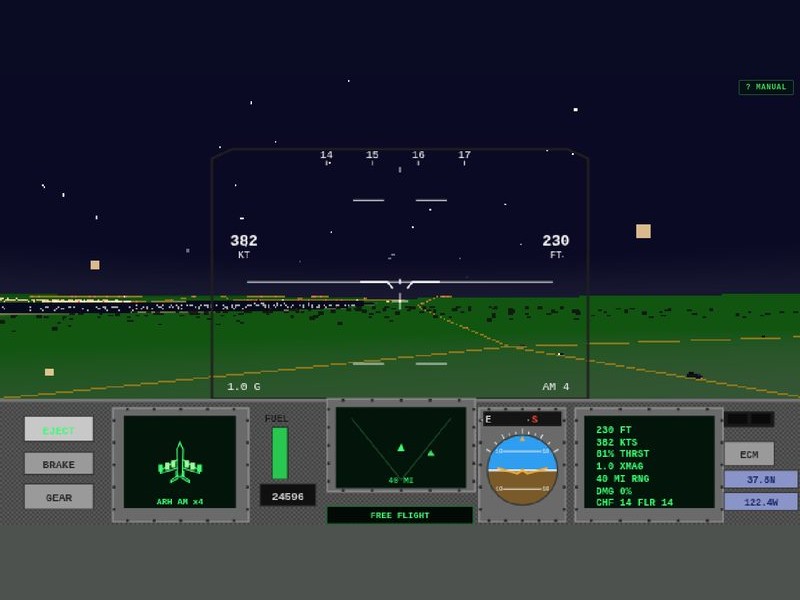
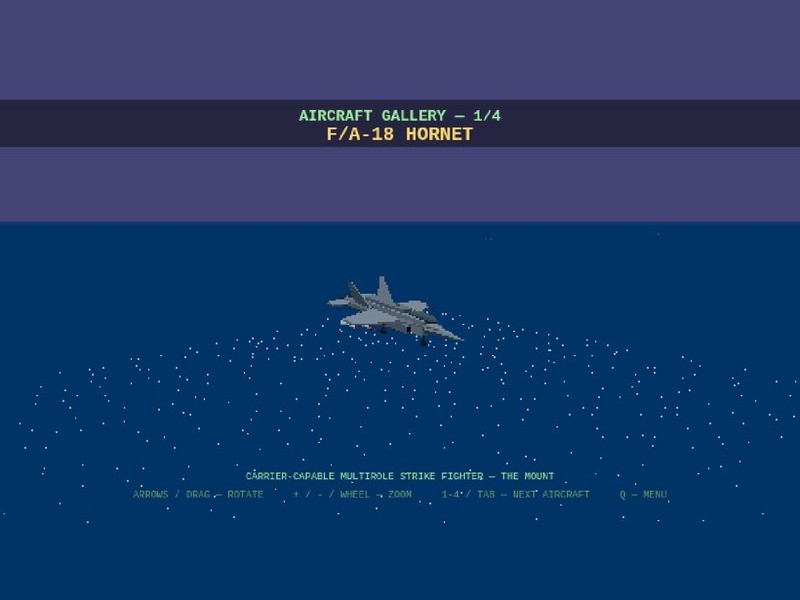
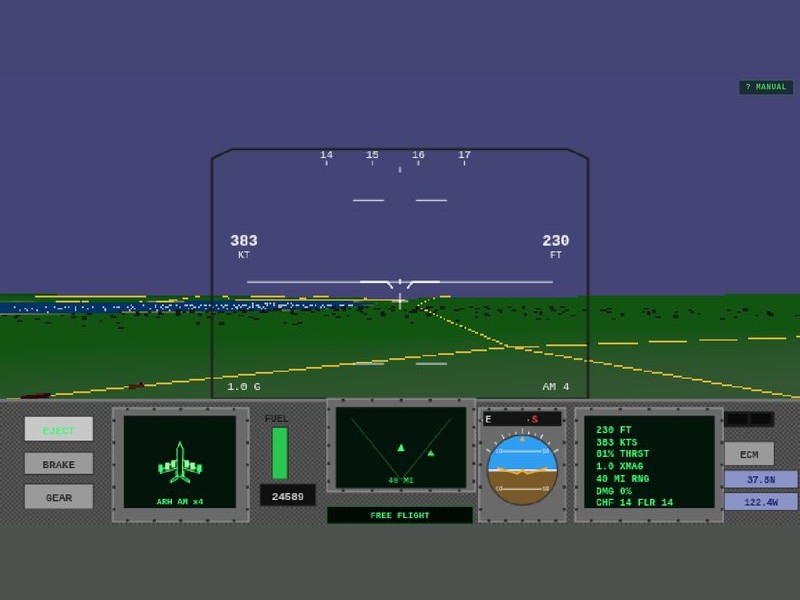
Follow-up to wands up, by popular request: the full vocabulary, frozen frame by frame with the signals arrowed. A carrier deck is too loud for radios and too busy for hesitation, so the Enterprise’s crew talks with wands — and every shirt color is a different trade. Here is the whole rainbow, caught in the act on the roof.
Yellow shirts — the aircraft directors
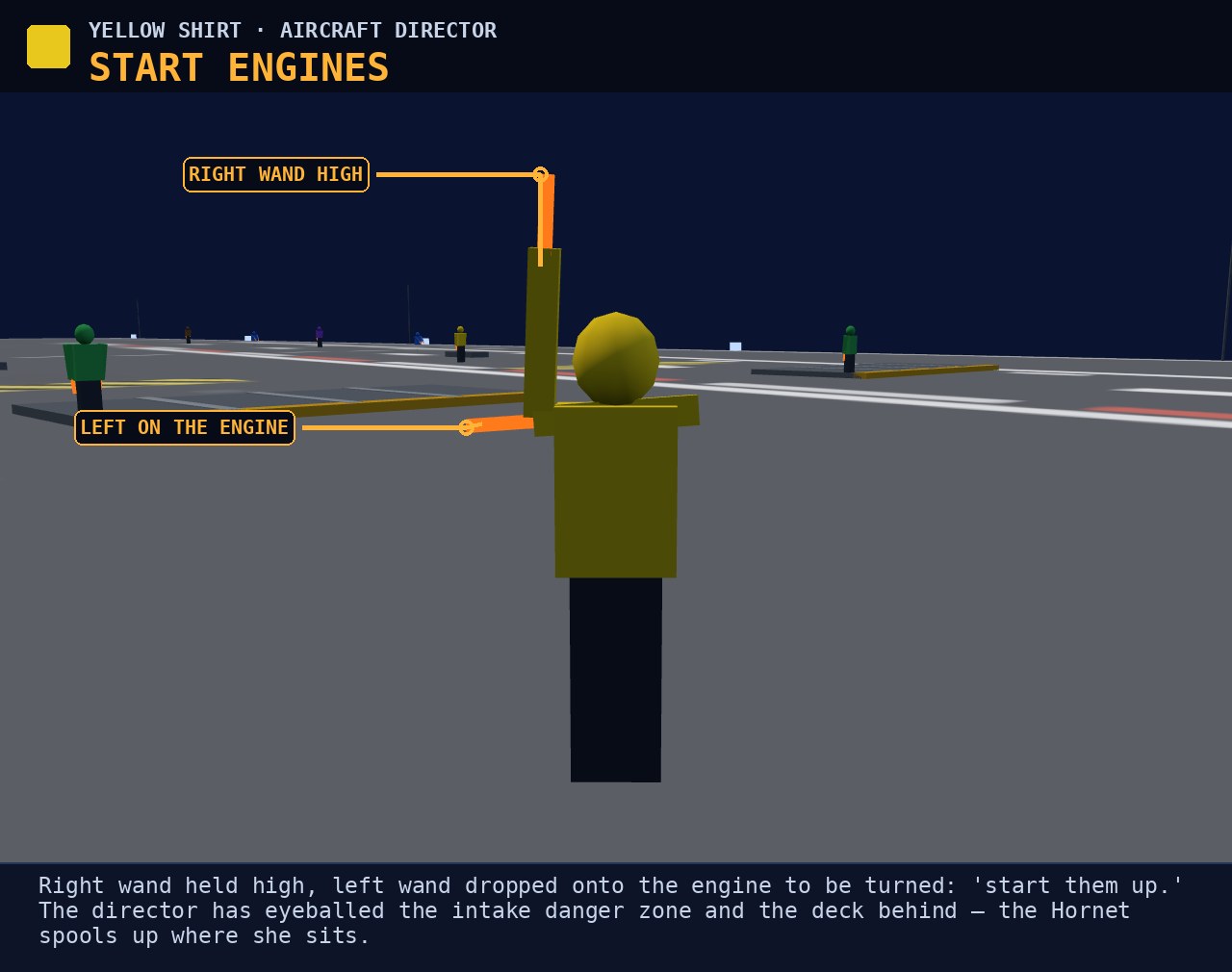
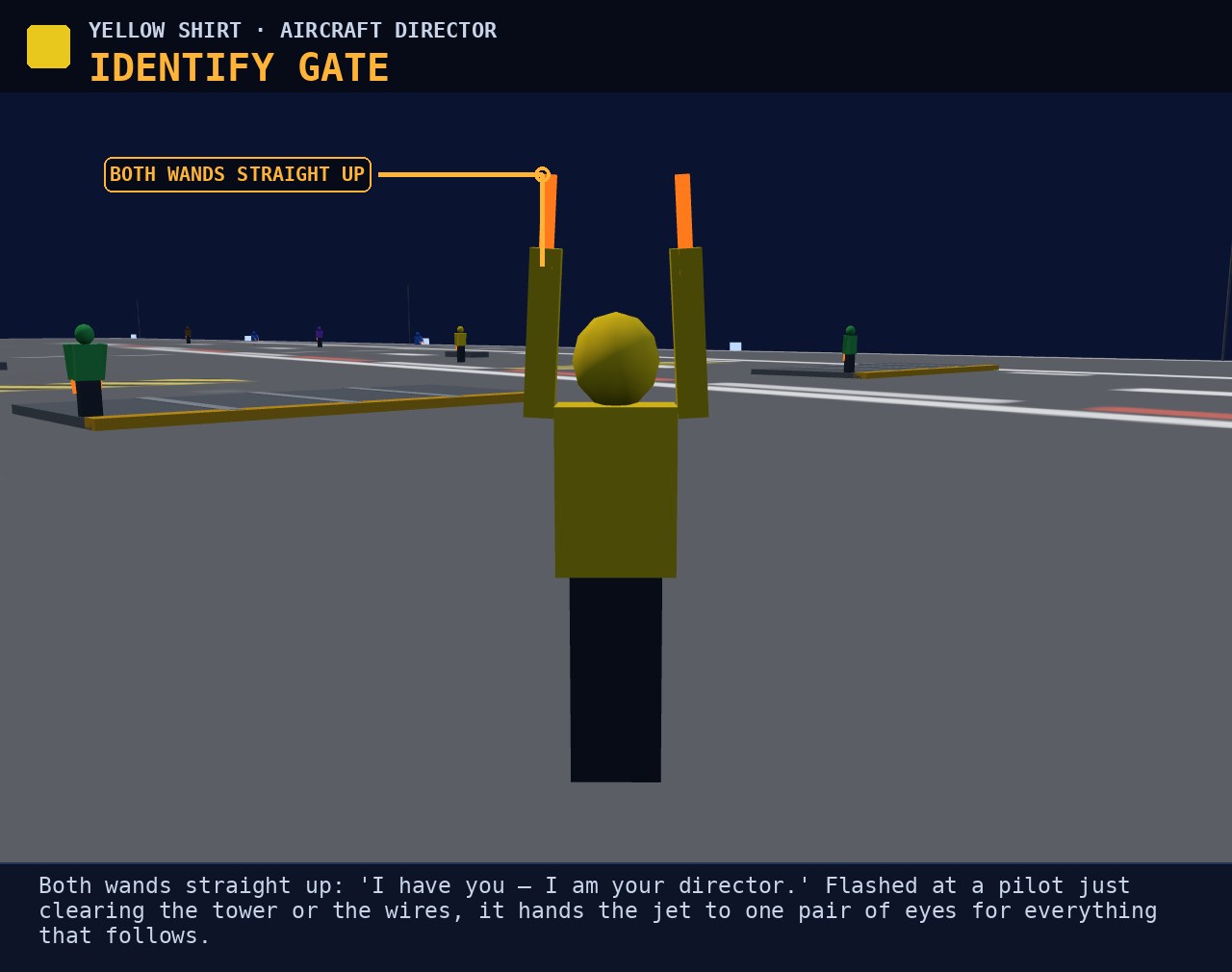
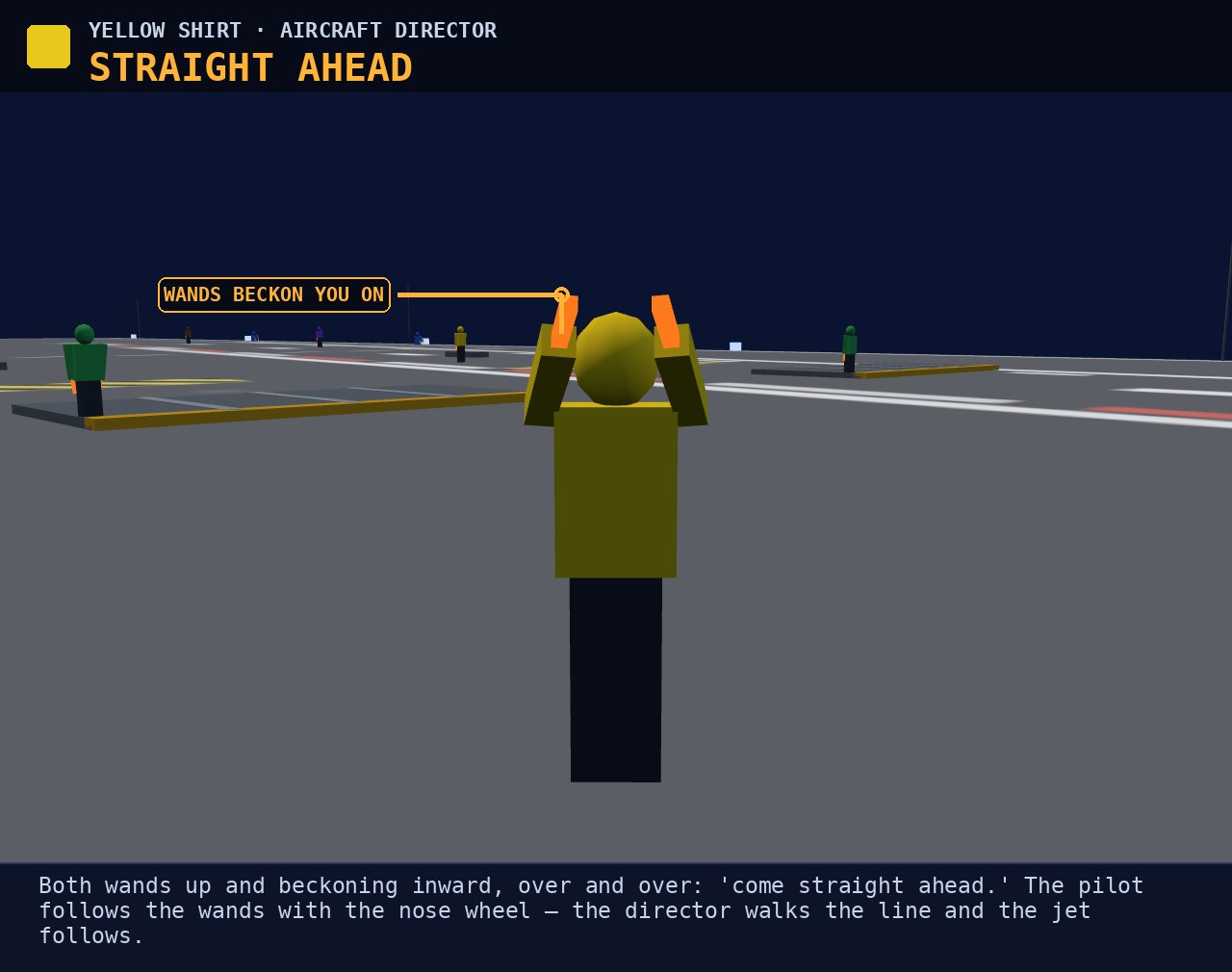
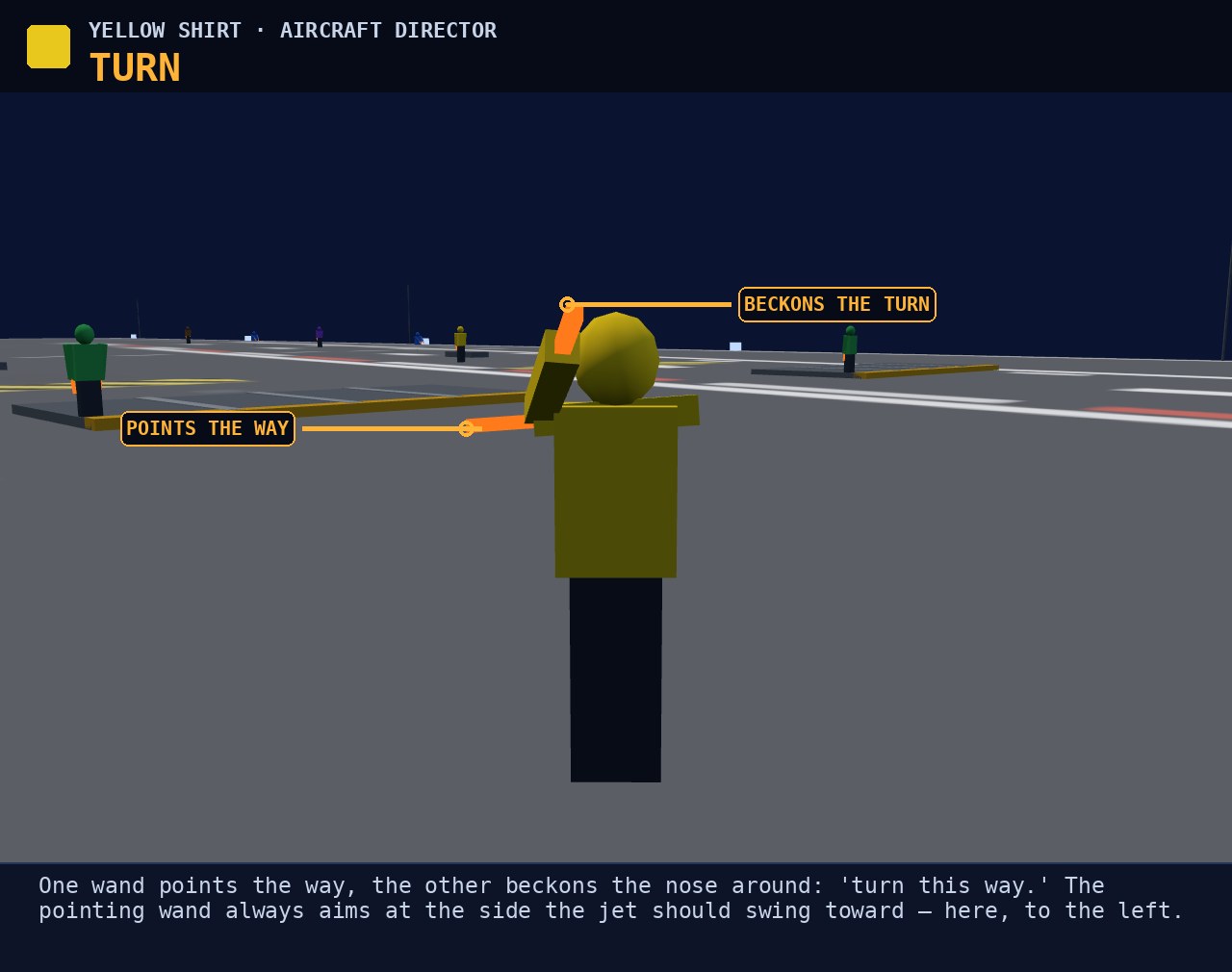
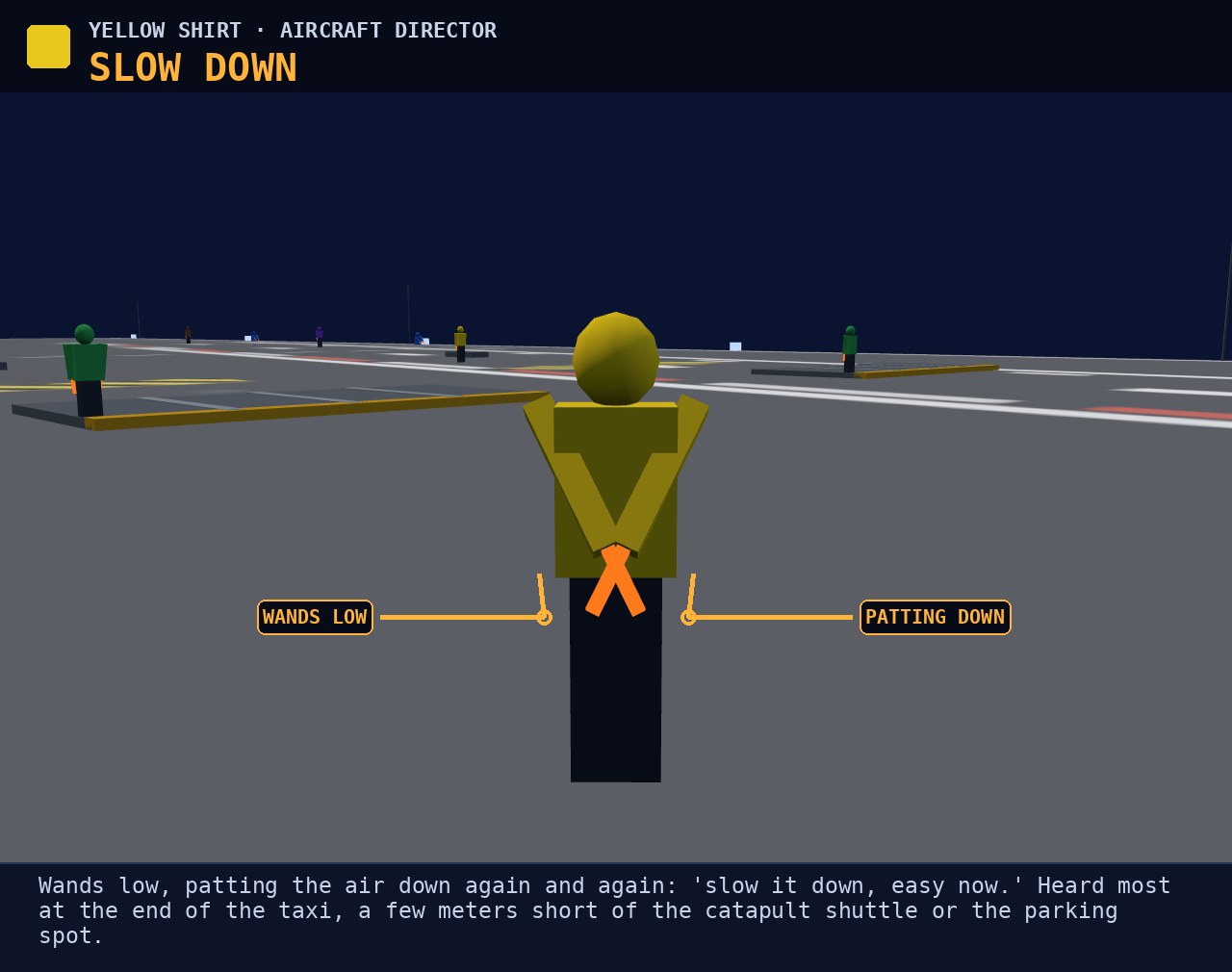
Yellow owns every moving jet. From the moment your engine lights to the moment the chocks go in, a director’s wands are the only traffic law that matters:
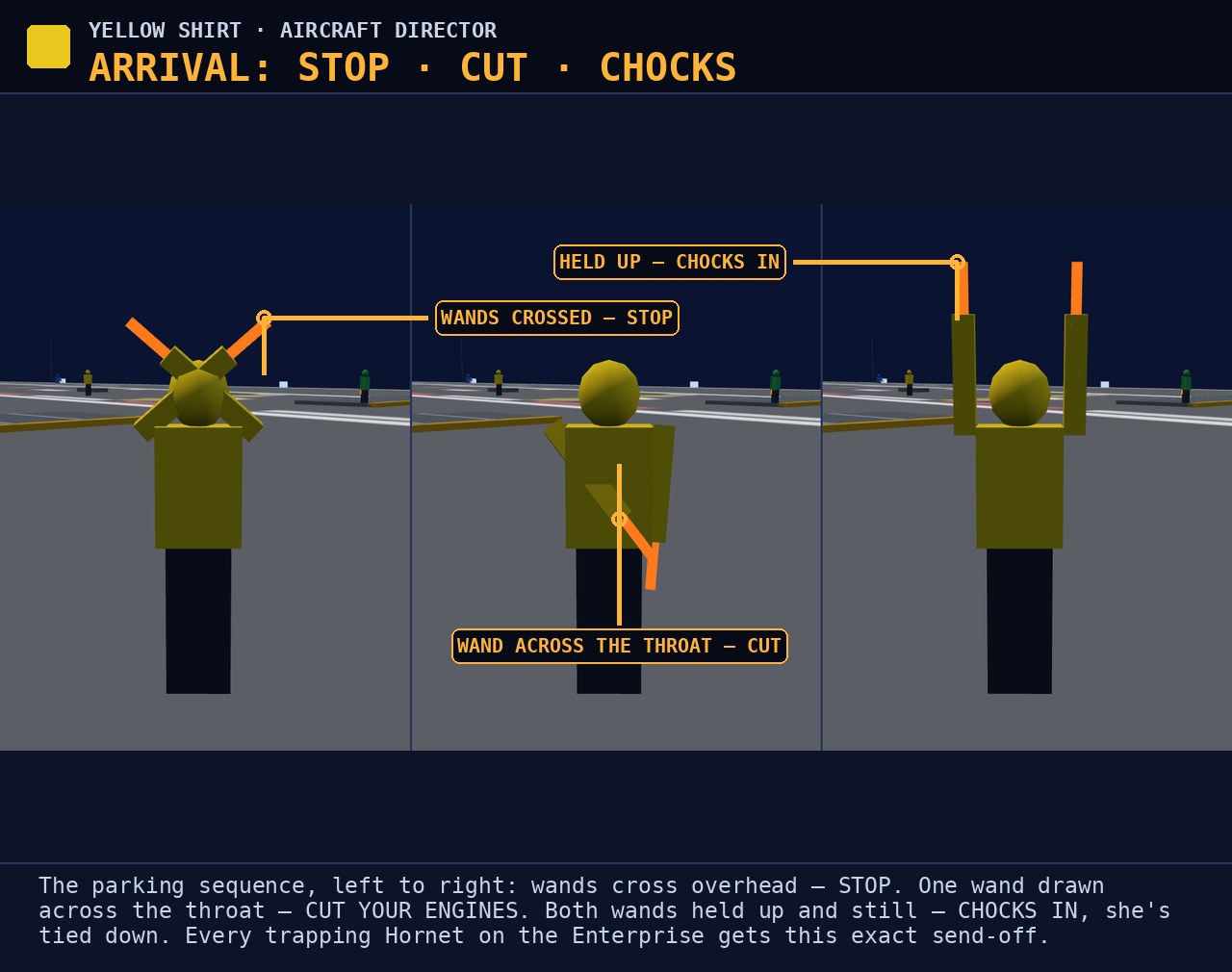
And when you come back aboard, the parking sequence is always the same three beats — stop, cut, chocks:
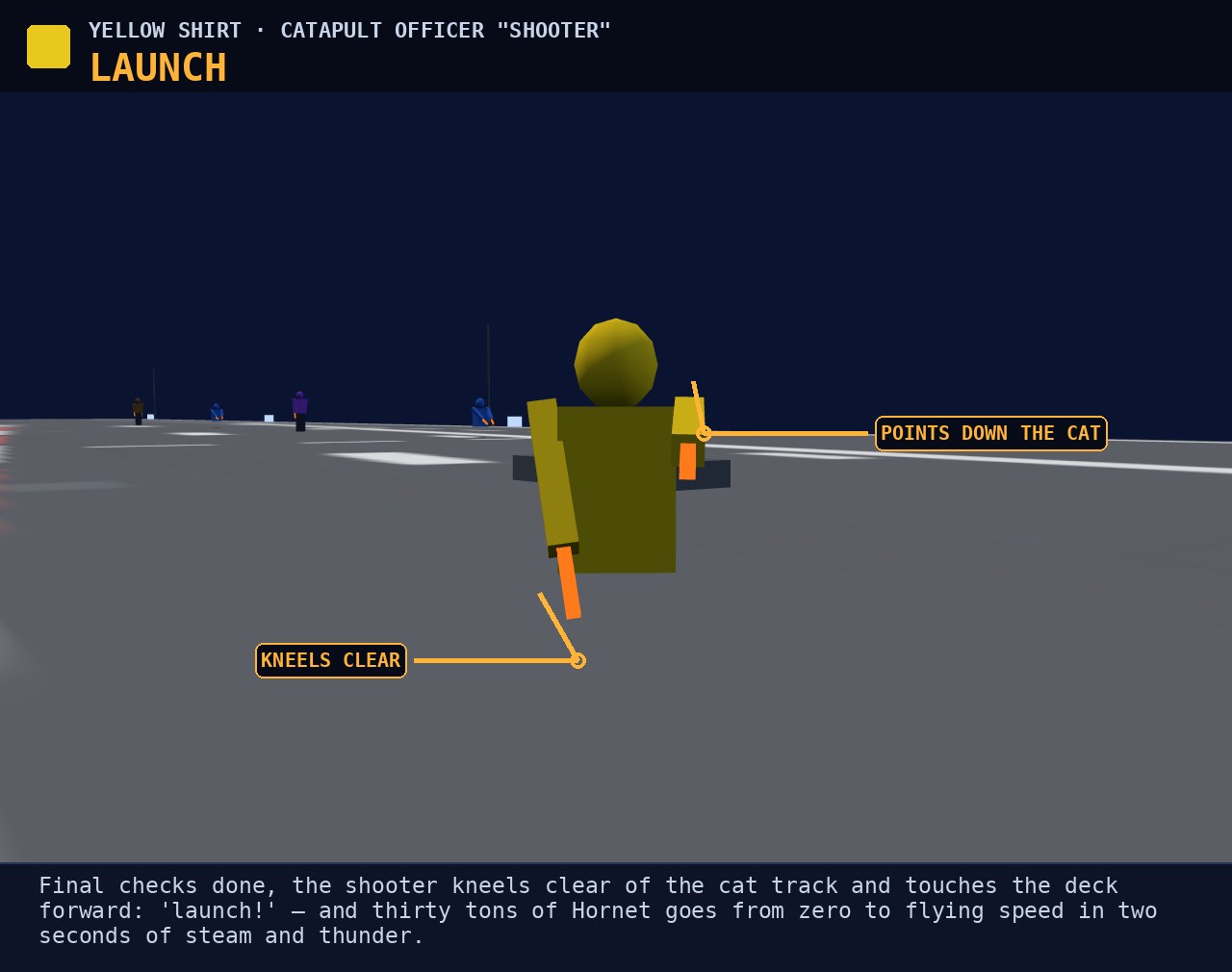
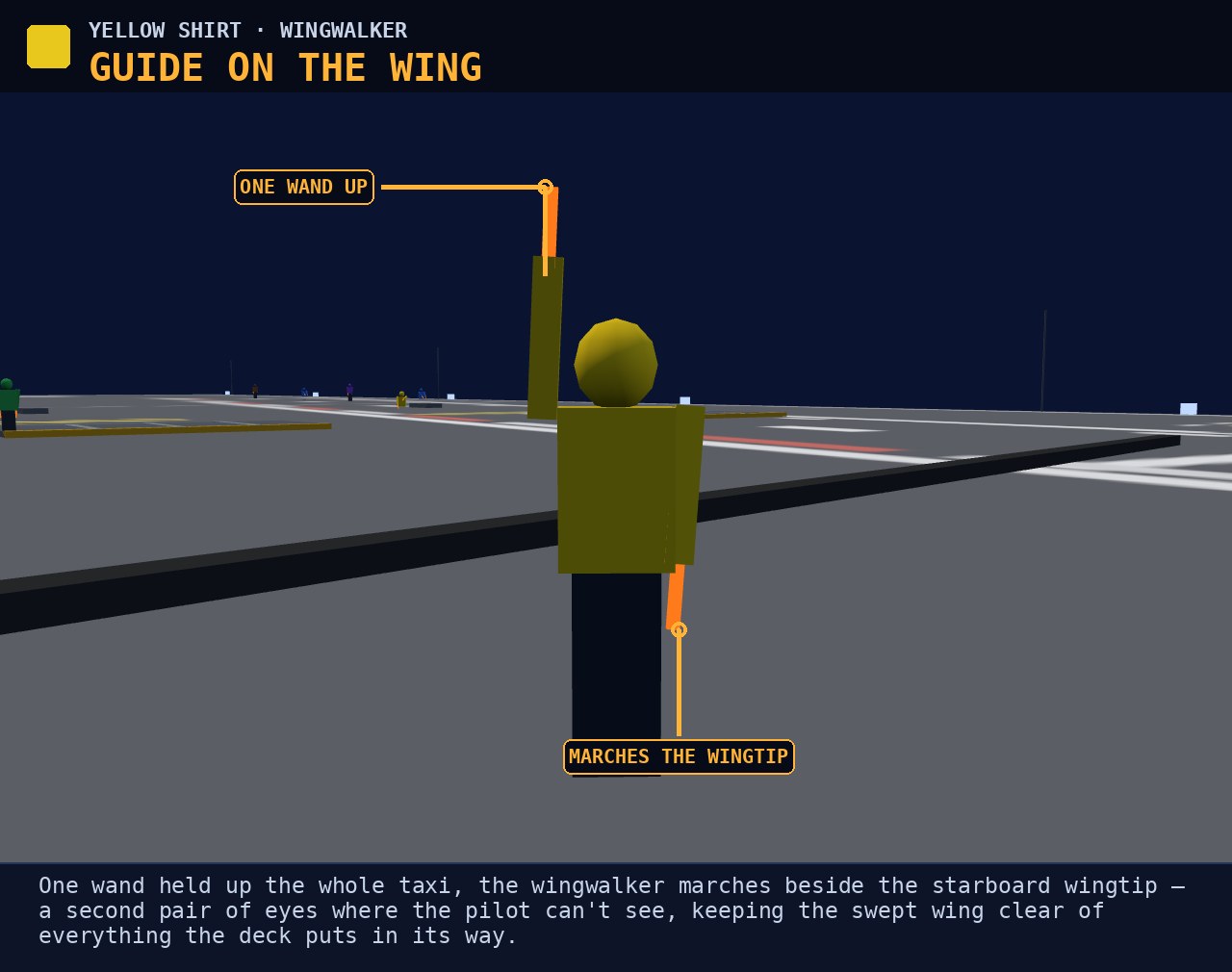
Two yellows work solo acts. The shooter — the catapult officer — sends every jet off the bow with the most famous gesture in naval aviation, and the wingwalker marches the starboard wingtip through the crowded taxi pattern where the pilot is blind:
The rest of the rainbow
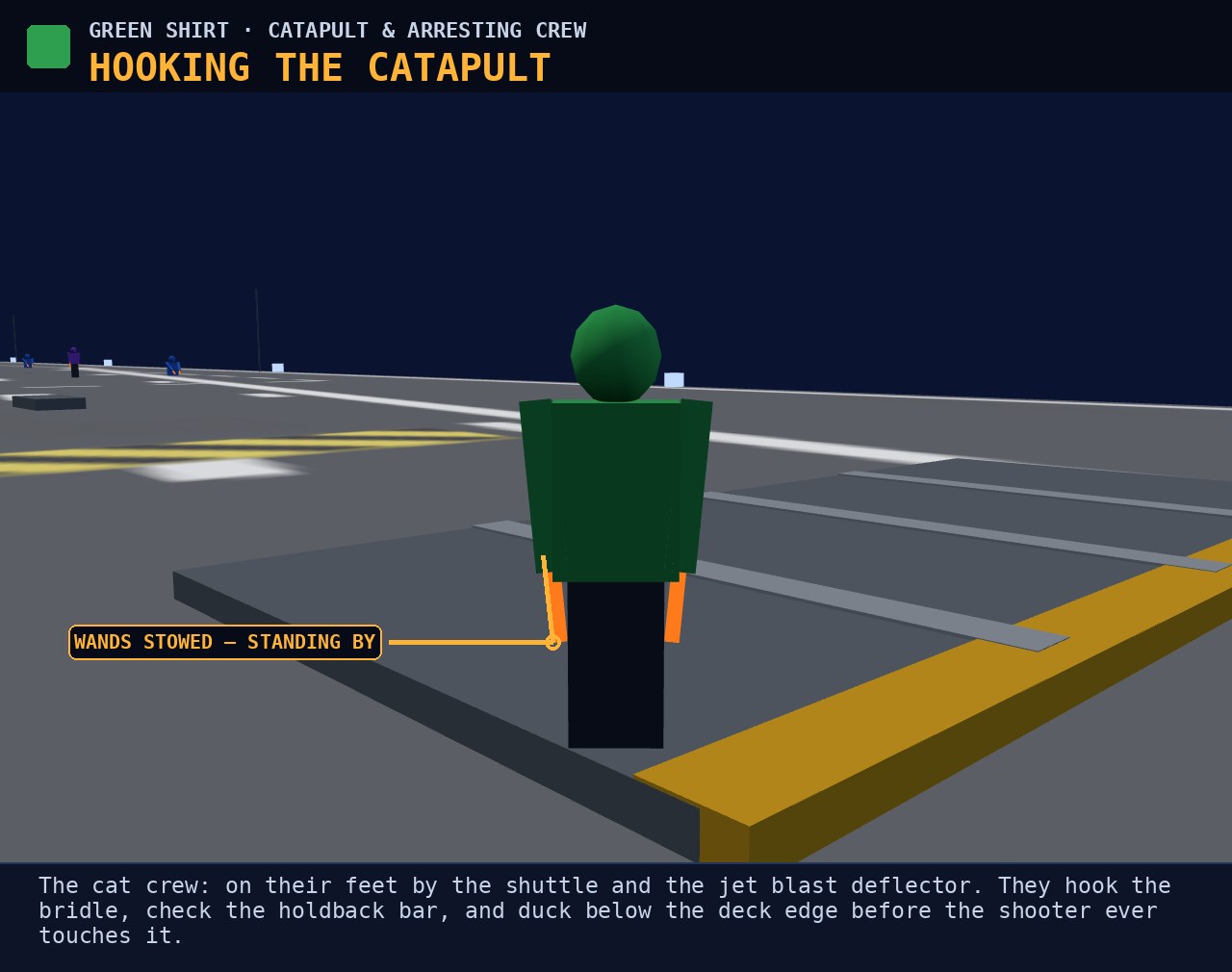
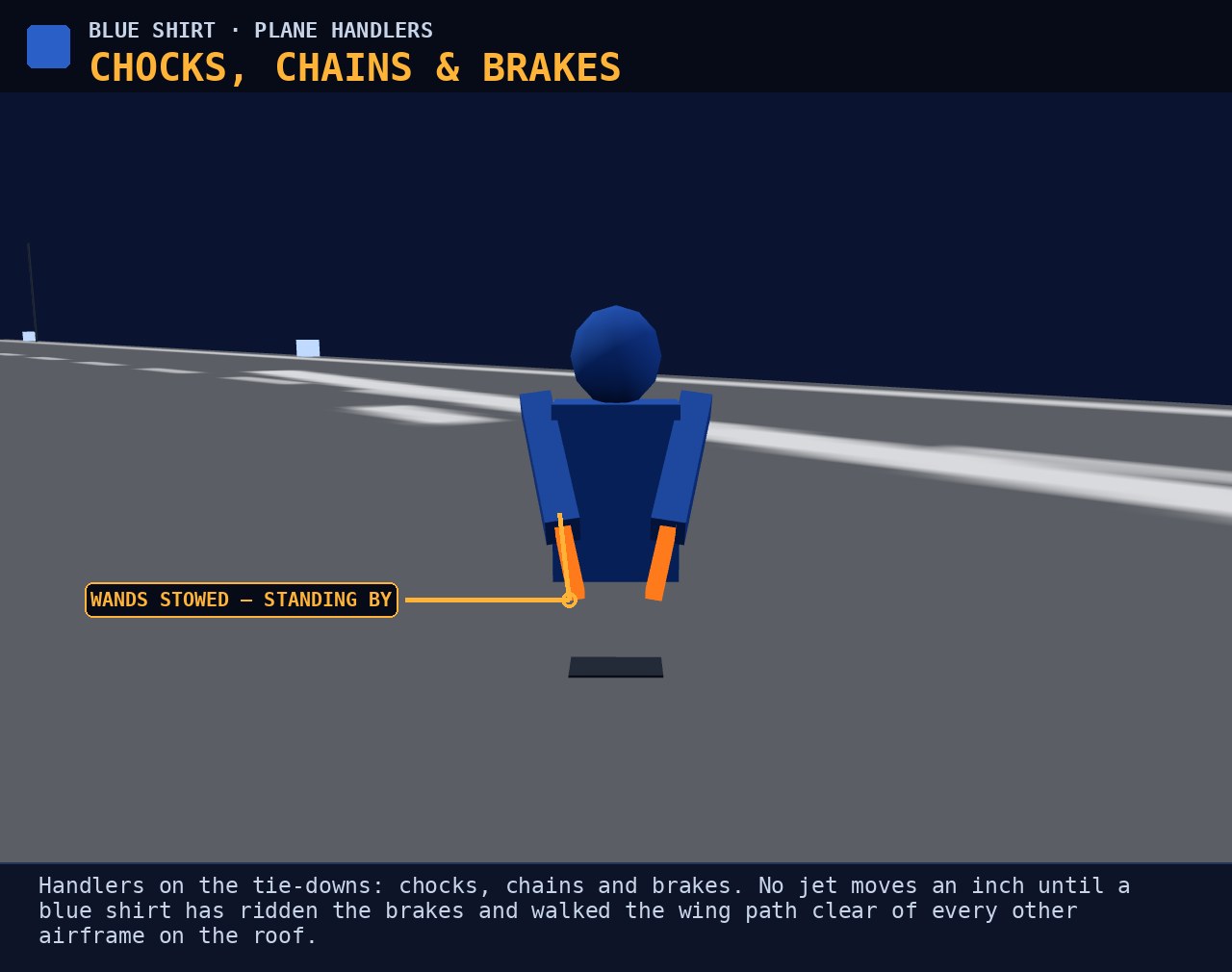
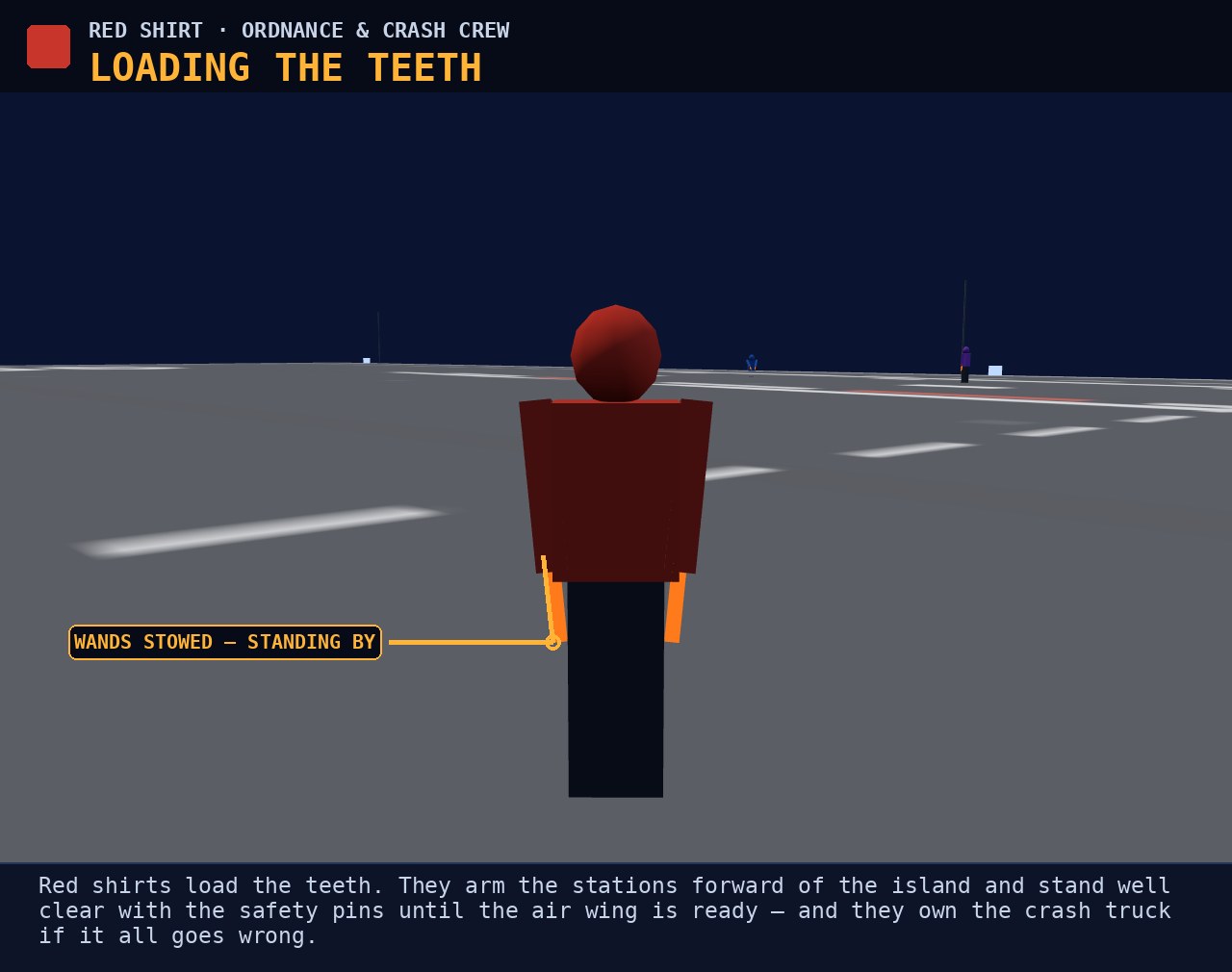
Everybody else keeps the machine turning around the directors. Wands stowed, jobs very much not:
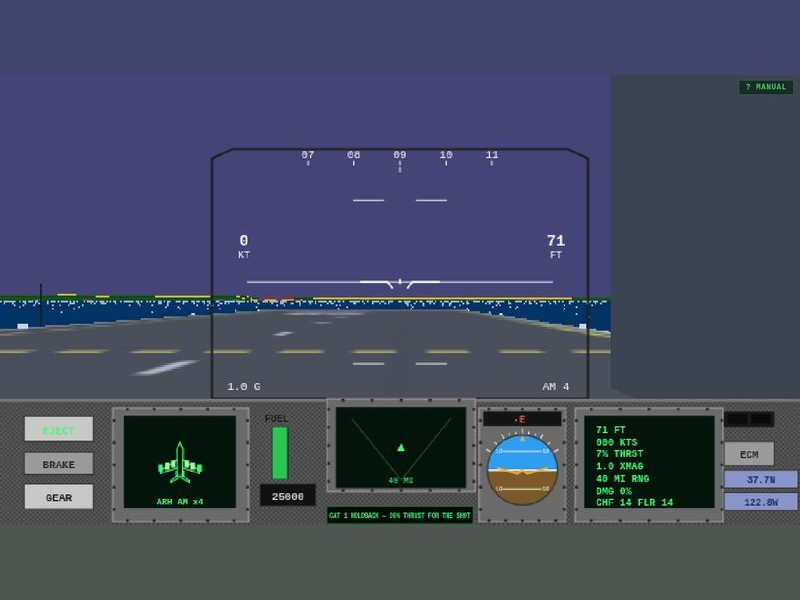
All of it is live on the flight deck right now: spawn on the roof and watch the directors pick you up with the identify gate, taxi to the cat and take the launch signal, or just spectate the air wing cycling — every jet that traps gets the same stop-cut-chocks send-off. Eleven months of flight school, and the deck still says it best with two orange sticks.
The flight deck crew already wore the right shirts — now they speak the language. The directors on the Enterprise work the standard marshalling vocabulary, wands lit and everything:
The full vocabulary.START ENGINES when a jet comes alive, IDENTIFY GATE (both wands straight up: “I have you”), STRAIGHT AHEAD beckoning, TURN LEFT / TURN RIGHT with the pointing wand genuinely aimed at the side the jet must veer, SLOW DOWN patting low on short final to the spot — then NORMAL STOP with wands crossed overhead, CUT ENGINES across the throat, and CHOCKS held high while the blue shirts duck in.
The wingwalker. A yellow shirt marches the starboard wingtip of every taxiing jet, one wand up the whole way — and stands fast with the wand up whenever the jet brakes. The directors hold a STOP while she’s brake-held, exactly as the book says.
You get marshalled too. Spawn on the deck and it’s start-engines and identify-gate; taxi for the cat and you’re waved forward and slowed onto the track; on the shuttle the wands cross, then chocks until you throttle up and the shooter takes over with the kneel-and-point. Trap back aboard and the recovery director waves you up the deck, slows you, and puts you to bed — stop, cut, chocks.
The two environment toggles on the main menu used to have a third stop — MISSION DEFAULT — which mostly asked the pilot to guess what it meant. No more:
DAY ↔ NIGHT. T is now a straight two-way switch; the row always reads exactly what you'll get: NOW: DAY or NOW: NIGHT.
CLEAR → CLOUDS → RAIN → STORM. R cycles the four weathers and stops nowhere else.
Authored sorties keep their briefing. Untouched, a mission still flies at its authored time — the Bear still comes at night. The moment you flip the switch, your choice becomes an explicit override. The plane-select screen shows the same two-state readout, and saves with an old pick migrate cleanly.
Menu navigation should never be a scrollathon. Three courtesies, all about never being stranded:
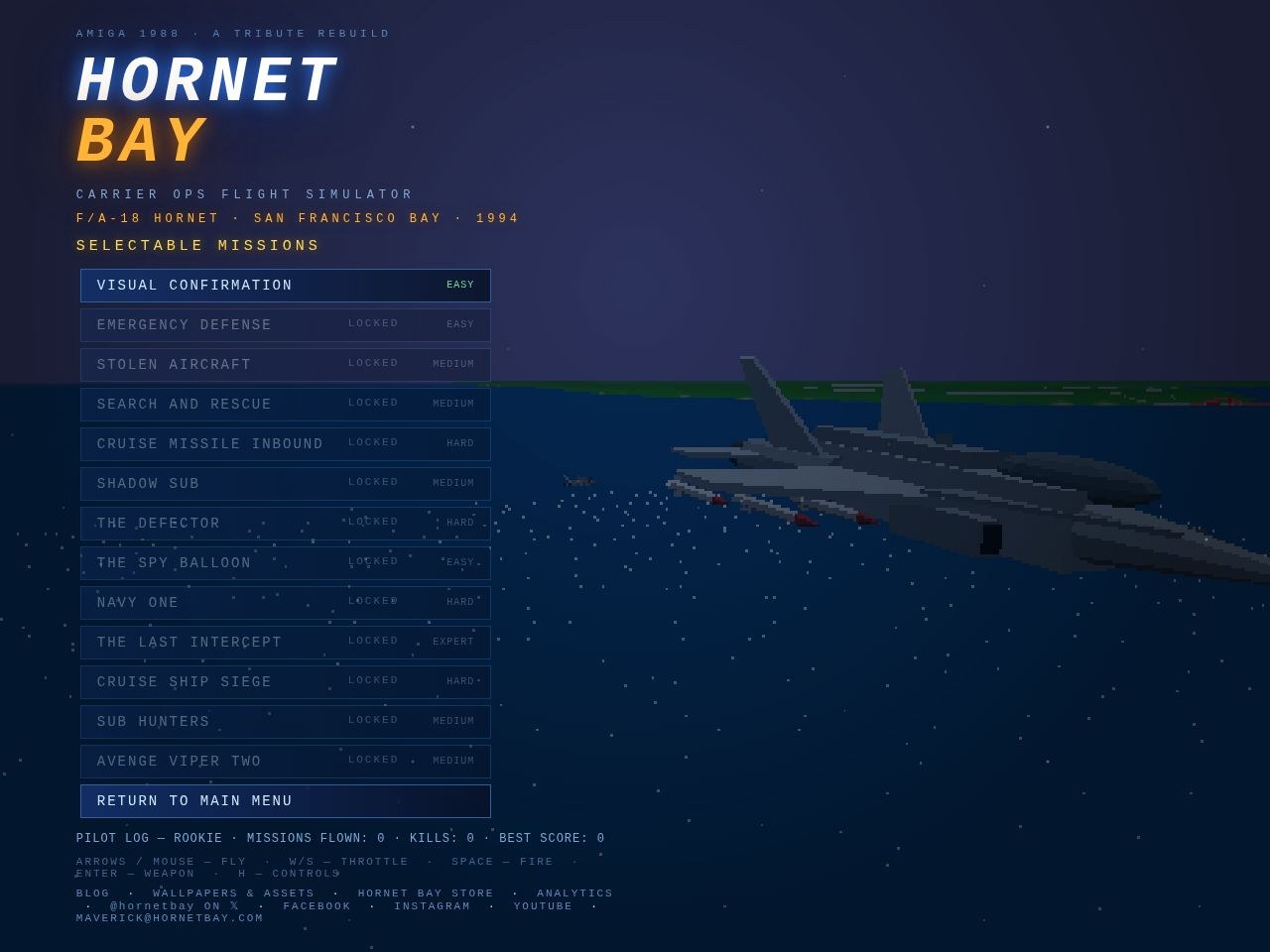
RETURN TO MAIN MENU is pinned at the top of every sub-menu. The campaign board, the flight school syllabus, the pilot log — the button now leads the list and it is sticky: sixteen mission rows can scroll under it and the way home never leaves the glass. The bottom ESC row stays too, and ESC still steps back one menu.
BACK TO MISSION on the main menu. Bail out of a briefing with ESC — easy to do when the teletype is running — and the main menu now offers one button (or the M key) straight back to that brief, mission title chalked on the tag. Launching the sortie retires the button; quitting mid-flight still gets RESUME FLIGHT instead.
Consistent everywhere. Same button, same position, same key — school, campaign and log behave identically, so the map in your head is the map on the screen.
Viper Three is in the water twenty-five miles west, alive and smoking, and two bandit patrols are being vectored to make sure he stays there. The rescue helo goes in anyway — your job is written on every SAR briefing board ever chalked: nothing touches the helo.
The Angel flies the whole profile. Off the deck, seventy-five knots at sixty feet, out to the smoke — then two minutes hovering dead still at eighteen feet while the hoist does its work, then the long low run home. She does not evade, she does not climb, she cannot afford to.
Two bandit waves hunt her. The first pair vectors in on the transit; a three-ship comes for her during the hoist, when she is slowest and lowest. Rated-65 pilots — veterans, cleared for the whole maneuver library.
Lose the Angel and the sortie is over. Bring her feet dry with Viper Three in the cabin and the debrief writes itself: that was the whole job — and you did it.
The flight deck has crew now — eleven handlers in the proper Navy colors, and they work the whole cycle exactly as their real counterparts do:
Yellow shirts direct. A director marshals the air wing up the cat-2 lane with the come-ahead wave, wands crossing overhead when it’s time to hold. The recovery director waves trap survivors toward the parking row the same way — including you, after your own wire.
The shooter shoots. Kneel on one knee beside the shuttle, one arm pointed down the track — your cat-1 shooter drops into the pose the moment you come to military power, and the cat-2 shooter does it for every air-wing launch.
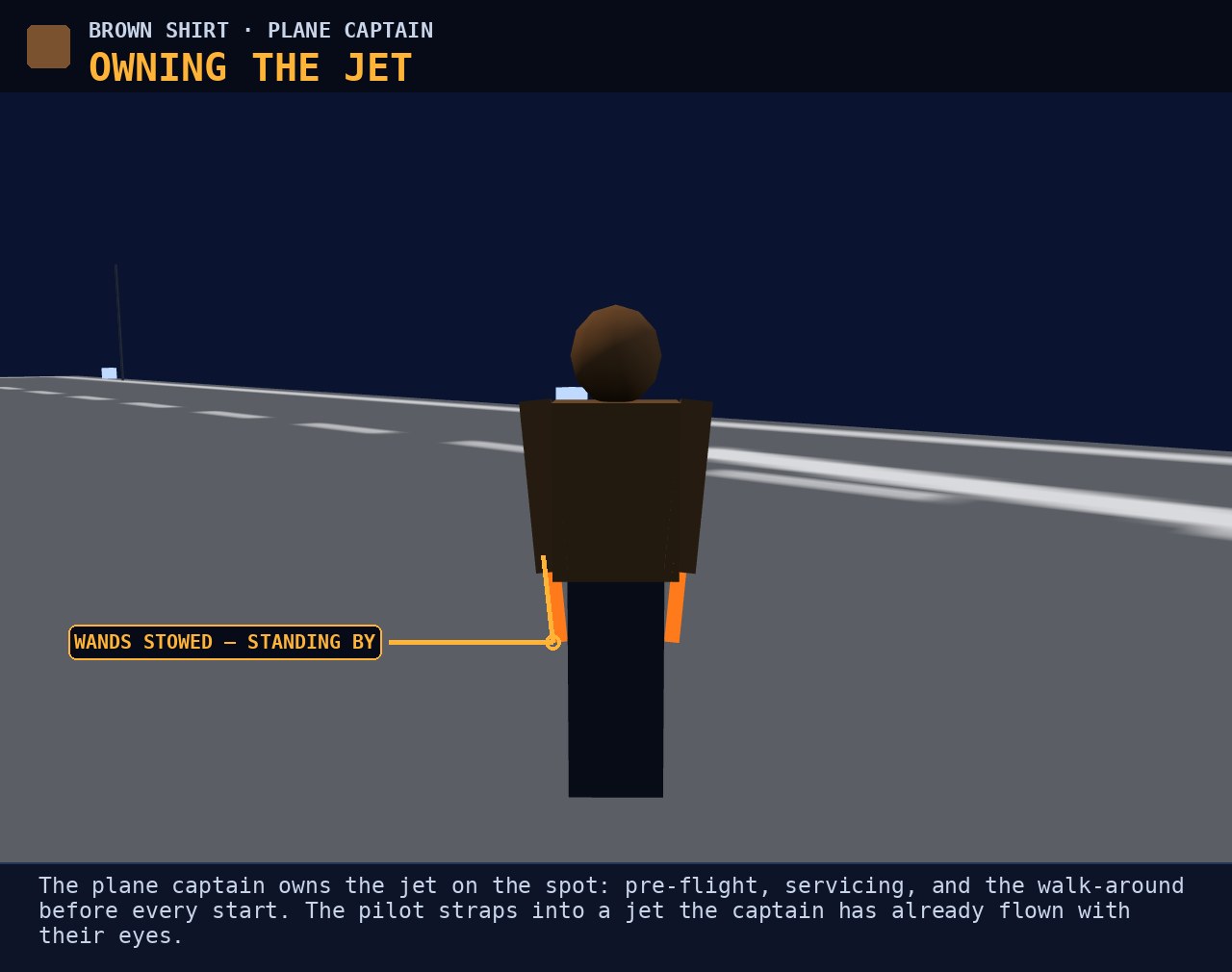
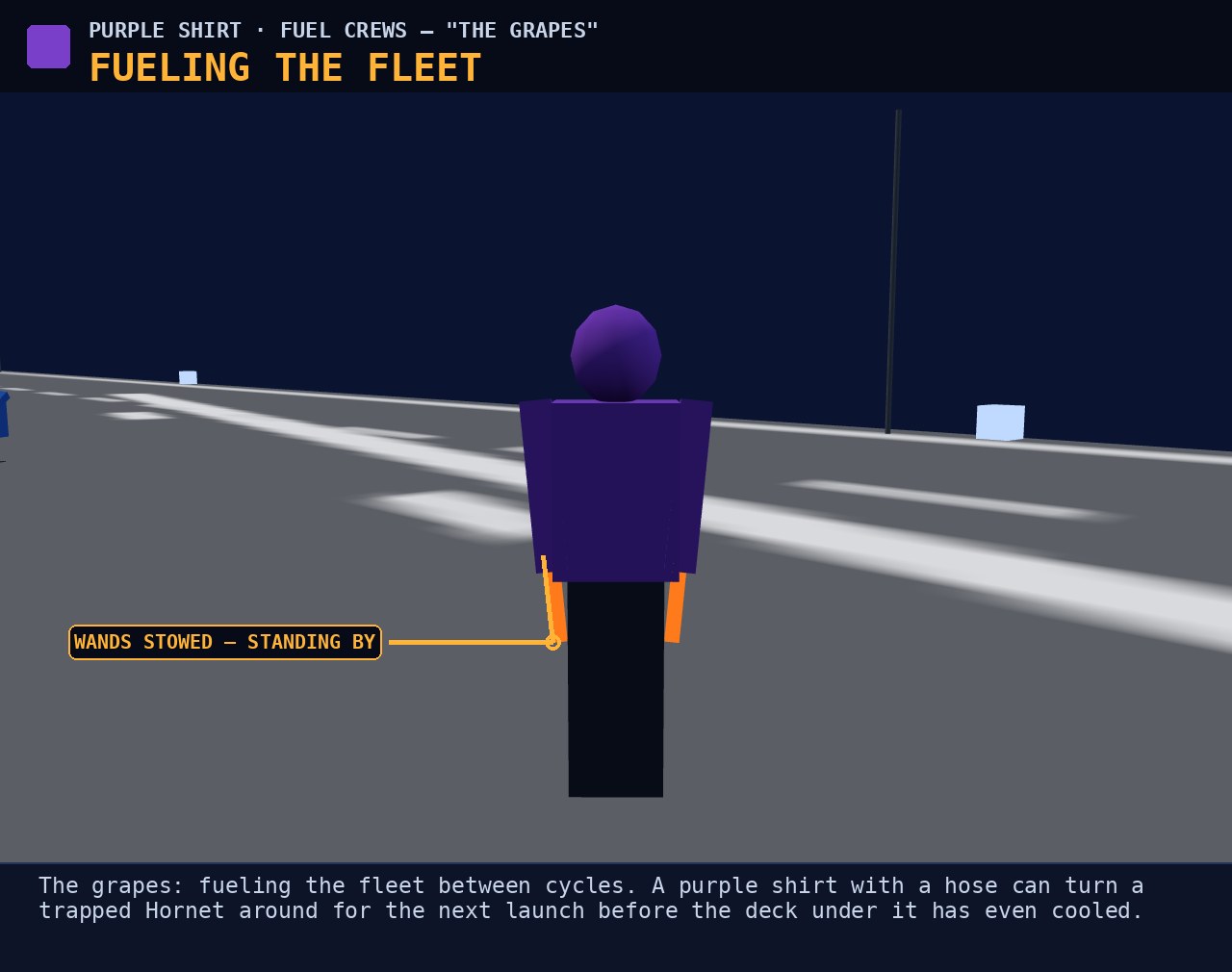
The right colors in the right places. Green shirts stand by their JBDs, blue handlers crouch on the tie-down chains along the port row, ordnance reds wait by the island, and the brown plane captain and purple fuel crew hold the bow spots.
Also in this build: SHIFT+J rides the spectate ring backwards — J steps forward through every contact in the area, SHIFT+J steps back to the previous one.
Two small fittings, both requested from the cockpit:
HOOK annunciator. The F/A-18 and the F-14 gain a fourth lamp in the left-hand stack — HOOK, amber when the tailhook is down, dim when stowed. On the ball you want to see it lit without thinking; USAF kit (F-16, F-15, A-10) keeps the honest three-button stack it always had.
KEYS / CONTROLS on the pause card. The pause menu now carries a straight route to the flight manual: PAUSED → KEYS / CONTROLS, read what you need, close it, and you land right back on the PAUSED card — no fumbling for the ? key with cold hands.
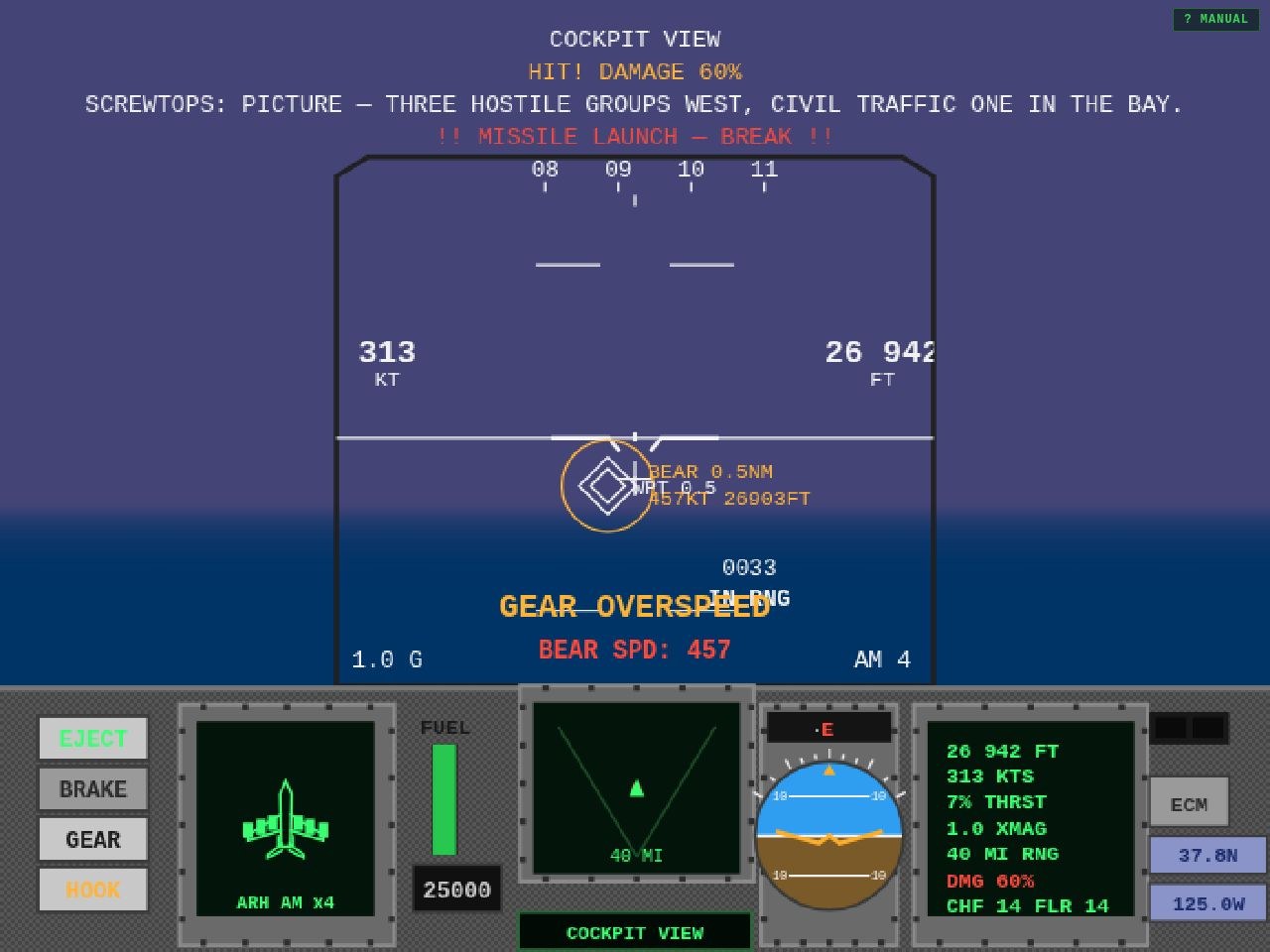
A turboprop contact, bearing 270, a hundred ten miles out, Angels 27 — and she is not out there to take pictures. The Tu-95MS Bear-H joins the sim: four NK-12 contra-props on a 35° swept wing, a glazed bombardier nose, twin guns in the tail barbette, red stars on the fin. She is in the gallery, the print bay, and the store — and she is the centerpiece of the two hardest sorties in the campaign:
M14 BEAR HUNT (80/100). One Bear, two Flankers riding shot — rated 75, aces, cleared for every maneuver in the library. She trucks for her launch point fifty miles off the boat; an expert pilot runs her down and kills the archer with the arrows still on the rails.
If the arrows fly. Two AS-4 Kitchens, eighteen seconds apart, steering for the moving carrier the whole way in. You and Viper Two hunt them — and if one leaks past, the escorts’ Phalanx CIWS is the last wall of lead: mounts pick the closest missile inside 3.8 km, walk tracers onto it, kill odds climbing steeply as the range closes. One Kitchen amidships and the sortie is over.
M15 BEAR PAK (95/100). The demonstration team: two Bears on two axes, four Flankers rated 92, eight killers in the air at once. Bring everything the school taught you. This one is the final exam.
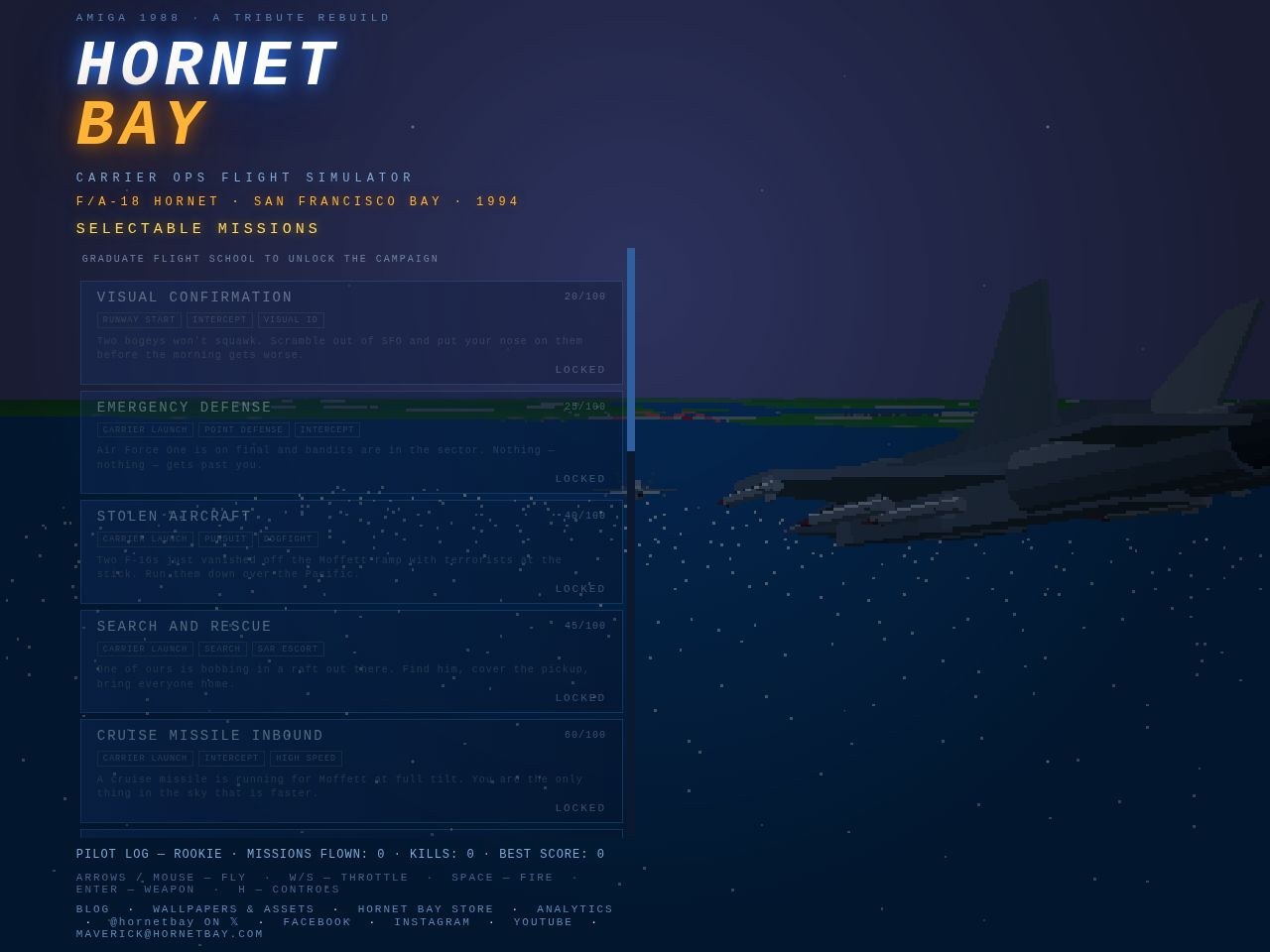
The fleet does not send students to war. The campaign board now stays locked until you graduate flight school — all seven sorties, in order — and it says so in plain amber: GRADUATE FLIGHT SCHOOL TO UNLOCK THE CAMPAIGN. Around it, the board got honest about what everything costs:
Difficulty, numbered. Every campaign mission and school sortie carries a rating out of 100, banded green to red — the first intercept reads 20/100, the Bear PAK finale reads 95/100. No more guessing what EXPERT meant.
Enemy pilots, rated 0–100. Early bandits fly like GREEN patrol pilots; by the late campaign you are meeting VETERANS, ACES, and finally LEGENDS — and the rating is not a label, it drives the AI directly. Higher-rated pilots fly faster, shoot sooner, and only they are cleared for the advanced maneuver library: split-S escapes, barrel-roll spoils, loops to force the overshoot. The briefing now prints the assessment before you commit: ENEMY PILOT RATING: 75/100 — ACES.
New school sortie: T-5 AEROBATICS. Rolls, loops and split-S, graded by the instruments — upright to inverted to upright for the roll, over the top for the loop, inverted then pull through for the split-S, all above 1,800 m or the figure doesn’t count. GUNNERY and DOGFIGHT renumber to T-6 and T-7; the dogfight remains your graduation.
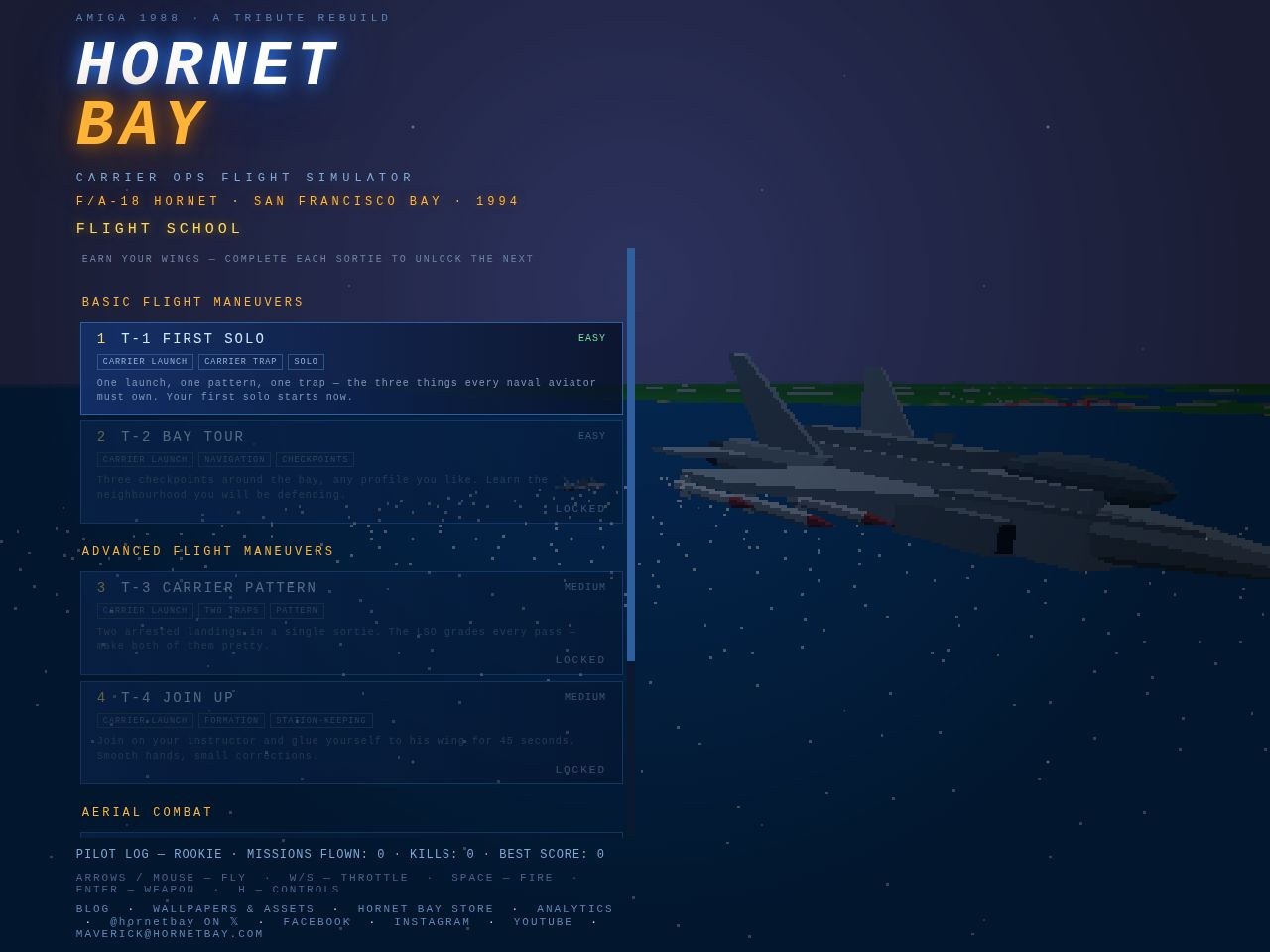
No more sampling the advanced courses on day one. Flight school is now a progressive syllabus: every sortie you pass chalks the lock off the next, from T-1’s first solo to the 1v1 graduation fight:
Sequential unlocks. FIRST SOLO opens the BAY TOUR, the tour opens CARRIER PATTERN, and so on up the ladder — BASIC into ADVANCED into AERIAL COMBAT. Each row shows its chips, hook and difficulty even while locked, so the syllabus still advertises what you’re earning toward.
Deep links play fair. A pasted #t5 from a friend lands on the school board with a LOCKED tag if you haven’t earned it yet — same honesty as the campaign ladder.
The board tells you the rule. A new line under the title reads it plain: EARN YOUR WINGS — COMPLETE EACH SORTIE TO UNLOCK THE NEXT.
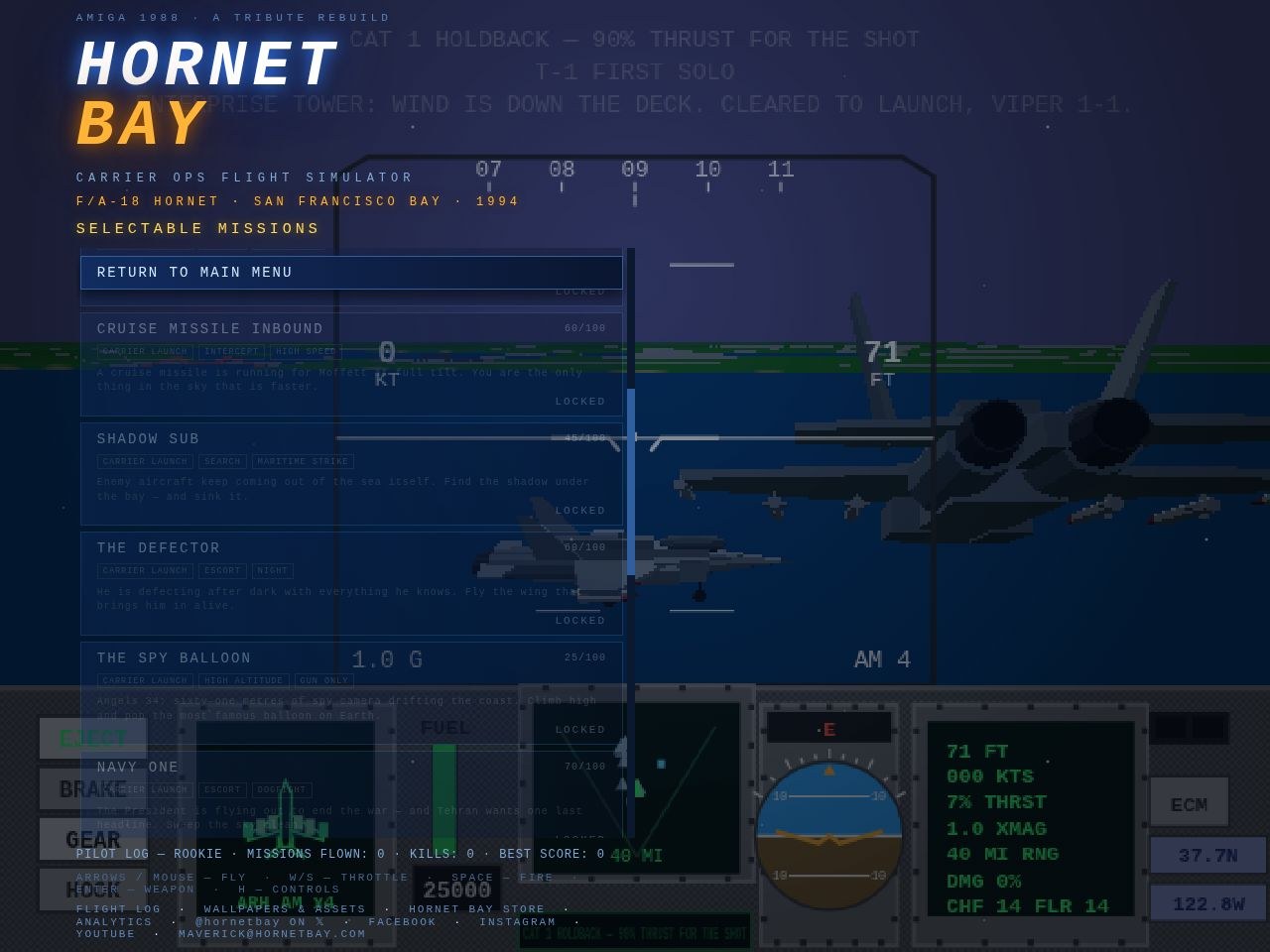
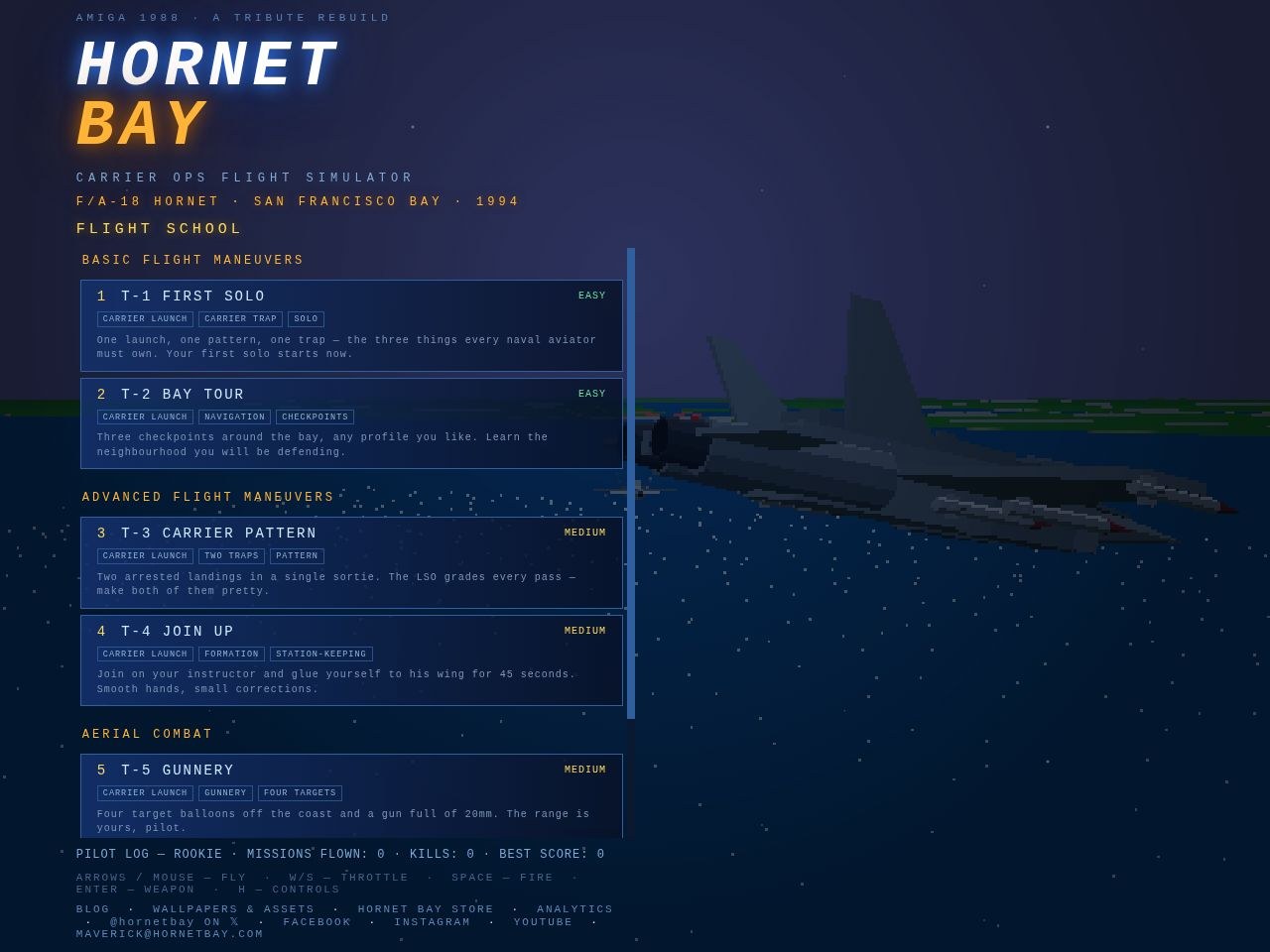
Where is the training program? Top of the main menu, where it always should have been. FLIGHT SCHOOL opens a proper training board — three courses, six graded sorties, every one wearing its chips, difficulty and pitch like the campaign rows, and none of them gated: a fresh pilot walks in on day one.
BASIC FLIGHT MANEUVERS.T-1 FIRST SOLO — one launch, one pattern, one trap; the old carrier qualification, properly homed at last (it still pins QUALIFIED on your log). T-2 BAY TOUR — Golden Gate, downtown, Angel Island: three checkpoints, any profile you like, a bonus for under five minutes.
ADVANCED FLIGHT MANEUVERS.T-3 CARRIER PATTERN — two arrested landings in a single sortie; the boat counts your traps, bolters don’t count. T-4 JOIN UP — your instructor holds a lazy circle at Angels 2.5; glue yourself to his wing for 45 seconds.
AERIAL COMBAT.T-5 GUNNERY — four target balloons tethered off the coast, the fleet politely holding fire so every one is yours. T-6 DOGFIGHT 1V1 — a rated-but-fair aggressor, fights on, no help coming; splash him and you’re cleared for the campaign.
Deep links, of course.#school opens the board, #t1 through #t6 jump straight to each briefing, and old #qual bookmarks still land on T-1. ESC during any school sortie re-spots you on the catapult, same as free flight.
Title, chips, difficulty — and now the reason to fly it. Every row on the mission board carries a one-line hook under the tags, written like the back of a proper 1988 box:
“Night. A nuclear cruise missile at 800 knots. One pass — or one million souls.” — THE LAST INTERCEPT, and you already know why it wears the red EXPERT tag.
“Angels 34: sixty-one metres of spy camera drifting the coast. Climb high and pop the most famous balloon on Earth.” — THE SPY BALLOON.
“They killed your wingman. Four bandits between you and even. You know what to do.” — AVENGE VIPER TWO.
Thirteen rows: title, difficulty badge, three chips, one pitch. Locked sorties show their hooks dimmed — the board advertises the whole campaign even while it keeps you honest about earning it.
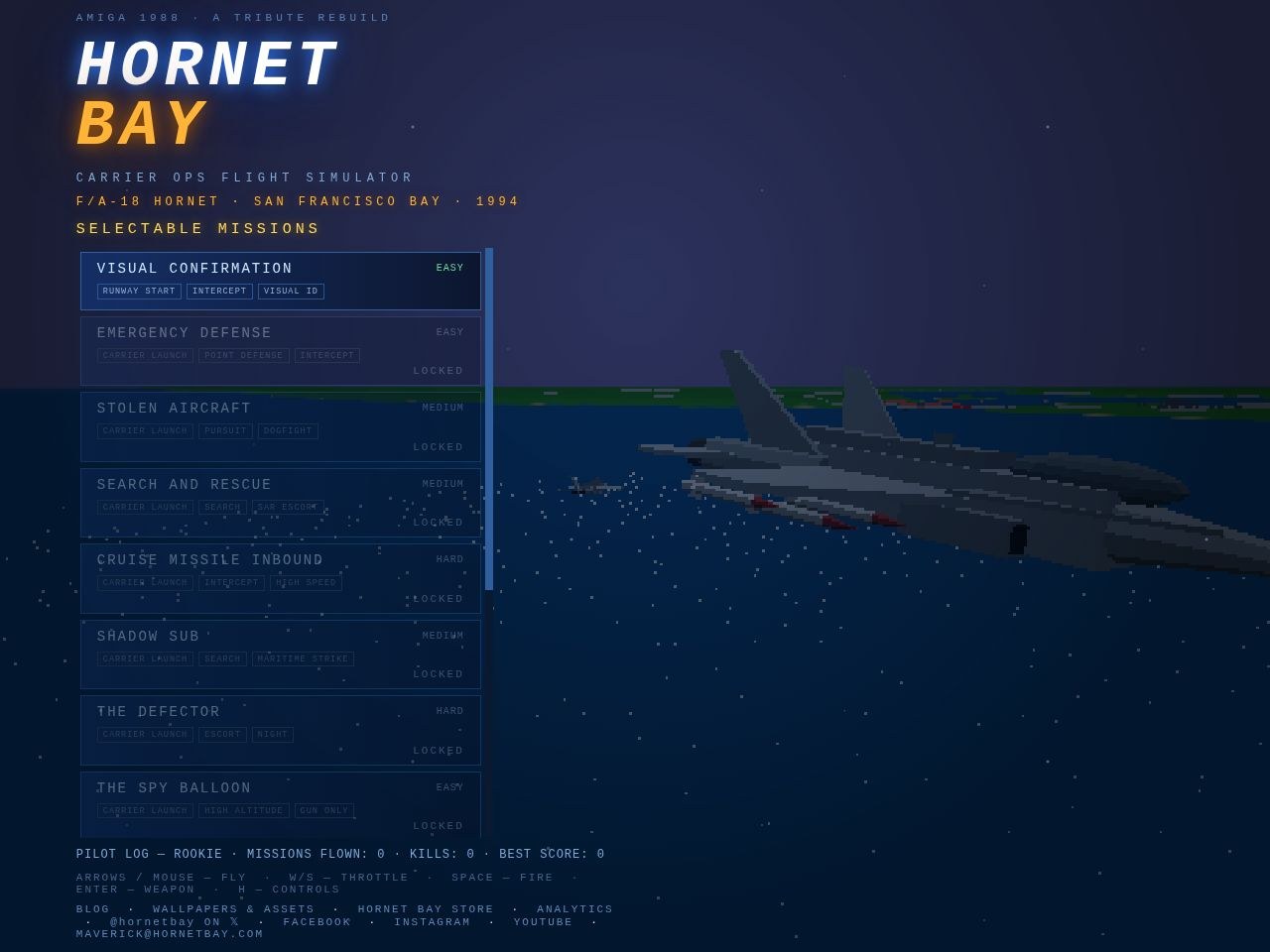
The difficulty tags were only the beginning. Every sortie on the mission board now wears a second line of type and maneuver chips under its title, so you know the shape of the fight before you ever read the brief:
How you start: CARRIER LAUNCH off the pointy end, or a RUNWAY START scrambling out of SFO like the original’s first mission.
What you do: INTERCEPT, PURSUIT, ESCORT, SEARCH, SWEEP, POINT DEFENSE, FLEET DEFENSE, MARITIME STRIKE, SAR ESCORT, VISUAL ID — the job, in one word each.
How it’s fought: DOGFIGHT, HIGH SPEED, HIGH ALTITUDE, LOW LEVEL, NIGHT, GUN ONLY — and ONE PASS for the sortie where there is no second run at the target. THE SPY BALLOON reads CARRIER LAUNCH · HIGH ALTITUDE · GUN ONLY; you already know the whole sortie.
Thirteen rows, three chips each, difficulty badge on the right — the board is a menu, a syllabus, and a warning label all at once.
Two more pieces of the most dangerous 4.5 acres on Earth fell into place:
The boards work. Both bow cats now have their jet blast deflector — the panel lies flush with the deck while a jet taxies over it into position, rises to its full 57° as the holdback tensions, stands through the shot, and drops the moment the shuttle fires so the next aircraft can come forward. Your cat, and the air wing’s: watch Cat 2 cycle a Viking and you’ll see the whole ballet — deflector up, wings spread, shot, deflector down.
Deck marshal, one mover at a time. Aircraft on deck no longer drift through each other. A single-mover rule sequences every taxi; a jet whose path is blocked by a parked aircraft, a jet at the cat, or you holds position with the brakes on until the way is clear — exactly like the yellow shirts waving and crossing their arms. Row jets slip out through the widest gap in the pack instead of driving over their neighbours, and a recovering jet that traps while the deck is busy waits on the angle until its turn. Wings stay folded for the whole taxi and spread at the cat, where the cat officer still won’t start the countdown until they read full spread.
Respotted for clearance. The C-2’s park moved out of the port row to the starboard street — the row was spotted tighter than a folded wingtip could clear, and the real deck would never allow it either.
Every sortie on the mission board now carries a difficulty tag down the right edge — a fixed column you can scan like the fuel gauge:
EASY in green — VISUAL CONFIRMATION, EMERGENCY DEFENSE, and the balloon: solo work against the forgiving end of the threat library.
MEDIUM in amber — the runaway Hornet, the raft search, the sub shadow, SUB HUNTERS and AVENGE VIPER TWO: shooting may be involved, but the odds are yours.
HARD in orange — the missile intercepts, the defector, NAVY ONE and the siege: bring the whole envelope.
EXPERT in red — THE LAST INTERCEPT alone wears it: night, four hundred metres a second, aces on escort, one pass. You were warned.
The tags dim with the row while a sortie is still locked, so the ladder reads honest for a fresh log: green first, red when you’ve earned it.
Six new sorties join the seven you know — the campaign board now runs thirteen deep, each one unlocked by finishing the one before:
M8 — THE SPY BALLOON. A reconnaissance balloon drifts the coastline at Angels 34, cameras clicking. Climb the ladder, get under it, and shred the envelope with the gun — a gentle first solo against a target that can’t shoot back. The frigate is under orders to hold her SM-1s: this one is yours.
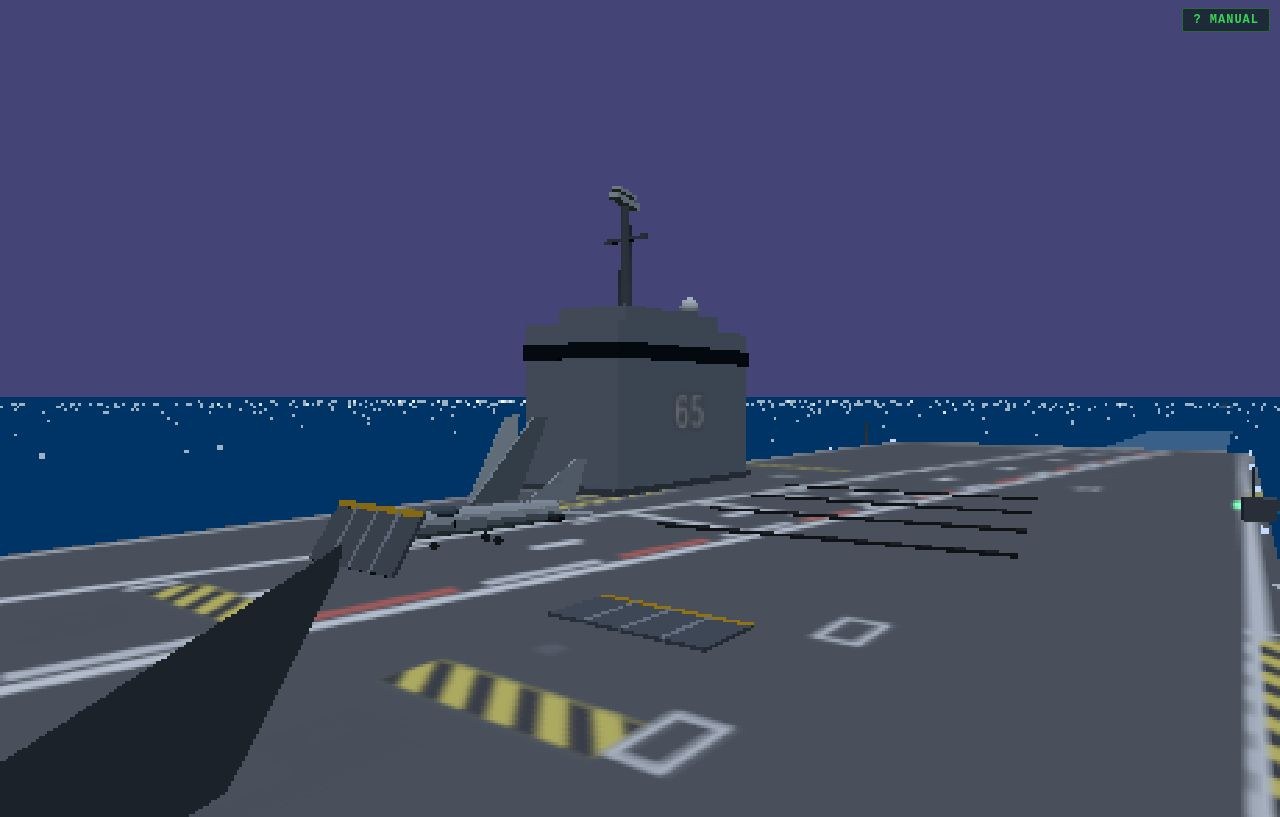
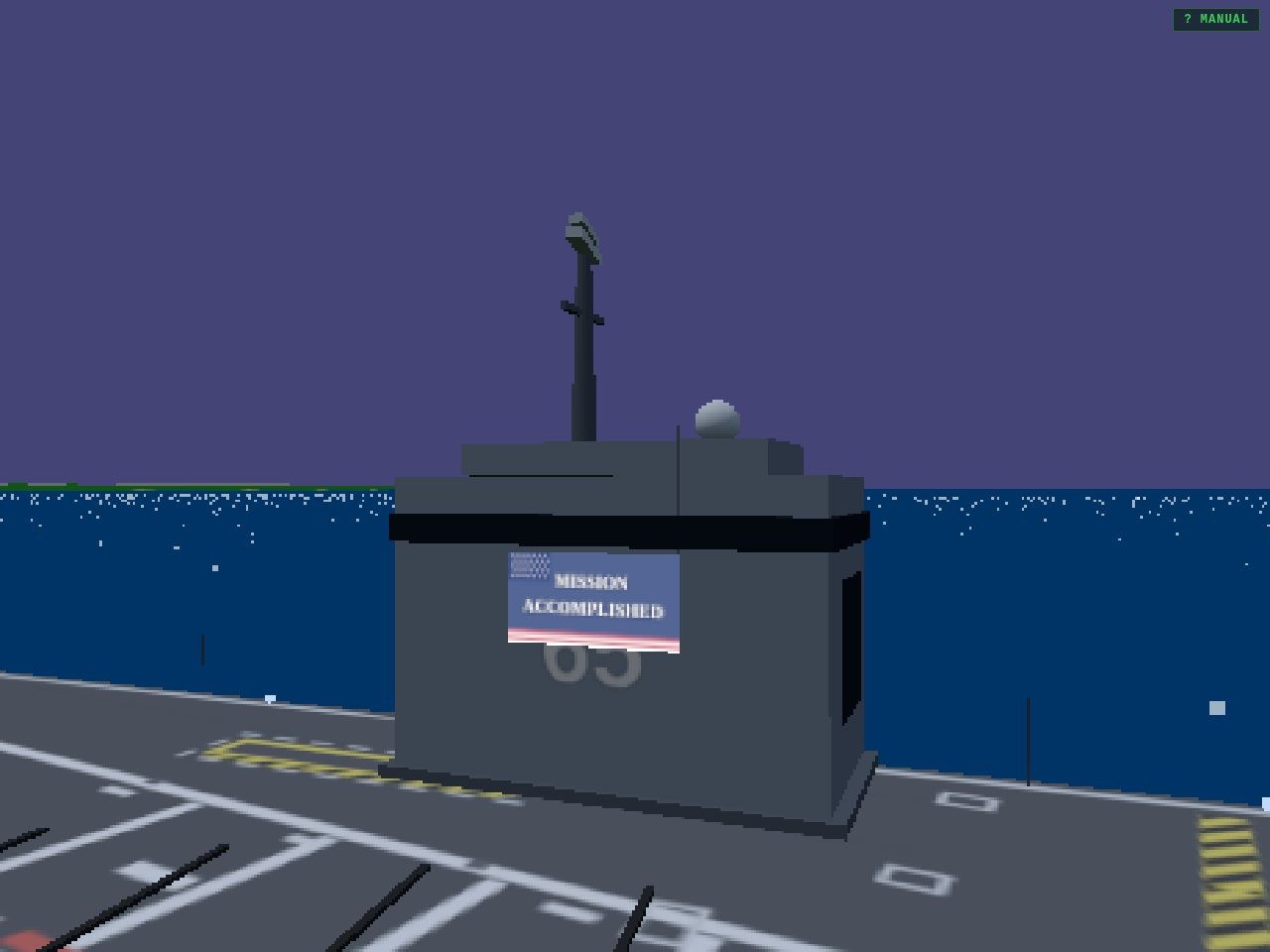
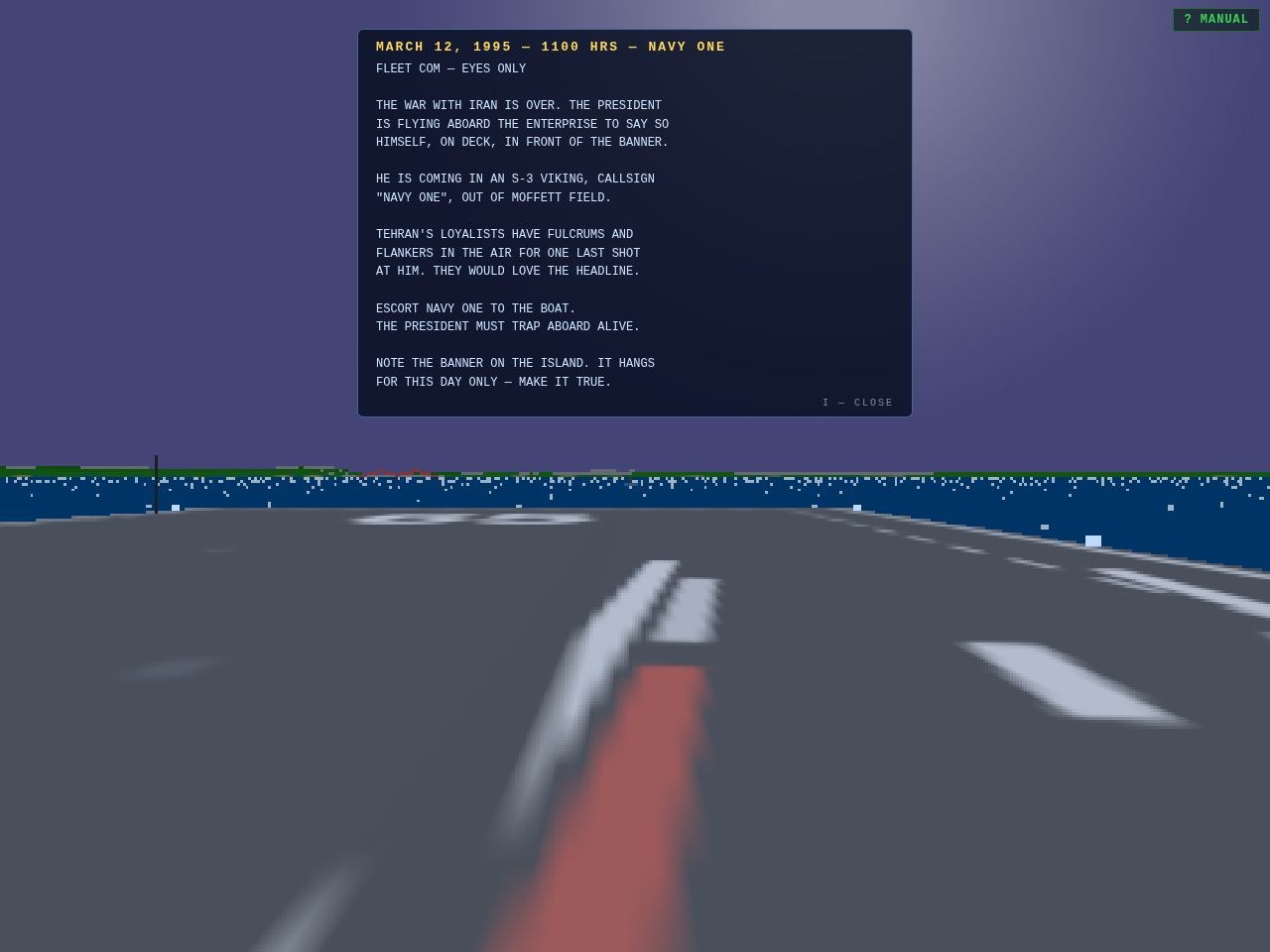
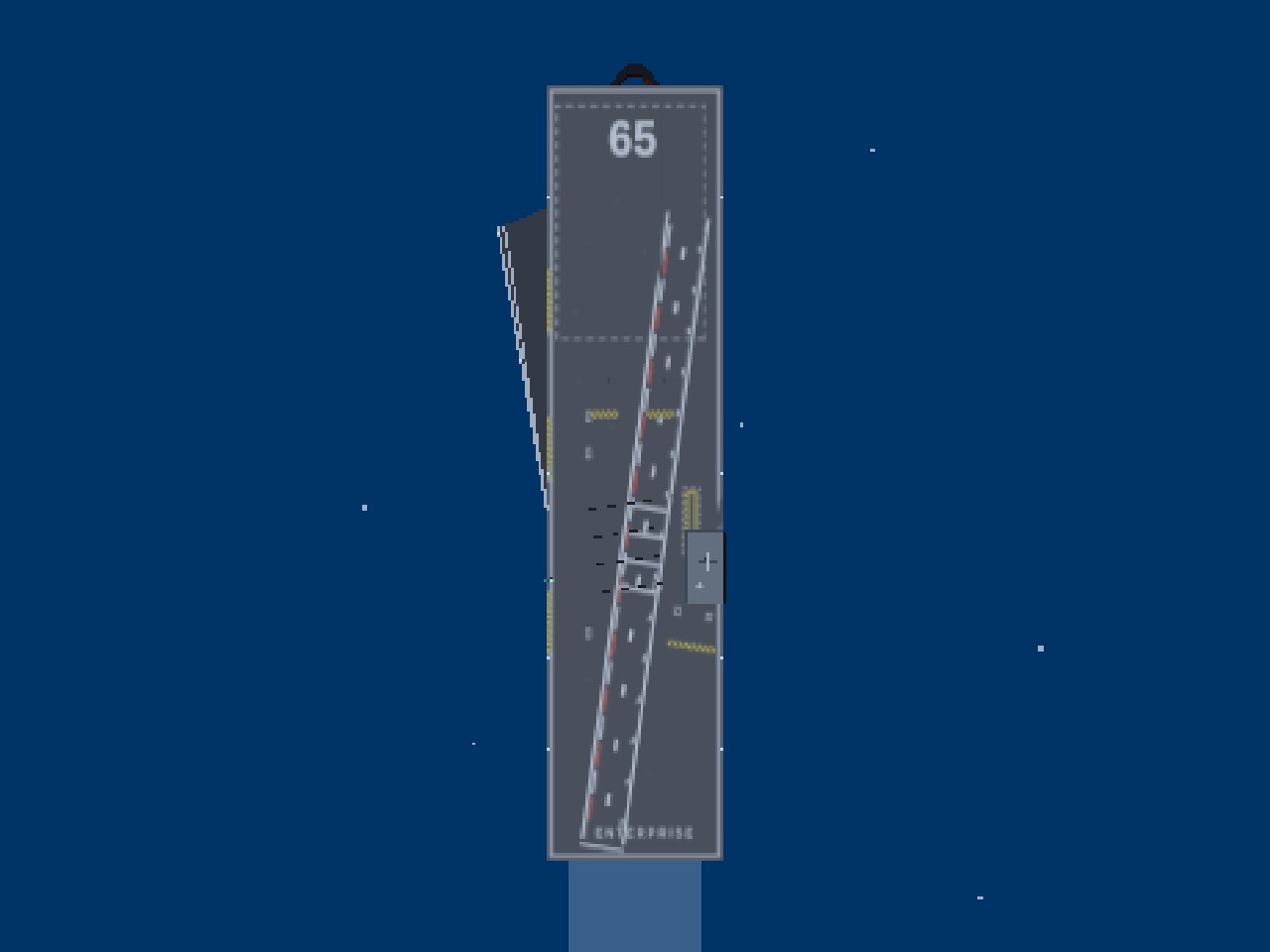
M9 — NAVY ONE. The war is over, and the President is flying out to the boat to say so — an S-3 Viking out of Moffett, callsign NAVY ONE. Tehran’s loyalists have Fulcrums and Flankers up for one last headline. Sweep the CAP, shepherd him through the groove, watch him trap aboard — and the banner unfurls on the island’s bridge face, over the 65, facing the flight deck exactly like the Lincoln in ’03. We repainted the cloth at full resolution so every pilot on deck can read MISSION ACCOMPLISHED from the foul line.
M10 — THE LAST INTERCEPT. Night. A nuclear-tipped cruise missile is running for the city at 400 metres a second with a three-ship Flanker escort. Your wingman — callsign EGARYTARIAS — takes a bandit off your tail so you can run the bogey down. You will know how you did by whether the bay is still there: the fail card reads ONE MILLION SOULS.
M11 — CRUISE SHIP SIEGE. Gunboats hold a liner in the strait. Cover the SEAL helo in — MANPADS on the decks, go-fasts circling — while she hovers twenty seconds over the fantail and drops the team. If a boat closes to 380 metres, it’s over.
M12 — SUB HUNTERS. A P-3, an S-3 and a dipping Seahawk work a submarine contact while MiGs and Sukhois scramble to break up the hunt. Keep every hunter alive and the torpedoes fly their ballet — the first two run wide, the third runs true. Lose one and the sub slips away for good.
M13 — AVENGE VIPER TWO. A quiet sweep, until the bounce. Your wingman never had a chance — but you do. Four bandits between you and even.
Finish one, the next opens. The board now gates the campaign: a fresh flight log shows only the first sortie, and each victory chalks the lock off the next briefing. Free flight stays wide open, as always.
The bad guys went to Topgun. Bandits used to drone along their routes until a Sidewinder found them; now every hostile pilot flies a proper maneuver library, and the skies are a great deal less sporting:
Threat-aware, not scripted. A missile in the air or a gun solution building and the bandit picks an answer — a hard break into the attacker, a scissors jink, a split-S for the deck, a barrel roll to spoil your tracking solution, or a loop to force the overshoot. One evasion flows into the next; they chain them like they mean it.
Skill you can feel. The library reads each pilot’s skill and agility — a green nugget jinks late and sloppy, a Flanker ace will roll through your burst and come out gunning. Mission aces are rated honestly: m10’s escorts are the best stick-and-rudder men Iran has left.
Fair fights stay fair. Scripted sorties mark their critical aircraft noAA — the fleet’s SM-1s no longer steal the balloon, the President’s escort, or the nuke out from under your guns. If a mission says the kill is yours, it’s yours.
The flight deck finally works like the world’s most dangerous ballet should. Three rules now govern every airframe the deck crew touches:
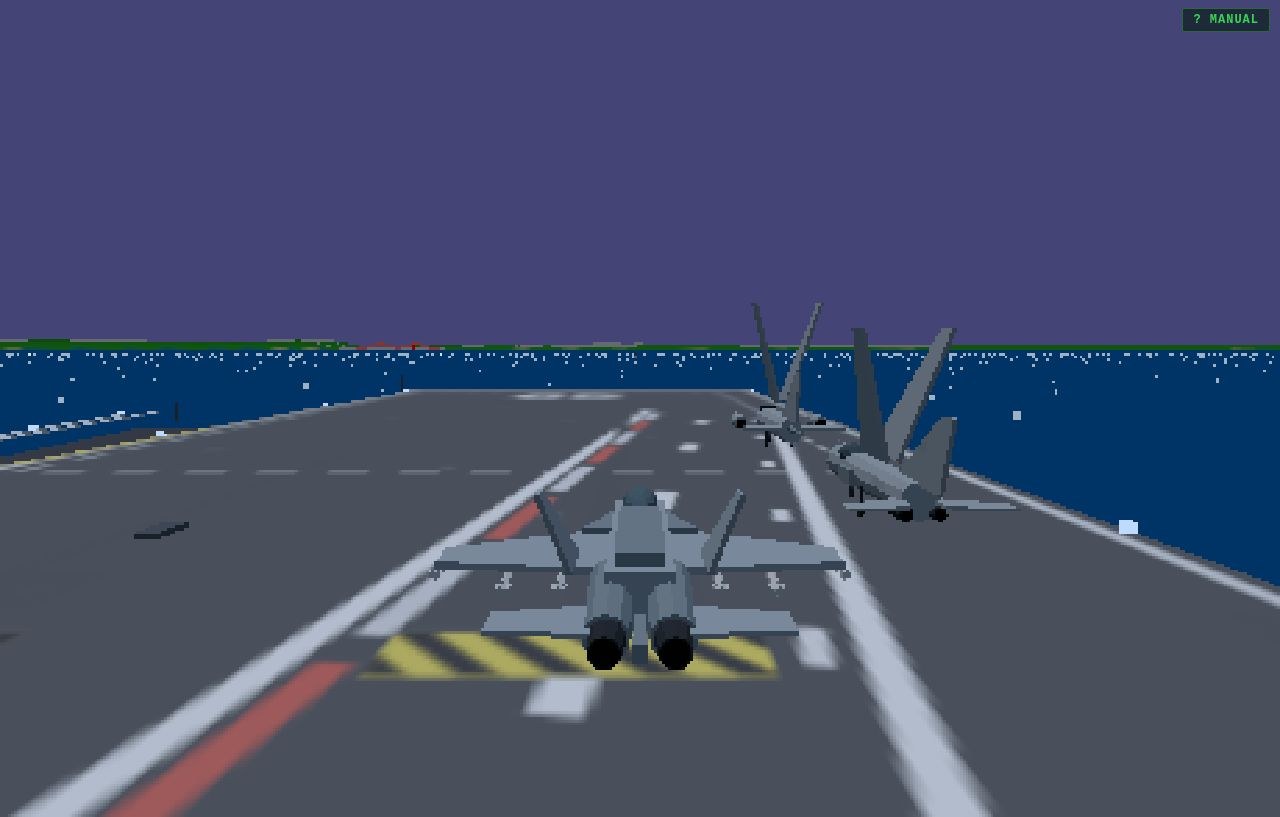
Fold for parking. Trap aboard, taxi clear of the foul line, and the wings come up — Sto-Wing slew on the Hornet, fold-up on the Intruder, Viking and Greyhound — so the next jet can park wingtip-to-wingtip. You can watch the whole recovery cycle from the island.
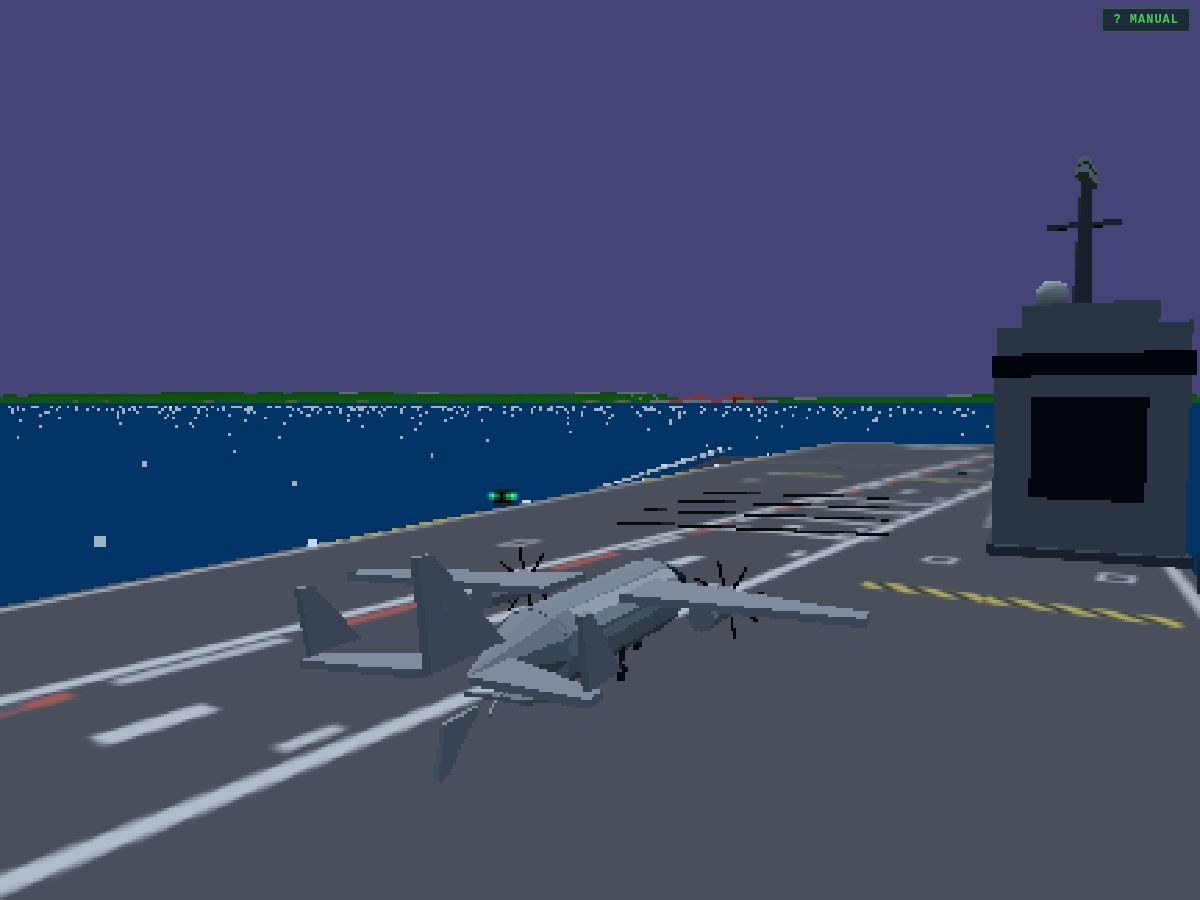
Spread before the cat. Taxi toward the shuttle and the wings deploy on the way, locks in, ready for the shot. And if somehow a jet reaches the holdback still folded, the cat officer simply waits: the countdown holds until the wings read full spread. Nobody goes off the pointy end with folded wings. Ever.
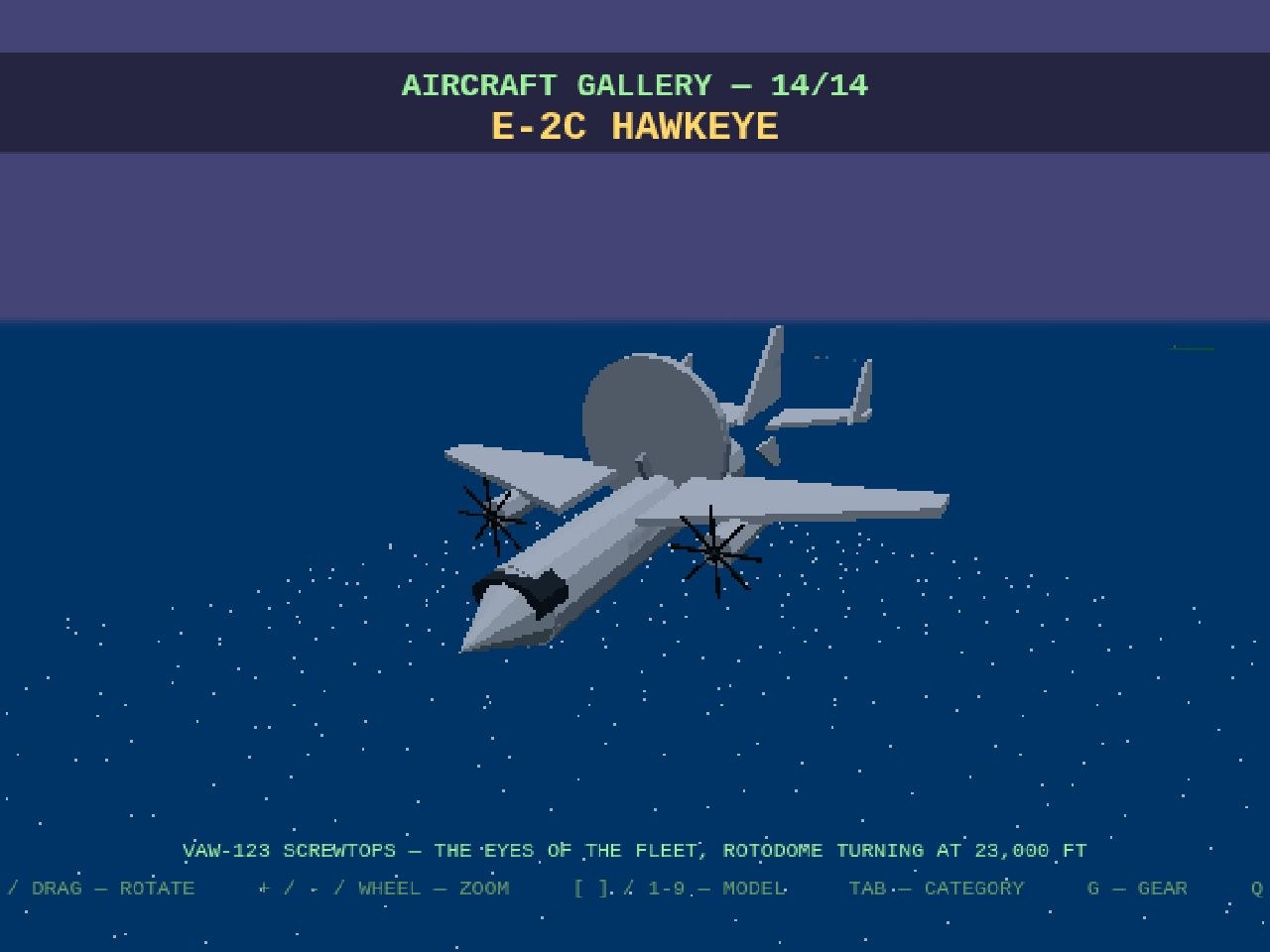
Steam and spin. The catapult now vents steam down the track behind the shuttle — for your launch and every air-wing shot. And a sharp-eyed correction on the E-2: the rotodome turns, but the struts that carry it stand still, exactly like the real dish.
Four small fittings, the kind you notice the first time you reach for them:
I recalls the brief. The full typed briefing — the one from the ready-room card — is now one keypress away at any point in the sortie. Objective, threat, the fine print about the banner on the island. I again puts it away.
The journal is searchable. A search box rides the blog menu — type “seahawk” and the eighty-nine entries narrow to the seven that matter. The query lives in the address hash and works with the tag filters, so #q=seahawk is a link you can paste to a friend.
Every gallery asset is a URL. Click any aircraft or vessel in the showroom and the address bar tracks you — #gallery/av8b opens the Harrier directly, step controls and all, and a bad slug falls back to the menu instead of a blank floor. Every model on the floor is now a link you can share.
The log remembers honestly. Campaign progress, unlocks and stats persist per pilot — and a fresh log starts at the first briefing, not mid-campaign.
The battle group has teeth and ears now. A hostile submarine prowls the deep water west of the group — she surfaces, she creeps, and when she’s hurt she goes deep and shows again somewhere else. Everyone with a dog in that fight now fights it:
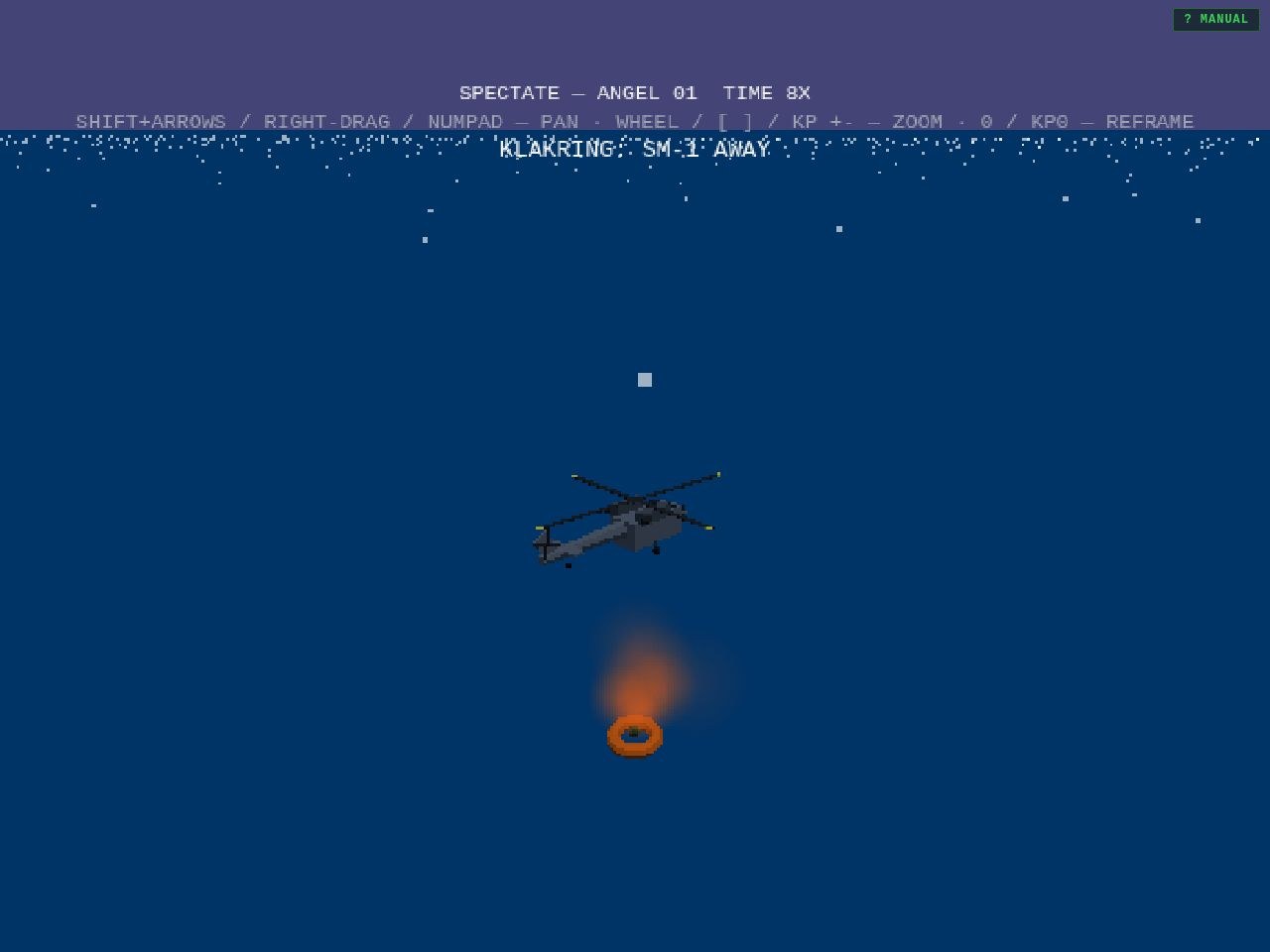
USS Klakring FFG-42 answers air raids. Any hostile aircraft that closes the group inside twenty-two kilometres eats an SM-1 off her forward launcher — we watched a MiG-29 take one over the bow and auger in. That is what a guided-missile frigate is for.
And she carries Harpoons. When the submarine surfaces in reach, Klakring puts a two-round Harpoon salvo in the air — then holds fire: you don’t shoot into a dipping zone with friendlies in the SAC. “WEAPONS HOLD — FRIENDLIES IN THE SAC.”
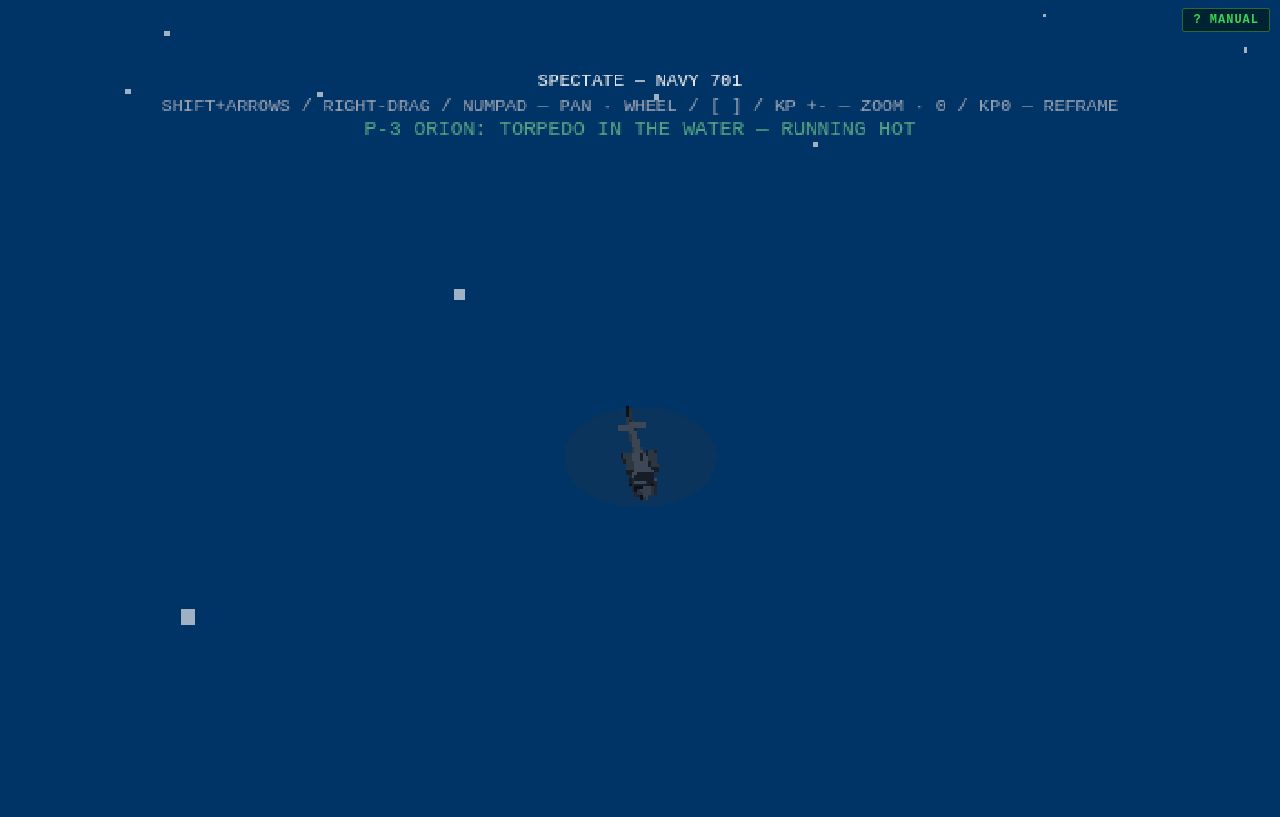
The P-3 is a proper sub hunter. She diverts off her patrol to the contact, wheels overhead at five hundred feet and seeds sonobuoys — orange cans riding the swell. Two wet buoys near the contact and the picture firms up: LOCALIZED. Then the torpedoes start: “TORPEDO IN THE WATER — RUNNING HOT.”
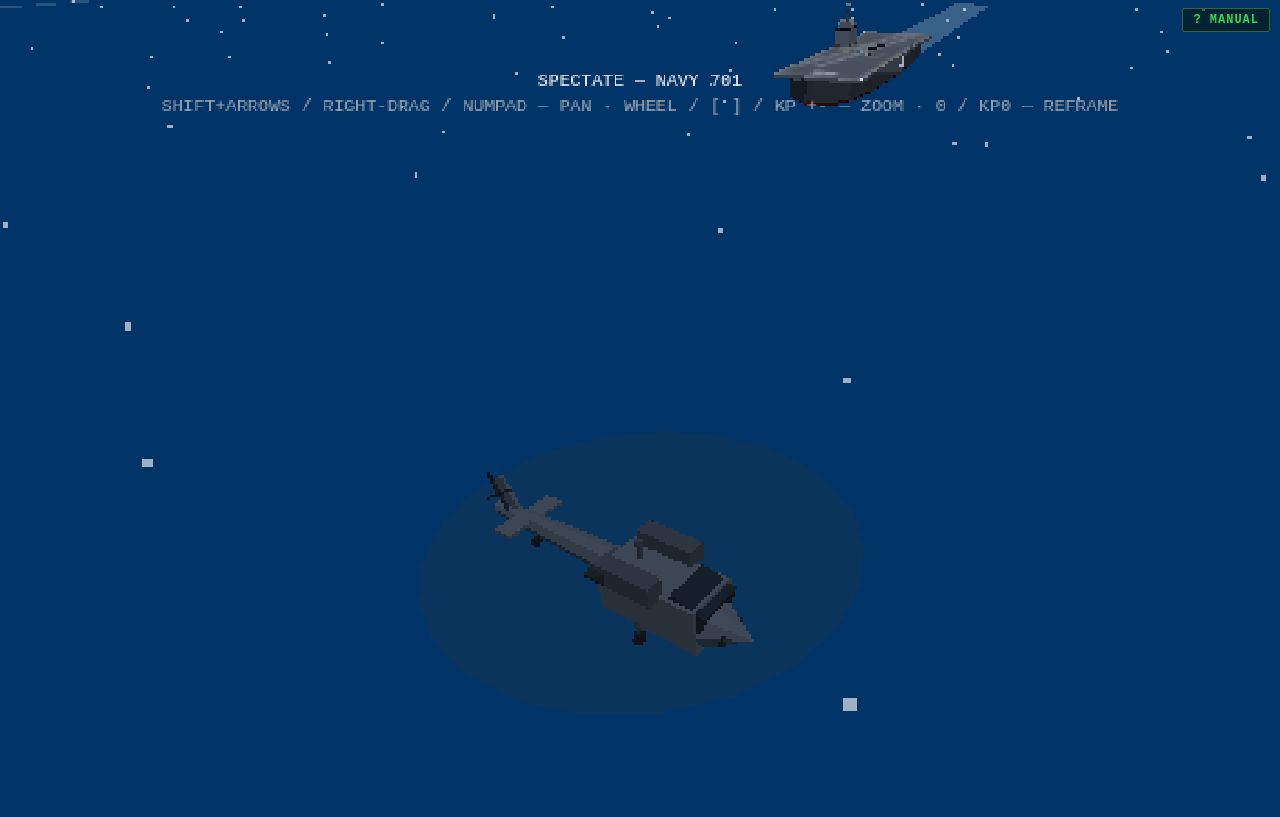
NAVY 701 dips too. The cruiser’s Seahawk flies out to the contact, winches down to sixty feet for a six-second dipping-sonar hold — buoy away — climbs, dips again, and once the contact is localized she puts her own torpedo in. Then home to the pattern.
She doesn’t die easy. Hurt her enough — Harpoons, torpedoes — and she goes deep and silent, contact lost, to surface again miles away when the coast is clear. The hunt never really ends; it just moves.
All of it runs on its own in free flight — find it on the map, or ride along with J: the P-3 sings the prop whirr, the Seahawk too, and the Harpoons fly quiet.
Two dials turned this push, one for your patience and one for your ears:
The warp ladder grows two rungs.Z now climbs 2x · 4x · 8x · 16x · 32x before dropping back to normal. Sixteen and thirty-two are for the long hauls — the inbound leg from the far waypoint, the air wing’s full pattern cycle, waiting on a trap queue. The whole world steps with you: traffic, helicopters, the carrier’s steam, all of it.
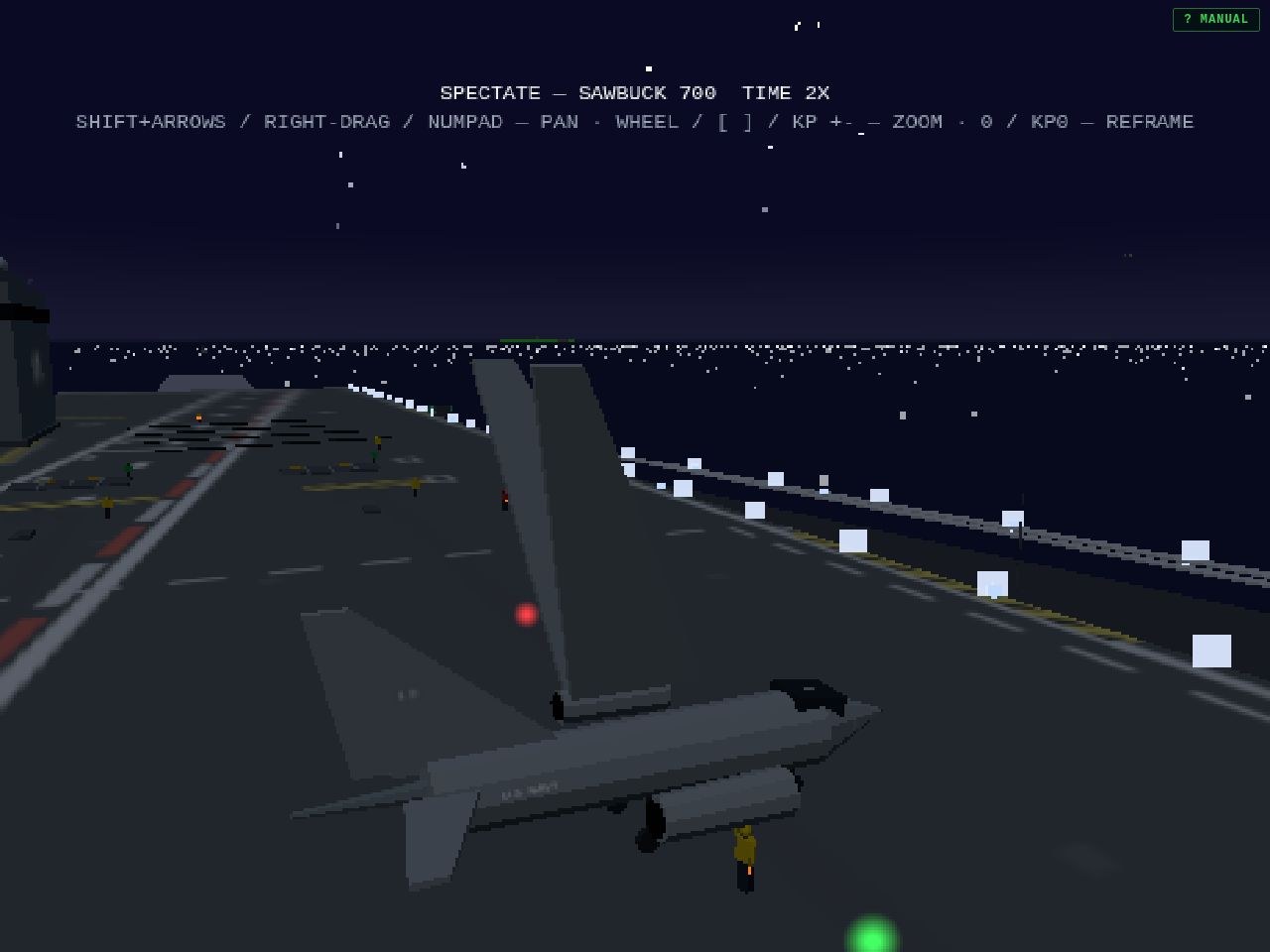
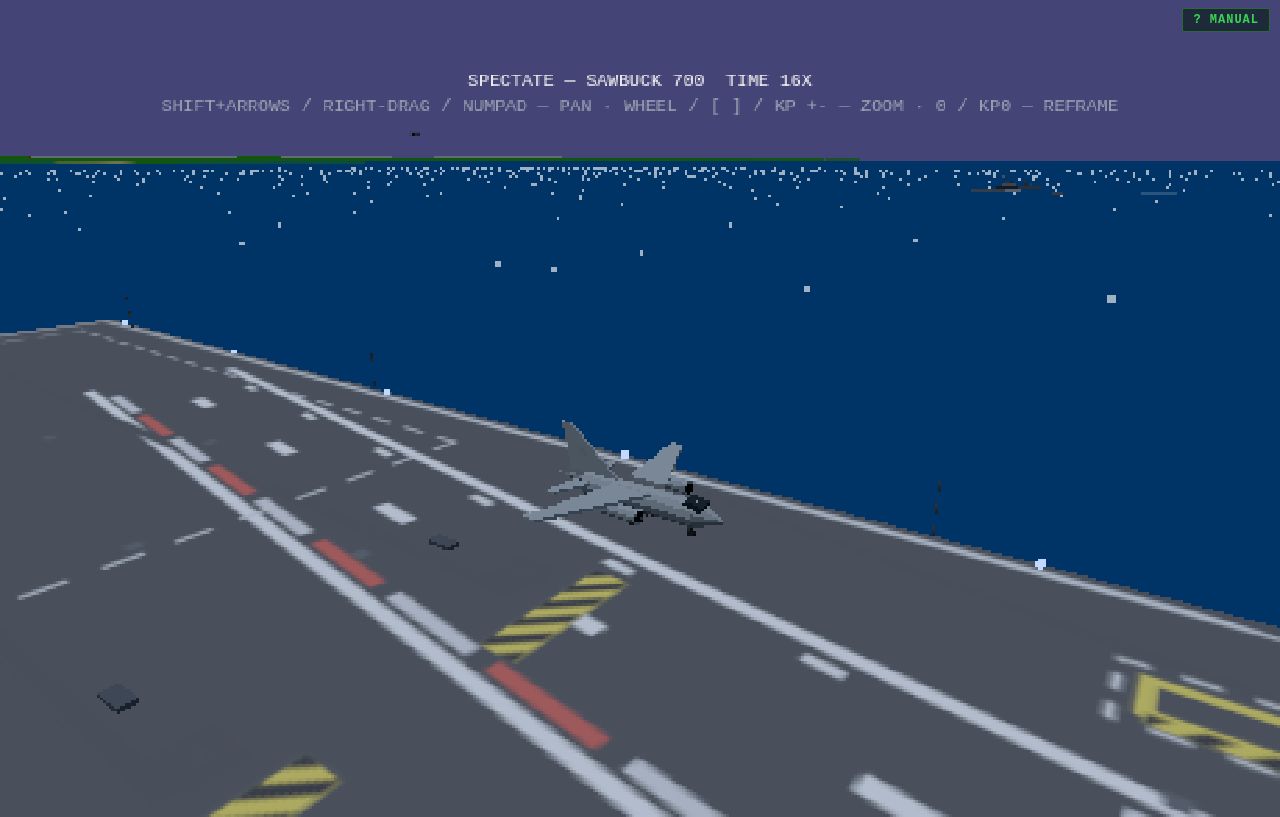
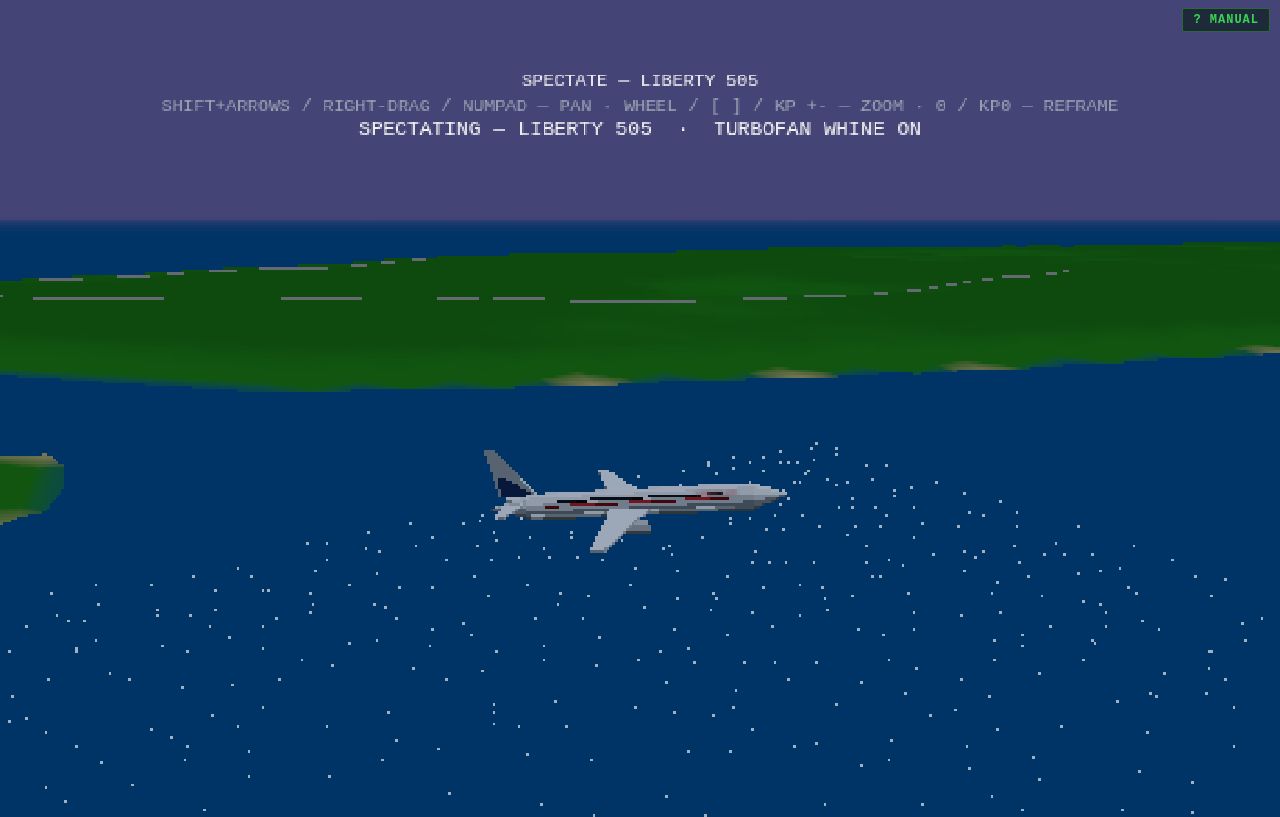
The S-3 sings turbofan now. Sharp ears caught it: the Viking is no prop — she runs a pair of TF34 turbofans under those wings. SAWBUCK 700 now gets the airliner voice in spectate (J), the high synthesized whine instead of the prop whirr. The C-2 keeps the whirr (hers are honest turboprops), the A-6 keeps the jet loop, and every other ride is unchanged.
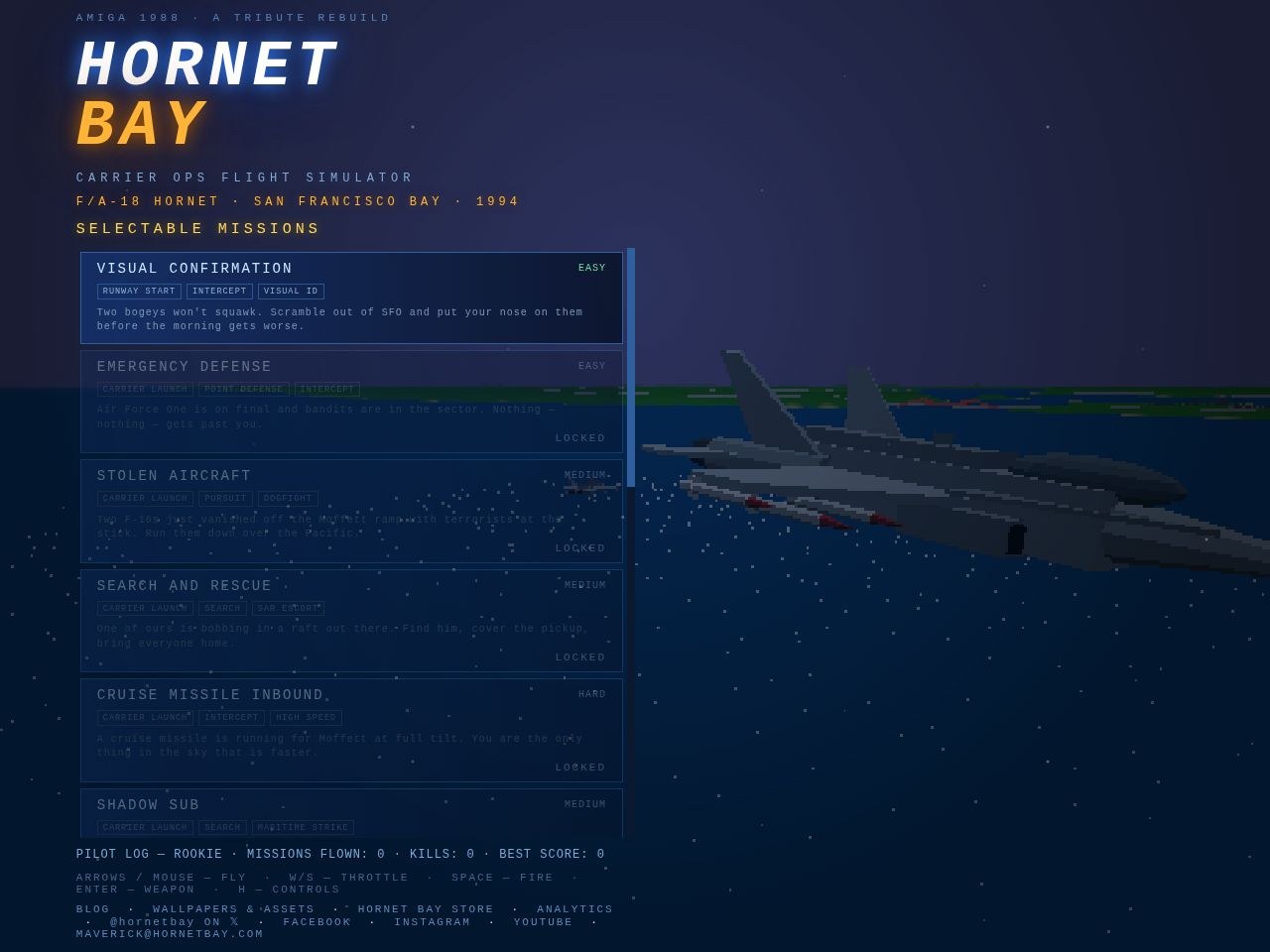
“Meet me at the mission select” used to mean a string of instructions — open the game, wait for the menu, press 6. Now it’s a link you paste. Every row of the menu carries its own URL stub, and the address bar tracks you as you move, so wherever you are, what’s in the bar is a link back to exactly here:
/#freeflight — straight to the free-flight map, pick your start point.
/#missions — the SELECTABLE MISSIONS board, and each sortie has its own: /#m1 through /#m7 drop you at that briefing.
/#log — your flight log statistics; /#gallery — the showroom floor; /#manual — the flight manual; /#menu — home.
And the outbound rows:/#blog, /#store, /#analytics, /#print all redirect to their sites, so every menu item — even the ones that leave the sim — has a stub.
Polite in the air: a link clicked mid-sortie never yanks the controls — routing waits for the menu. And if you suspended a sortie with Q, /#resume puts you back in the cockpit.
Two flight-model matters settled this push, both spotted by pilots watching the traffic instead of flying it:
Helicopters now fly like helicopters. The old model popped a few feet off the pad and then climbed while it travelled, rotor disc tilted like it was impatient to be somewhere. Not any more: NAVY 701, the shuttle birds and K-MAN now lift vertically to their cruise altitude — tracking the deck beneath them as they rise — level off, fly the leg at that altitude, and only descend when it’s time to land, gliding down toward the spot on the final leg. Watch the cruiser’s Seahawk on a circuit and you’ll see the whole profile: straight up, level across, slide down, settle.
Everyone rolls into the turn now. An audit of every AI pilot in the bay — airliners, bandits, the air wing, the helicopters — found several rolling away from their turns, banked left while heading right. The sign convention is now proven, documented and fixed in all four steering classes: a right turn banks right, everywhere. The pattern over the carrier finally looks like a pattern, not a coin rolling on its edge.
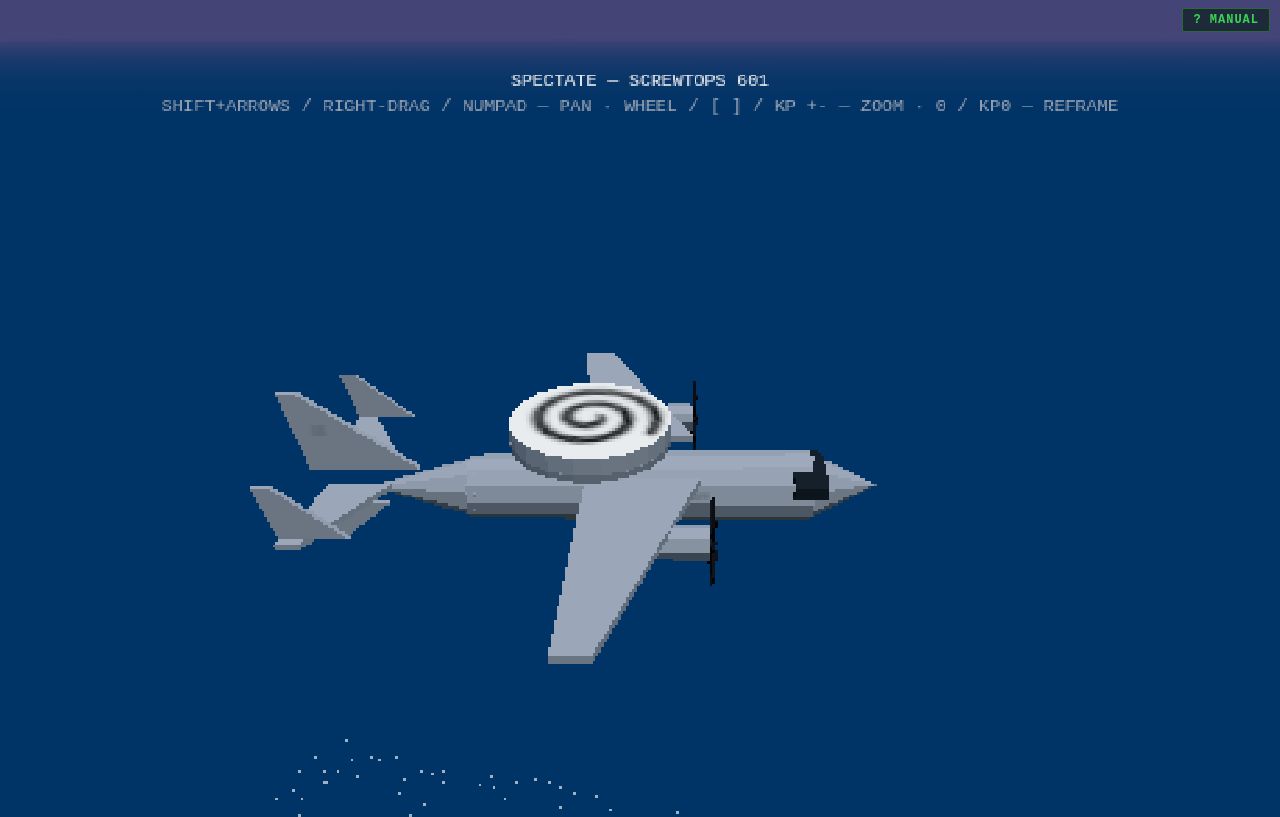
The Hawkeye’s orbit used to be a lazy 28-kilometre wheel parked over the east bay — fine for scenery, wrong for coverage. SCREWTOPS 601 now flies a proper station: a twenty-mile by twenty-mile oval centred on the middle of the map, still at angels two-three (23,000 ft), one lap about every fourteen minutes at 140 kt. From up there the radar picture genuinely covers the whole chart — carrier waters to the inland edge — which is what an AWACS is for. Ride along with J until you find her; the rotodome still turns, and she still calls the picture, the bogies and the civil traffic exactly as before.
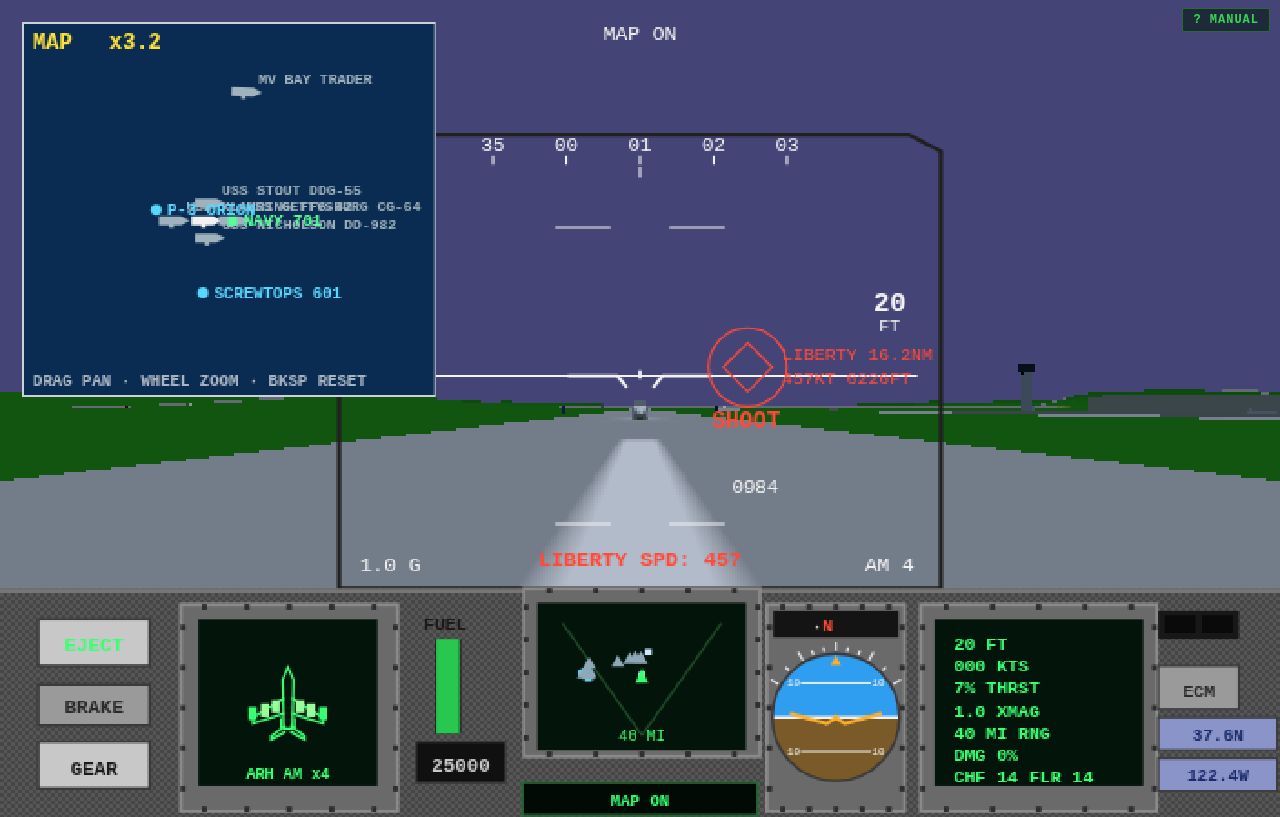
The tactical map (N) was always the whole bay or nothing, drawn at eighty-eight percent over the world — the sea shimmered through the chart like a double exposure. Both fixed:
Drag to pan. Grab the chart with the mouse and pull it where you want it; the window slides over the whole 115-by-104-kilometre sheet. The gun politely stays silent while you’re dragging the map — no accidental bursts mid-brief.
Wheel to zoom. Roll in up to twelve times closer for a proper look at the group: here’s GETTYSBURG, STOUT and NICHOLSON in formation with the carrier, SCREWTOPS 601 on station to the west. The zoom factor shows top-left; markers clip neatly to the chart edge.
BACKSPACE reframes the whole bay in one tap.
Fully opaque. The chart now draws solid — sea blue and land green, nothing bleeding through from the world behind it.
Spectate mode (J) used to be a silent film. Now every aircraft you ride sounds like itself, three voices crossfaded by type:
Jets — the Hornet, Tomcat, Viper, Eagle, Warthog, MiG, Flanker and the air wing’s jets — reuse the recorded Amiga engine loops, pitch following speed.
Airliners get a turbofan whine, synthesized fresh: two detuned high sines over a band of compressor hiss that rises with speed. Ride a Liberty 737 up the approach and it sings exactly like the cheap seats.
Props get a whirr — the E-2, the C-2 and the P-3, plus all four helicopters: twin blade-pass saws beating against each other the way two turboprops do, over low rumble.
Ships, the carrier and missiles stay quiet — some rides have no engine note to give.
Notifications come with you. Important messages — radio calls, trap calls, warnings — now print on-screen under the spectate title instead of staying home in the cockpit bar. They ride on-screen in the cockpit view too, no longer confined to the little strip in the panel.
The flight deck is no longer a quiet place to be left alone with your thoughts. The Enterprise now works her 1994 Pacific air wing around the clock — three period squadrons flying a continuous launch–pattern–trap–park cycle whether you are watching or not:
KNIGHT 501 — the VA-52 A-6E Intruder — SAWBUCK 700, the VS-37 S-3B Viking, and PROVIDER 30, the VRC-30 C-2 Greyhound, park on the starboard row, taxi the safe lane to Cat 2 (Cat 1 stays yours), and get flung off the bow in turn.
They fly the pattern like professionals: climb off the bow, the break, a port-side downwind at 850 feet, base, and the final gate — then down the 3.5° groove to the angle deck and the 3-wire. Rollout, taxi clear, park, and go again.
The radio knows the script:CAT 2 — YOU’RE AWAY on the shot, BOLTER, BOLTER if the wires are missed (they go around, honestly), and TRAPPED ABOARD when the hook takes. The feed calls the 3-wire by name.
Discipline, even ambient: the air wing holds a lap if you are on final, and only one jet works the groove at a time — the rest stack politely in the pattern. Taxi routes respect your spot on Cat 1.
Everywhere a friendly should be: blue contacts on radar with their callsigns, named on the tactical map (N), and spectate-able with J — ride the COD down the groove from the LSO’s seat sometime.
Why 1994 matters: all three squadrons were the real Pacific operators that summer — VA-52 and VS-37 in CVW-15, VRC-30 Det 1 flying its first cruise — researched, liveried, and parked on the wrong carrier entirely, as tradition allows. Missions involving these airframes come later; the flightpaths are already here.
“GUIDED-MISSILE CRUISER” was never going to cut it. The four escorts of the battle group now sail under their own names — chosen from the ships that actually shepherded the Big E through her mid-90s:
USS Gettysburg (CG-64) — Ticonderoga-class Aegis cruiser, holding the van 2,400 yards ahead. Gettysburg rode shotgun on the carrier’s 1996 return to sea after the long refuelling, and kept the station for years.
USS Nicholson (DD-982) — Spruance-class destroyer on the port beam. Another repeat consort, from the ’96 cruise through Desert Fox.
USS Stout (DDG-55) — Arleigh Burke-class guided-missile destroyer to starboard, named for Rear Admiral Stout and present in the ’98 group.
USS Klakring (FFG-42) — Oliver Hazard Perry-class frigate as the astern picket, parked well clear of the approach so your final stays sacred.
The sourcing: the November 1998 Navy Wire battle-group list for Enterprise reads Gettysburg, Stout, Nicholson, Klakring almost verbatim — the closest real formation to our 1994, when the Big E herself was finishing her refuelling overhaul. Alternate history, accurate consorts.
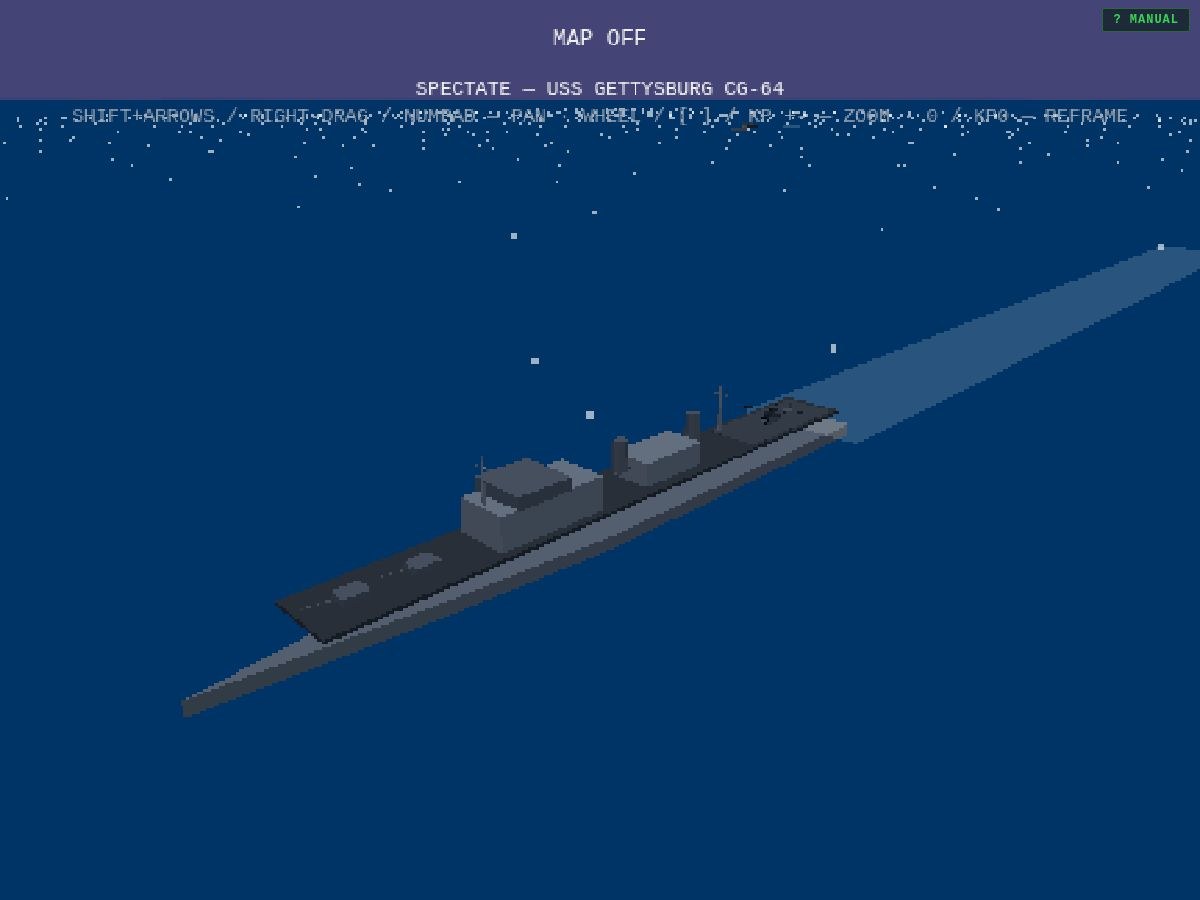
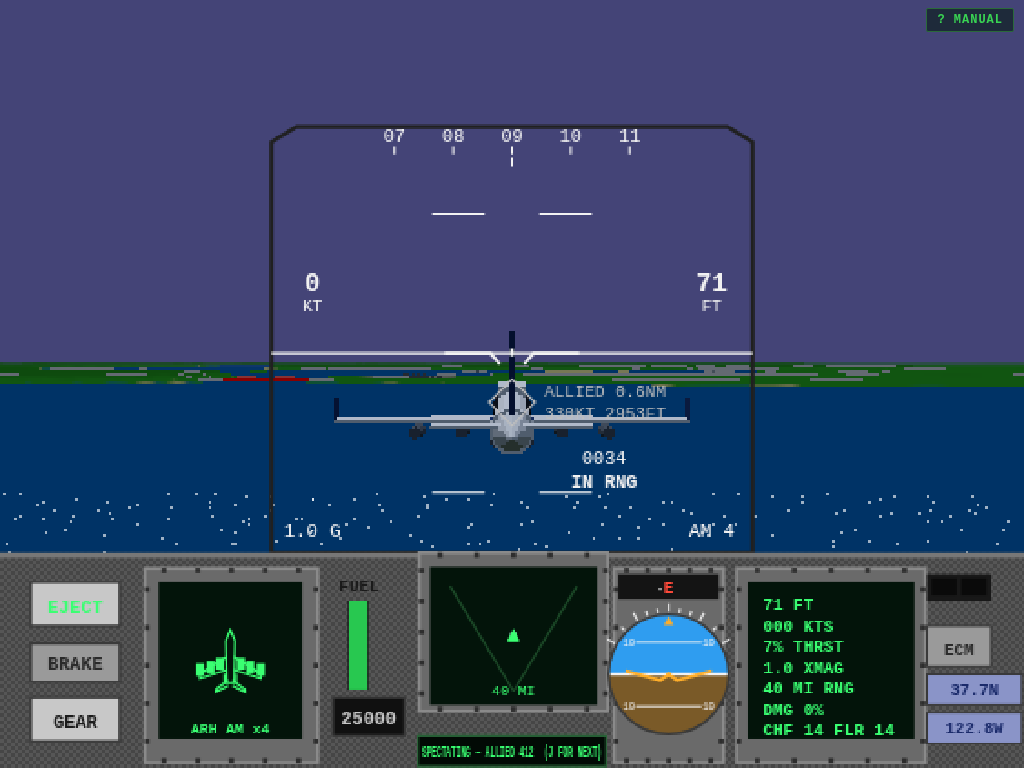
Where you’ll see them: the tactical map (N) labels each hull by name, the radar paints them as steel-grey triangles, and J spectates them too — the banner reads the name back at you, as in the shot above.
Eighty-four entries in, the journal needed a filing system. Four upgrades this push, all about getting a story in front of you — and getting you to the story:
Every post has a proper Twitter card. Each entry’s page already carried its own title, description and screenshot for shares — now the few image-less entries fall back to the squadron crest, so a pasted link always unfurls with art. X, Facebook, anywhere that reads the meta.
Instagram joins the share bar. There’s no web share dialog for Instagram (they like it that way), so the button does the honest thing: copies the entry’s link and tells you it’s ready for your story or bio. Six buttons and a copy-link now ride under every post.
The journal paginates. Ten entries to a page, newest at the top, with a pager at the foot — eighty-four entries came to nine pages. Page position lives in the address hash, so a link to page 5 is a link you can share.
And a filter menu. A row of tag chips — FEATURE, AIRCRAFT, SPECS, GRAPHICS, MERCH and the rest — sits under the header. Pick one and the journal narrows to just those entries, paginated the same way; the tag rides the hash too, so filtered views are shareable links. The canonical tag shelves at /blog/tag/… remain for the crawlers.
The journal turned eighty-three entries this week, and it finally occurred to us: if you like a story, you shouldn’t have to copy the address bar like it’s 1988 too. Every entry — all eighty-three of them, plus every future one — now carries a share bar at the bottom:
Six ways to pass it on: X, Facebook, Reddit, Hacker News, plain old email — and a COPY LINK button that drops the permalink on your clipboard and says so. Each one opens the network’s own share dialog with the entry’s title and link already filled in.
Every page, old and new: the bar builds itself from the entry’s own permalink, so it works identically on the journal index, on each entry’s own page, and on the tag shelves — no per-post wiring, nothing to forget next time.
Same voice, same look: monospace, bordered, amber on hover — it wouldn’t do for the buttons to look like they came from a website that respects itself.
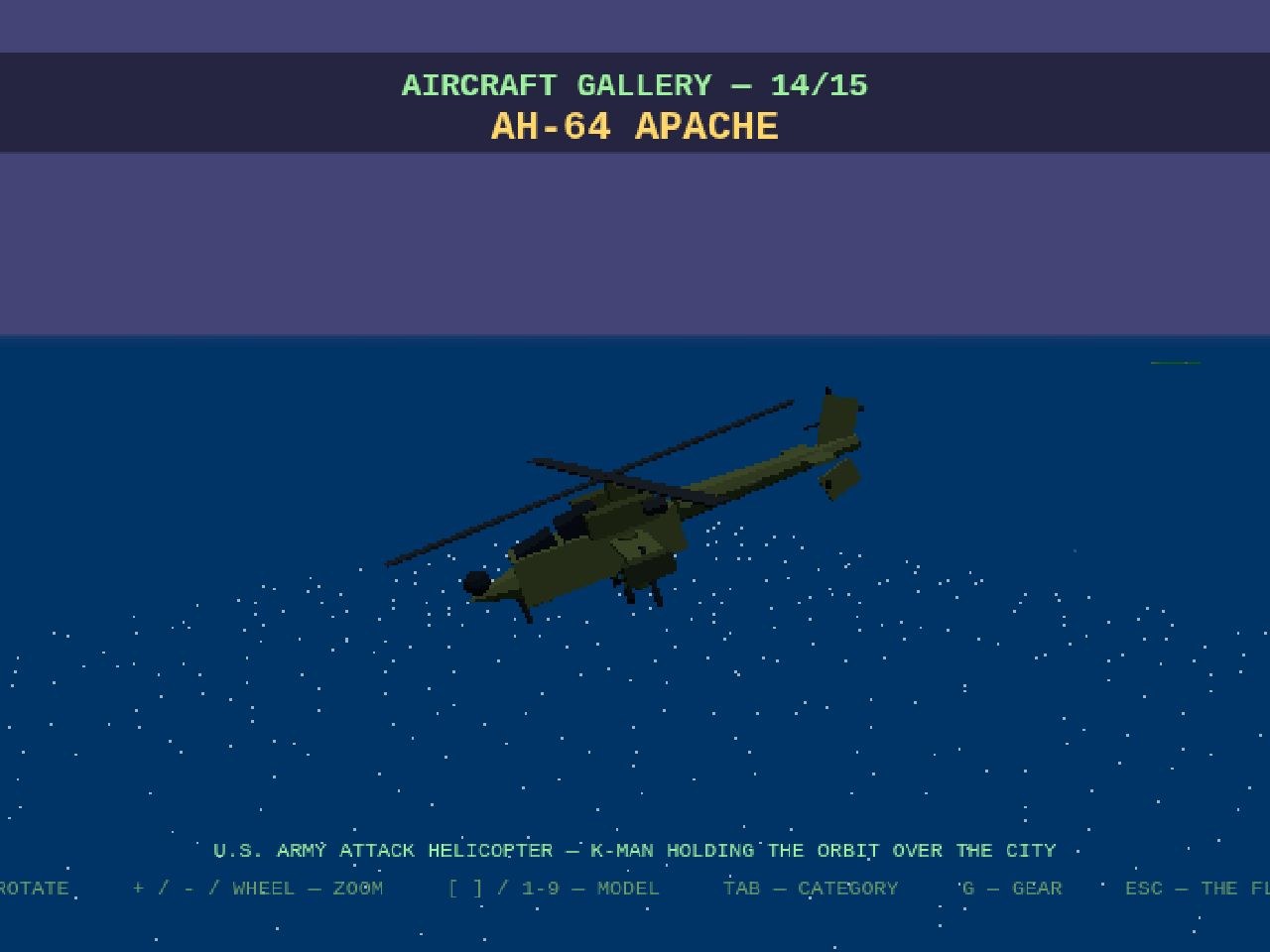
Two small but satisfying fixes this push. First, a structural one: a sharp-eyed pilot noticed the E-2C’s aft fuselage section was simply not there — the quad tail hung four metres behind the hull with nothing in between. Her tail cone is riveted on now, and the printable STL, the single-model zip and the Complete Fleet all got the corrected geometry. Second, a personnel matter: we finally know who’s riding in K-MAN’s front seat. Meet the gunner:
Clarry G is Alameda born and raised — close enough to the old Naval Air Station to fall asleep to the sound of Hornets trapping on the Enterprise. He decided at age nine he was going to fly. The Navy, in its wisdom, said no: one eye a half-line short on the chart.
So he went Army. Re-mustered as an aerial observer, then front-seat gunner on the AH-64 — the seat where the shooting actually happens. The chain gun under the Apache’s chin slaved to his helmet: where Clarry looks, thirty millimetres of attention follows.
The name: Clarence, formally — but only his mother and the pay office use it. What the G stands for is a matter of unit policy, which is to say he won’t tell you. The crew answer to it anyway. K-MAN, the callsign, comes from his grandfather’s old ham-radio handle, and Clarry wears it like a borrowed jacket: proudly, and slightly too big.
He knows the city by roof. A thousand feet up on the twelve-point wheel he calls “the paper route,” Clarry can name every helipad, crane and water tower downtown — and claims he can read license plates on the Bay Bridge. Nobody’s verified it. Nobody’s disproven it either.
He’s winning the bet. Standing wager with the cruiser’s Seahawk crew, NAVY 701: first to spot the P-3 coming off its inspection pass calls it on the radio. Clarry is up forty dollars and insufferable about it.
And he keeps a mascot. Zip-tied to the sensor turret: a rubber chicken, name of Clarence Jr., officially listed in the aircraft’s log as “ballast.” If you zoom in on the gallery model — well. Some details are for the crew to know.
Two scopes got smarter and one room got a lot bigger this push:
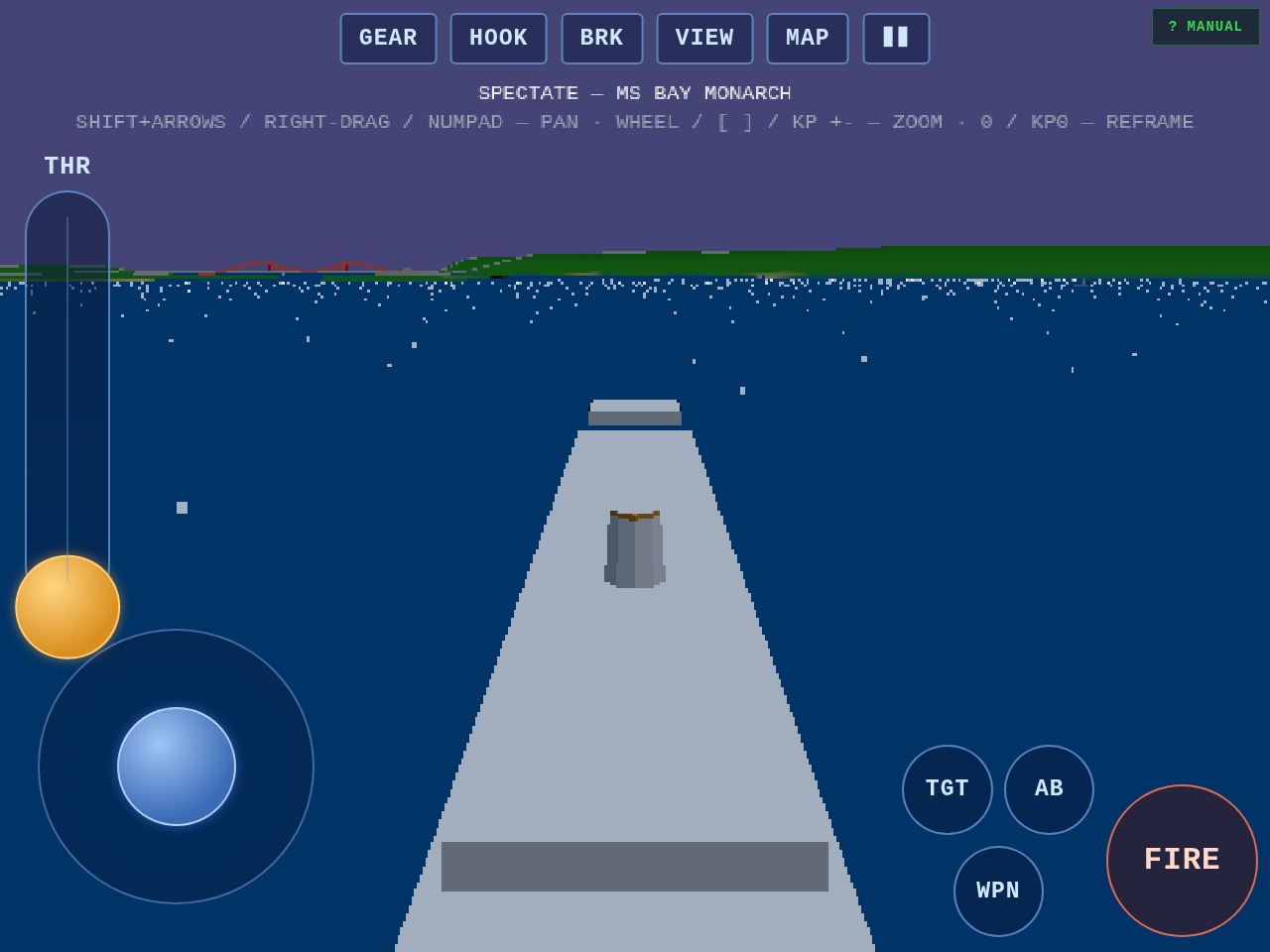
Big hulls are now radar contacts. Freighters, tankers, container ships, the cruise liner and every warship in the group paint as steel-grey triangles on the radar scope — and on the tactical map (N) they draw with their names: MV BAY TRADER, MT PETRO PACIFIC, MS BAY MONARCH and the rest. Sailboats, crabbers and weekend cruisers stay below notice, exactly as they should.
The map keeps getting busier. Ships join the air picture that already carries callsigns for SCREWTOPS 601, the P-3, the airliners, your wingman and the helicopters — now including the Army’s Apache, K-MAN, orbiting the city.
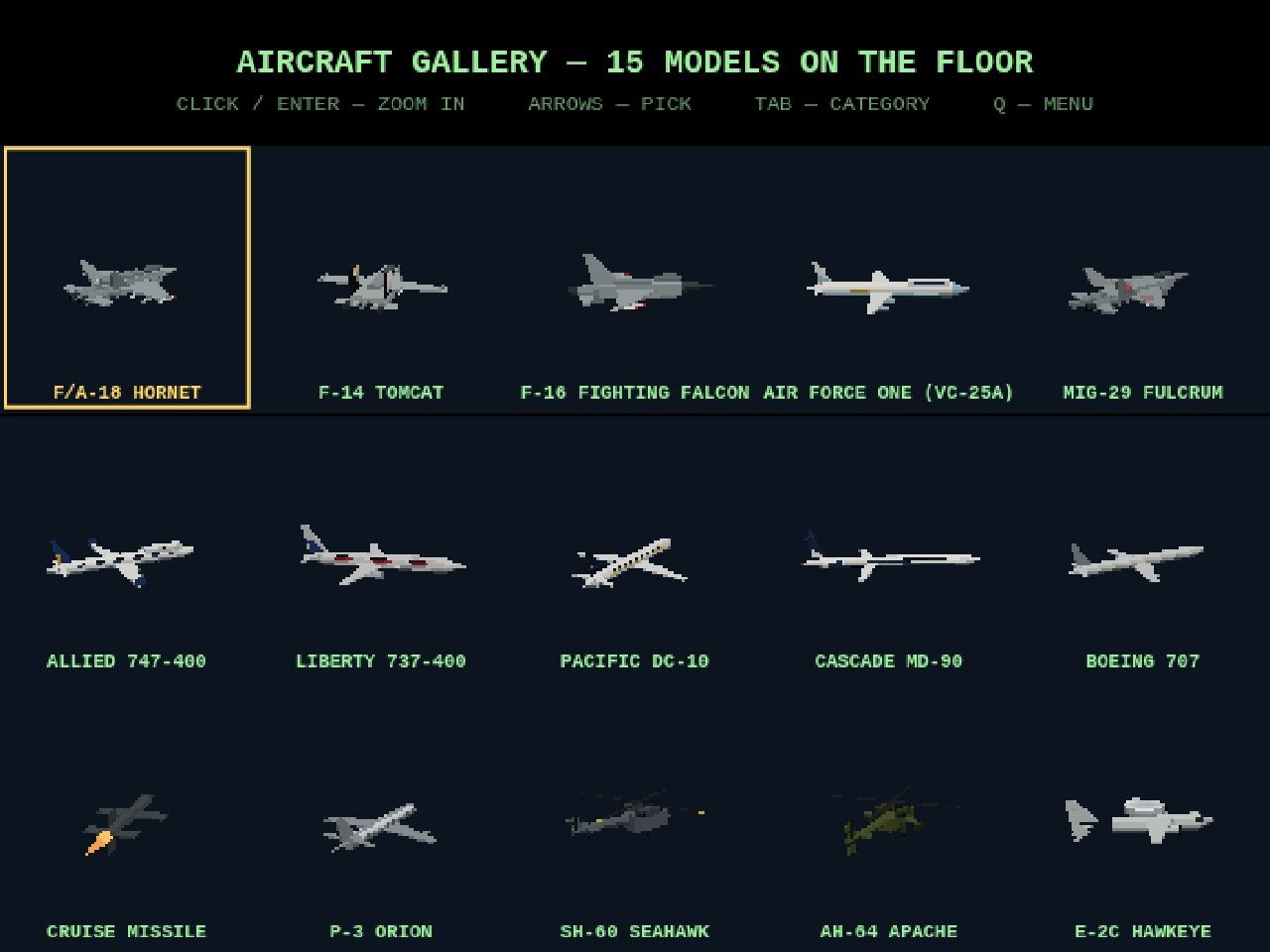
The gallery is a showroom floor now. Open it and every model of the category is on display at once — fifteen aircraft, twelve vessels, all spinning under the lights with nameplates. Click any of them (or arrows + ENTER) to zoom in for the close-up with the old rotate-and-zoom controls; ESC takes you back to the floor. TAB switches categories: AIRCRAFT — planes and helicopters together — and SHIPPING.
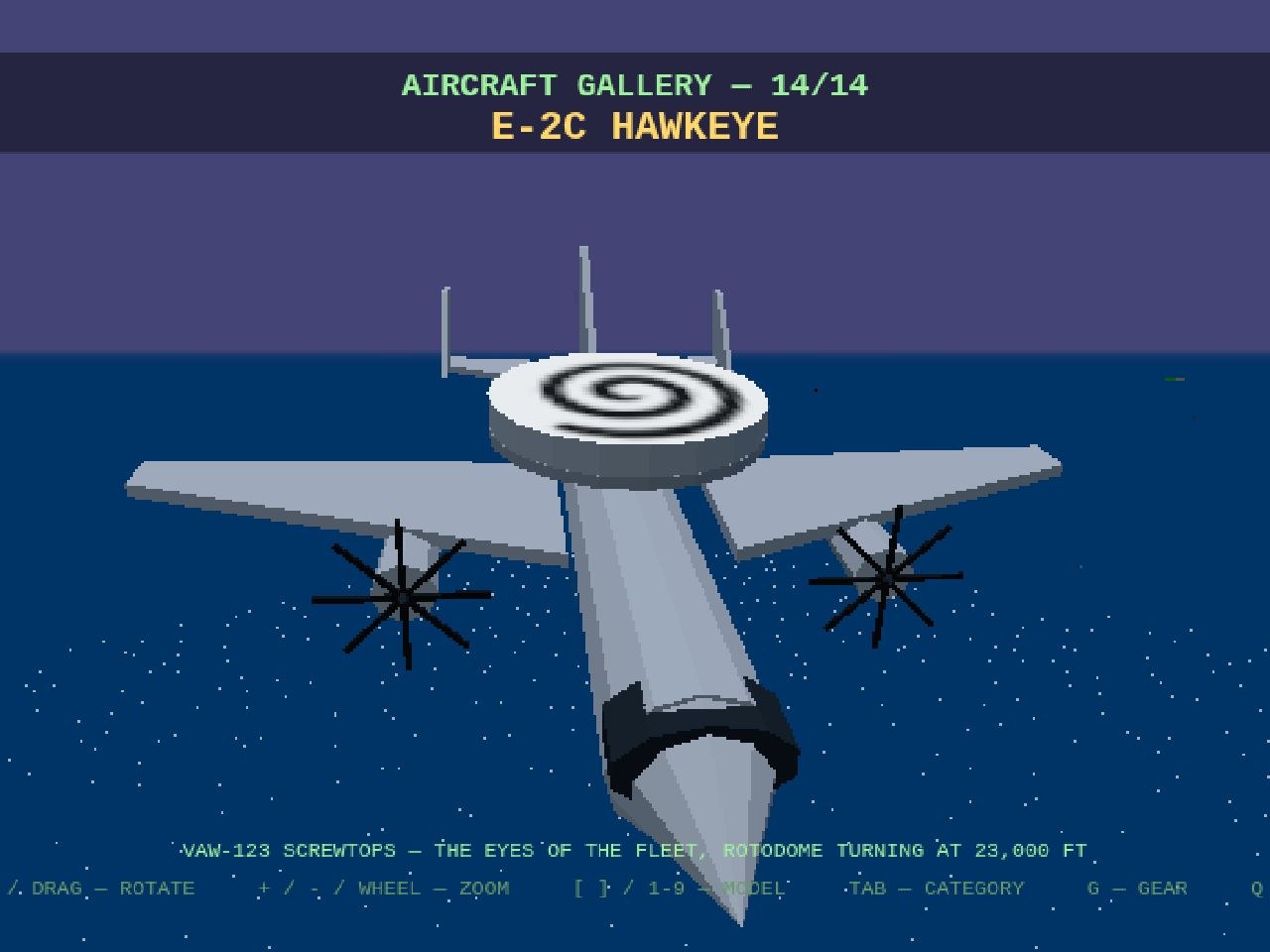
Four new printables on the slipway. The P-3 Orion, SH-60 Seahawk, E-2C Hawkeye (Screwtops corkscrew and all) and AH-64 Apache join the store as printable STLs — bringing the Complete Fleet zip to twenty-seven models: fifteen aircraft and twelve vessels. The studio even captured the corkscrew on the Hawkeye’s dome for the box art.
Three refinements this push, one of them thanks to a sharp-eyed squadron historian with a diecast model:
The Screwtops spiral, done right. Our first attempt wrapped a barber-pole around the rotodome’s rim — wrong bird. The real VAW-123 mark is a bold black pinwheel on the dome’s flat faces, hub to rim, two turns of corkscrew. Repainted to match: as the dome turns overhead, the swirl screws exactly like the squadron’s namesake. Top and bottom, so you can read it from below too.
Missile view. The O key now rides the newest round in the air — Sidewinder, AMRAAM or Phoenix — with the full spectate camera: SHIFT+ARROWS or right-drag to orbit it, wheel or [ ] to zoom, 0 to reframe. O again cycles every round in flight, then hands you back your cockpit. When the round resolves — splash or miss — the view lets go on its own.
The map learned everyone’s name.N now draws the whole air picture with callsigns: hostiles in red, the wingman and helicopters in green (rotorcraft get square markers — NAVY 701 on the cruiser circuit, SHUTTLE ONE and TWO working the pads), the P-3 and SCREWTOPS 601 in cyan, and every airliner in white with its flight name. One glance tells you who’s who in the bay.
The pattern over the bay just got crowded — in the best way. One push brings five new regulars to the airspace, a fix for the Tomcat’s manners, and a voice for the Phoenix:
You no longer launch alone. Every mission sortie now catapults you with an assigned wingman — VIPER TWO — off the deck 2.6 km behind you, joining on your right wing (90 m abeam, 70 m back) as you climb out. He covers a 12 km bubble around you, takes the shot when he has it — real AMRAAMs, real kills — and when a bandit gets on his six he jinks and calls for help: you’ll hear him on the radio and see TWO: DEFENSIVE! flash amber on the HUD.
You can task him. The backquote key (`) opens the wingman orders card: ATTACK MY TARGET, COVER ME, FORM UP, RETURN TO BASE — 1–4 issues the order and he executes to the best of his ability, acknowledging on the radio. (The comma key, our first choice, turned out to be the rudder. He’s a good wingman, but he can’t fly two planes.)
The cruiser’s helicopter actually flies. An SH-60 Seahawk spools up on the guided-missile cruiser’s aft deck, lifts, flies a four-leg circuit around the group, then comes home and lands on a moving deck — the approach math chases the ship itself, steaming at 15 knots. Five new helipads — SFO, Oakland, Moffett, Alameda and the SF Heliport downtown — host shuttle helicopters running pad-to-pad across the bay.
A P-3 Orion works the sea lanes. Twelve kilometres west of the group she flies an 11×5 km oval at 500 feet, MAD boom out, hunting submarines — and every couple of minutes she breaks off to make a visual inspection pass 400 m abeam of a surface contact, announcing each run on the radio.
SCREWTOPS is on station. An E-2C Hawkeye from VAW-123 orbits the bay at angels 23, rotodome turning, and calls the fight the way a real Hawkeye does: BOGEY with clock code, miles and angels when a hostile closes; CIVIL TRAFFIC when an airliner conflicts with your altitude; a FRIENDLIES round-up and a full PICTURE every couple of minutes. Bullseye is Alcatraz — check in and she’ll tell you so herself.
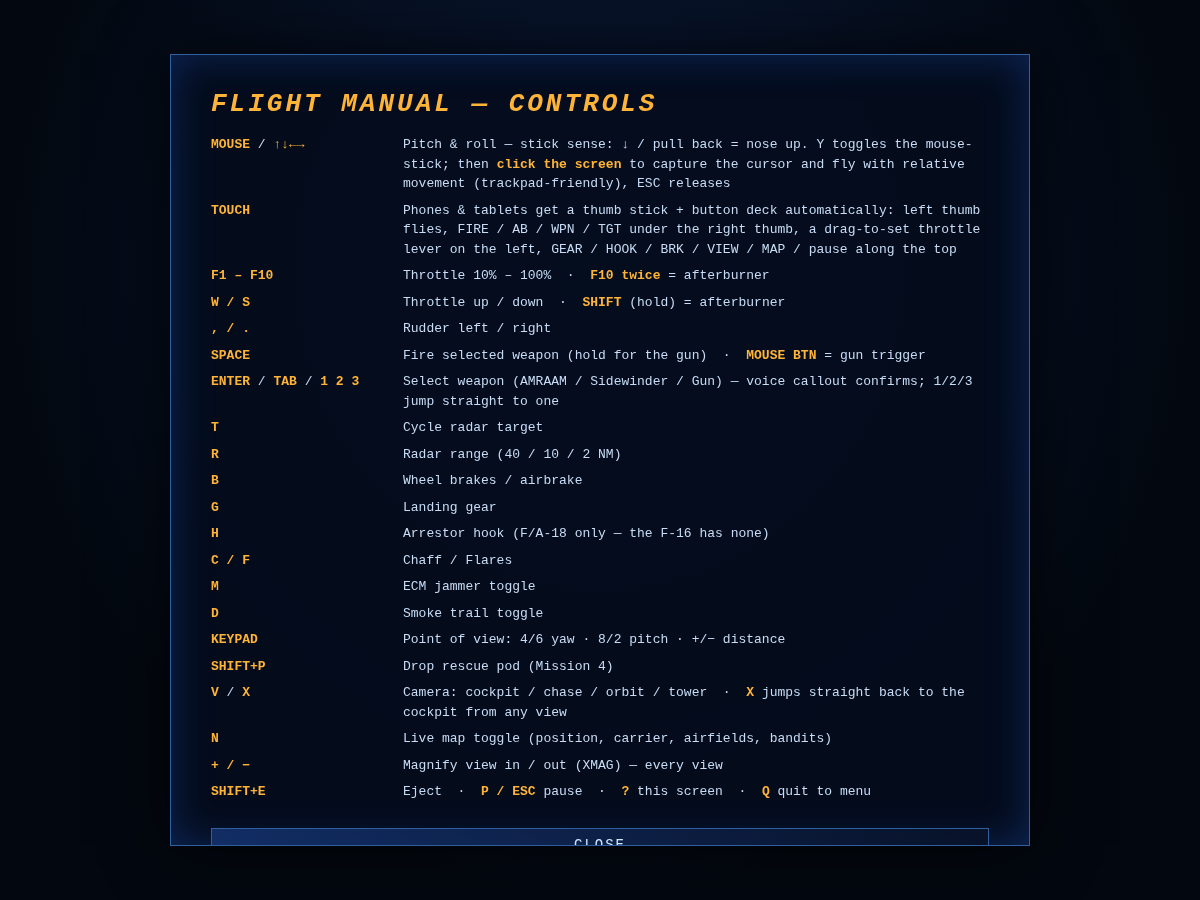
Housekeeping for the Tomcat. Her swing-wings now sweep the right way — aft, hugging the fuselage, not forward like a duck (a rotation-sign bug, caught and fixed) — and the contrail tips follow the gloves as they travel. The Phoenix found its voice too: selecting AIM-54 now gets the same spoken callout as Sidewinder, AMRAAM and guns. All three new birds are in the gallery, which now hangs fourteen aircraft.
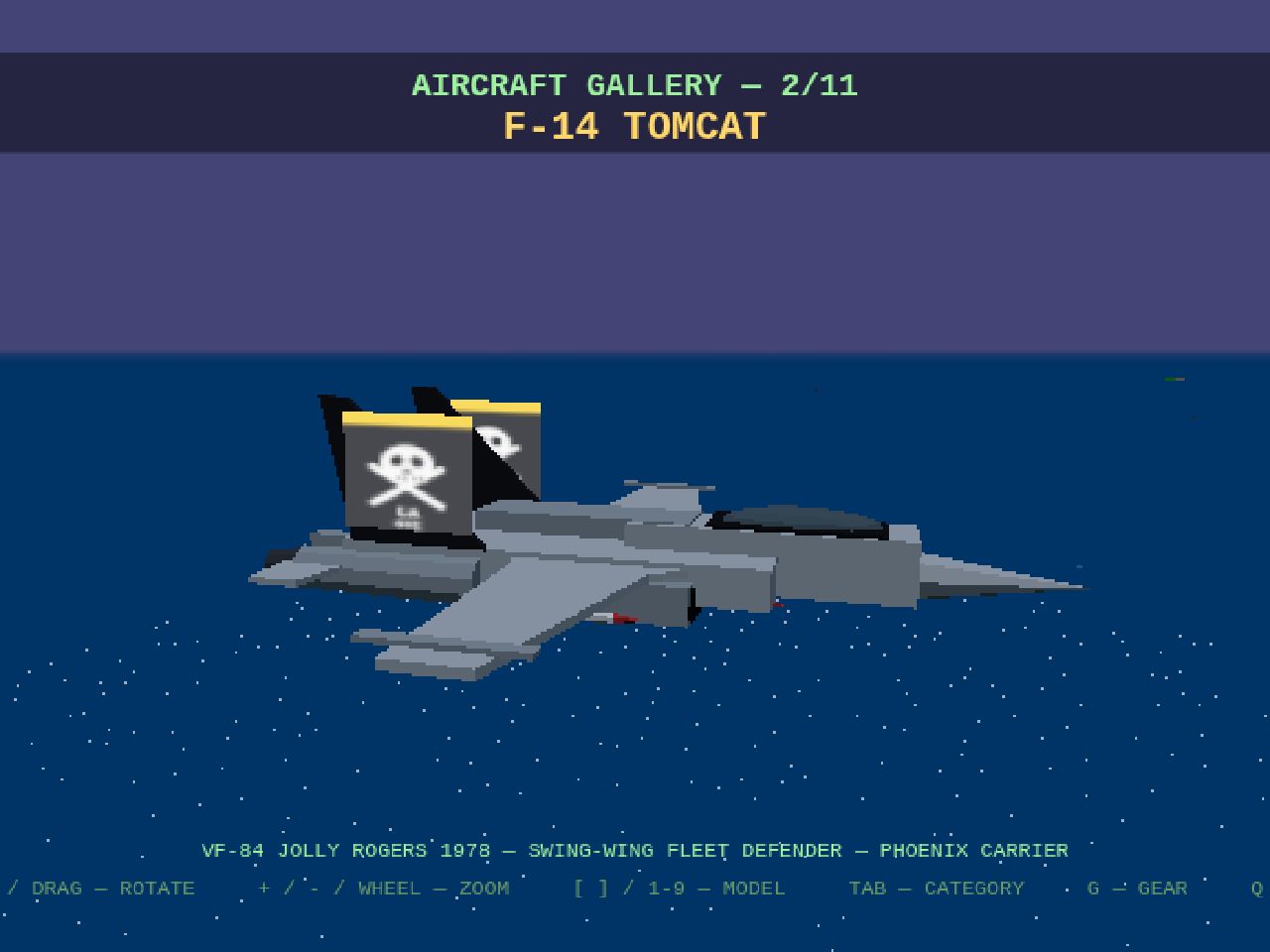
The flight line just grew a third mount, and she’s a big one. The Grumman F-14 Tomcat — fleet defender, swing-wing icon, and the only fighter ever to operationally sling the AIM-54 Phoenix — is ready for catapult shots off the Big E, wearing the 1978 VF-84 Jolly Rogers scheme: gull grey over white, black tails with yellow tips, skull and crossbones on both rudders, AJ on the modex:
She’s fully carrier-qualified. Cat 1 holdback and stroke off the bow, tailhook and wires back aboard — the same boat ops as the Hornet, with the Tomcat’s heavier, thirstier twin-engine personality (and a higher ceiling: those TF30s breathe up to 50,000 ft).
The wings sweep on command.S works the swing-wing: 20° spread for the pattern, 68° swept for the dash, easing over about two seconds just like the real box. The flight model morphs with the geometry — drag drops, stall speed climbs, roll sharpens, the G limit rises — and the HUD calls out the sweep angle as it travels. She even oversweeps to park, wings hugging the fuselage on the deck.
Four AIM-54 Phoenix in the tunnel, two Sidewinders on the glove pylons. The Phoenix is a different class of weapon from anything else in the bay: fatter, faster, and fired from far beyond the horizon — radar-guided all the way, FOX 3. It rides the rails from 1.2 out to 90 kilometres.
The AWG-9 reaches out. The Tomcat’s radar adds a 100 MI tier on top of the usual 40/10/2 — R cycles the lot, and the scope, the lock logic and the Phoenix’s envelope all honour the big radar’s legs.
She’s a squadron purchase. Plane-select 3 asks for the unlock code once; the Tomcat DLC in the Hornet Bay Store delivers it instantly for $8, and the jet stays in your logbook for good. Squadron founders fly her free, of course.
The printable joins the fleet. Her STL — wings spread, four Phoenix kept in the tunnel, skull and crossbones on the tails — is in the 3D Print Bay for $5, and THE COMPLETE FLEET bundle now packs all 23 models.
Sharp eyes over the round-down spotted it: the Big E’s deck still wore a straight axial centreline down the middle, which read as the runway. No more — like every real carrier, her runway is now unmistakably the angled deck:
The straight centreline is gone. What remains is the one true runway: the angled landing strip, offset to port so pilots land left of the island — the whole point of the angled deck since 1952.
The strip got the full treatment — bolder edge stripes, bigger centreline dashes, and a threshold bar across the stern end where the pass begins.
Everything still agrees: the arrestor wires, the IFLOLS meatball and the landing aim-point all derive from the same strip geometry, so what you see is exactly what you trap on. Verified from the overhead: strip angles off the ship’s line and passes port of the island, wires square across it.
The printable carrier wears it too — the six-angle shots in the Print Bay were re-taken on the new deck plan.
The J spectate camera now answers to the numeric keypad — the same keys the original used for its external view, so muscle memory transfers:
KP 4 / 6 pan around the aircraft or hull you’re riding, KP 8 / 2 tilt the camera up and down — the exact motions SHIFT+ARROWS and right-drag already did.
KP + / − zoom in and out (KP 9 / 3 work too, matching the original’s POV keys), joining the wheel and [ ].
KP 0 reframes — snap back to the default trailing shot, same as the top-row 0.
No friendly fire: outside spectate the keypad still drives your own jet’s external orbit view exactly as before — the two camera crews never fight over the keys, and leaving spectate never surprises you with a hijacked viewpoint.
The manual and the on-screen hint under the SPECTATE banner both list the new keys.
The R toggle just grew a full weather ladder. Where it once flipped CLEAR/RAIN it now steps through five states — MISSION DEFAULT → CLEAR → CLOUDS → RAIN → STORM — on the main menu, on the plane-select map, and saved between visits:
CLOUDS breaks the original’s cloudless sky — the scattered sprite deck that ships with the sim finally gets to fly, fading in over a couple of seconds with a light dimming of the day. Everything eases; nothing pops.
RAIN implies overcast now — the streak rain you know, under the cloud deck, with the usual gloom dragging the murk in close.
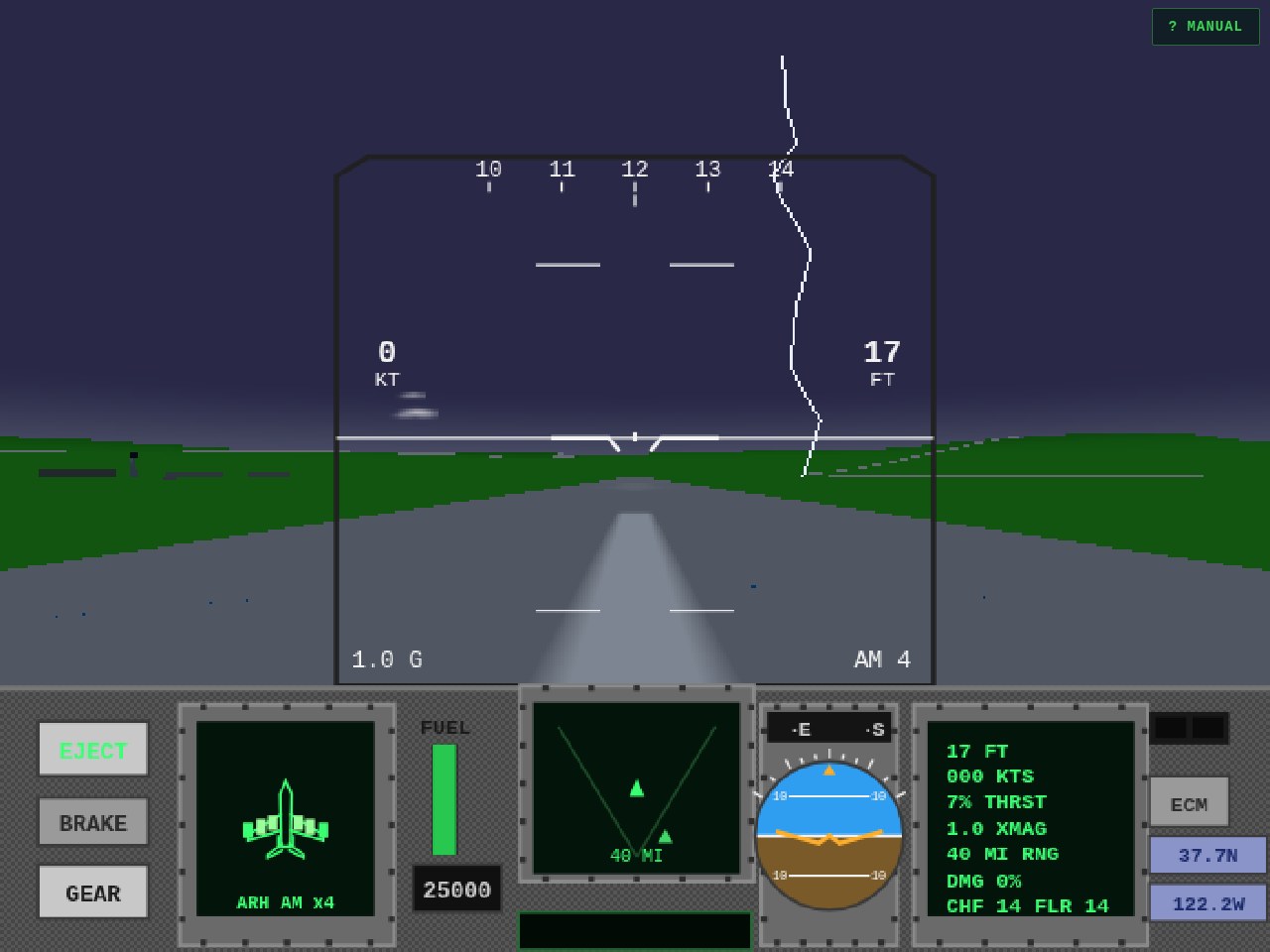
STORM brings the lightning. Every few seconds a jagged channel bolt walks down out of the deck somewhere within a few miles, the whole sky answers with a cold blue-white flash, and the thunder arrives late — delayed by true distance at 343 m/s, a crack decaying into a long low rumble through the audio graph.
Clouds got their own weather channel — separate from the rain blend, so overcast days can exist without a drop of rain, and every state fades smoothly through the same sky/fog/sun gloom the rain always used.
Manners kept: satellite planning maps stay free of rain, murk and bolts; pausing still silences the sky; and missions you authored stay exactly as clear as you left them — MISSION DEFAULT never surprises you.
The slipway is clear and the fleet is launched: all 23 printable STL products are live on the squadron’s Fourthwall store, and every button in the 3D Print Bay now says ADD TO CART:
All 22 models plus THE COMPLETE FLEET are on the shelves — each product carries its studio portrait, its spec sheet, and the zip (STL + PRINTING.txt) attached for instant delivery the moment checkout clears.
Checkout is real Fourthwall end-to-end — add to cart on hornetbay.com, pay on the squadron store, and the download link arrives by email. Merchant of record, taxes, delivery: all handled, same as the merch.
The wiring happened by API, not by hand — all 23 products were created, priced, imaged, file-attached and published through Fourthwall’s Platform API in one scripted run. Restocks and new models are now a one-command affair.
One plumbing fix along the way: the storefront catalog returns ten products per page by default, and with 23 new arrivals the older shelves went dark. The shelf and every stub page now fetch the full catalog in one page — all buttons lit, verified live.
The fishing boat stays free — the sample row downloads straight from the site, no checkout, while its $2 twin sits on the store for anyone who’d rather toss a coin in the jar.
All 154 photographs in the 3D Print Bay have been re-shot in a proper studio:
Backgrounds are gone. Every model now renders on transparency — no sky, no sea, no horizon. What’s left is the model and nothing else.
The models are much bigger in frame. The camera now solves its distance from the actual vertices of each mesh, so every aircraft and hull fills the frame edge-to-edge at every one of the six angles — roughly double the on-screen size of the old captures.
A studio sweep replaces the scenery. Cards on the shelf, the six-angle viewer, the bundle banner and the free-sample crabber all sit on a soft bay-blue radial backdrop behind the transparent render — consistent from thumbnail to full size.
Same squadron rule, new technique: the renders are still built by the game’s own model code in the gallery showroom, now lit by a three-point rig (key, fill and hemisphere) and captured straight off the GPU with the alpha channel intact.
A large six-angle gallery on every page — the model captured all the way around in 1600×1200, with a thumbnail strip to step through the views. Walk around it before you print it.
Full spec sheet beside the viewer: printed size, exact scale, real length, file size, format — plus the blurb, the price, and the buy button (which lights up the moment the Fourthwall products go live, same as the shelf).
Prev/next navigation runs through the whole fleet, and every page carries Product structured data and its own canonical link — the sitemap now lists all 22.
Standing rule held: all 132 new captures were shot in the in-game gallery, the squadron’s official photo studio.
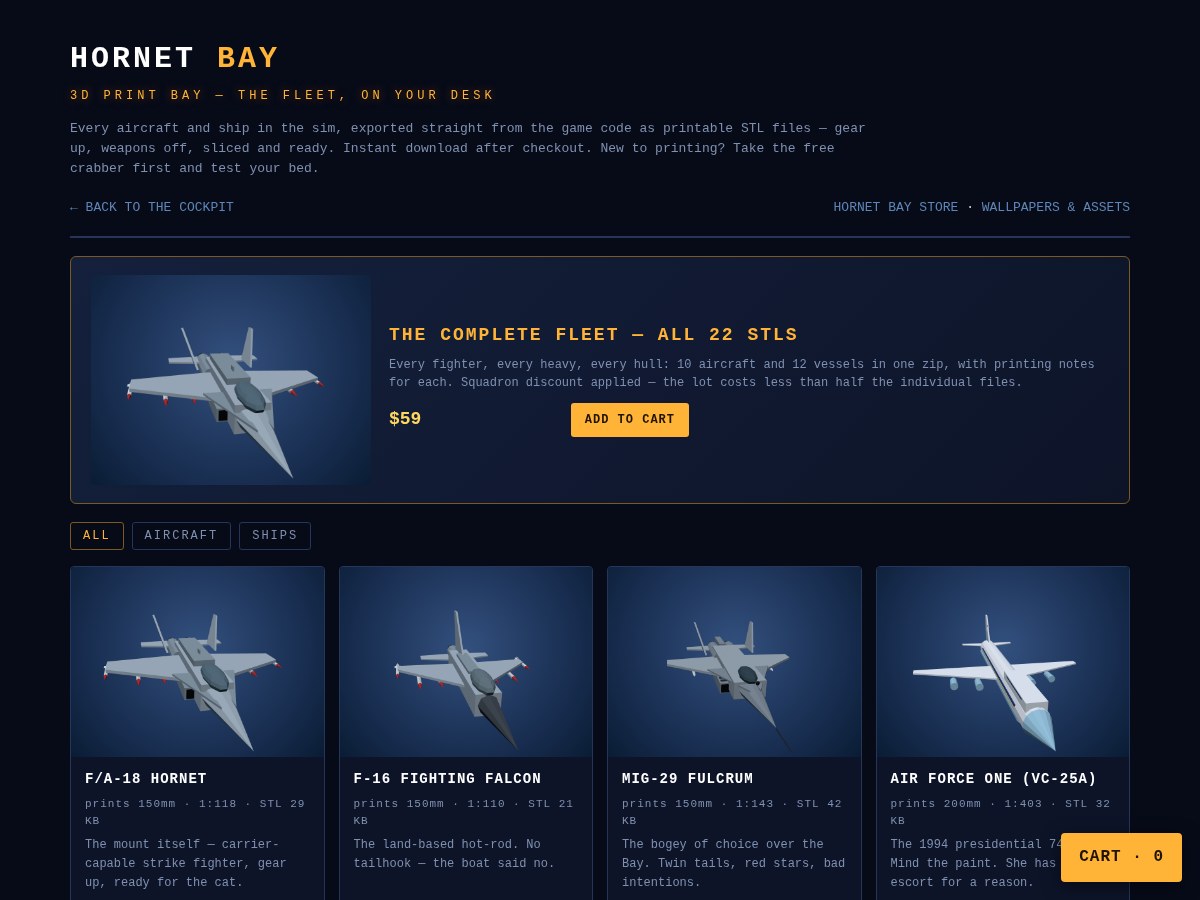
The models in the sim were too good to keep on the far side of the screen. The 3D Print Bay is open:
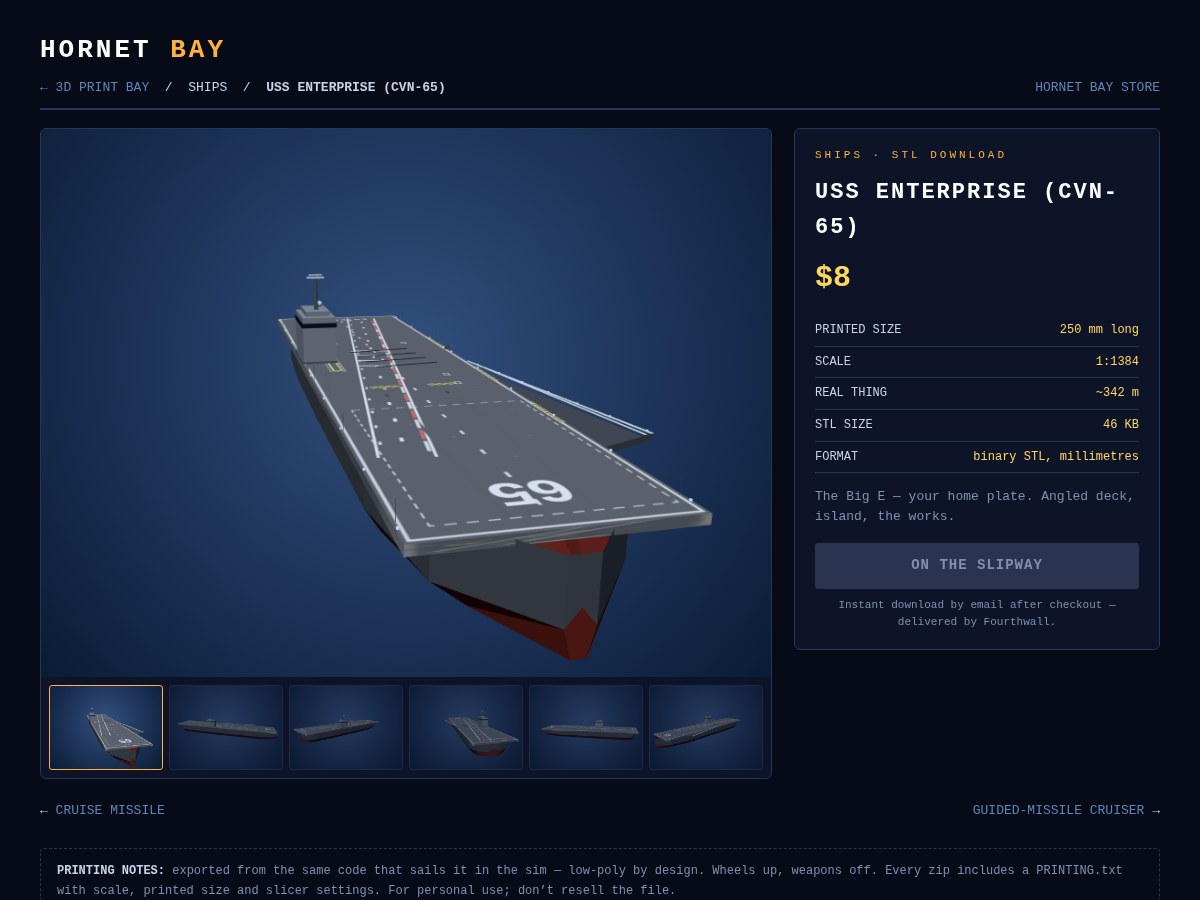
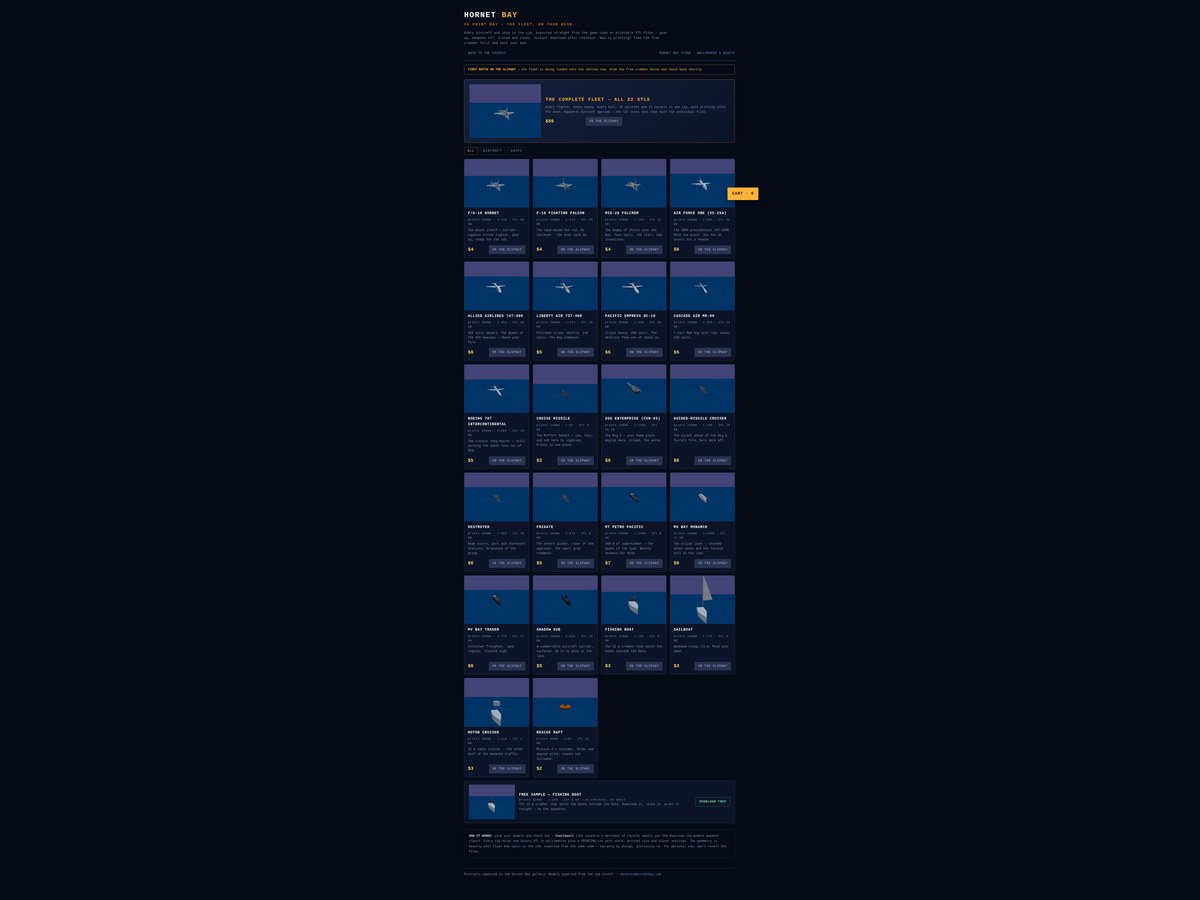
All 22 models as printable STL files — ten aircraft (Hornet, Falcon, MiG-29, the five SFO heavies, Air Force One, the cruise missile) and twelve vessels (the Enterprise, her three escorts, the supertanker, the cruise liner, the freighter, the sub, and the small traffic). Every one exported straight from the same code that flies and sails it in the sim — low-poly by design, gloriously so.
Print-ready out of the zip. Wheels up, weapons off, scaled in millimetres with the longest dimension sized for a standard print bed, and a PRINTING.txt in every zip with the scale, printed size and slicer settings. Ships print hull-down, no supports needed on most beds.
Priced per model — $2 for the little rescue raft, $4 for the fighters, up to $8 for the Enterprise — or take THE COMPLETE FLEET: all 22 files in one zip for $59, less than half the individual prices.
A free sample so you can test your bed first — the fishing boat zip downloads right from the page, no checkout, no email.
Checkout and delivery run through Fourthwall (the squadron’s merchant of record, same as the store): the download link arrives by email the moment payment clears. The paid files themselves are never exposed on the site — only the freebie.
Gallery coverage grew to make this possible: the Boeing 707, cruise missile, Shadow Sub and rescue raft all joined the showroom, and every card portrait on the page was captured in the gallery — squadron policy now.
The shelves are being stocked as this goes to press — if a buy button still says ON THE SLIPWAY, the crabber is free while you wait.
A batch of details that were bugging the flight line — features first:
Gallery gear toggle. Aircraft in the showroom now pose wheels-up by default, and G drops the gear (and raises it again) on anything that has wheels to show.
Spectate everything.J no longer stops at aircraft — it rides every contact in the bay, nearest first: airliners, MiGs, yachts, freighters, the supertankers, the escorts, and the Big E herself. While spectating, SHIFT+ARROWS or RIGHT-DRAG pans and tilts around the subject, WHEEL or [ ] zooms, and 0 reframes.
Pause means silence. Holding the sim with P now suspends the entire audio graph — engine, lock tones, gatling, weather, all of it — and releasing the pause brings it straight back.
And the fixes:
AI aircraft finally retract their gear. Any gear-equipped AI jet used to fly the whole sortie with its wheels hanging out — gear now comes down only on the ground and on final, and goes up the moment they’re airborne.
SFO’s south end is clear. Three terminal and hangar blocks overlapped the southern stretches of the 01L/01R strips; they’ve been shifted off the pavement. No more clipping a building on short final.
Menu titles cleaned up. The F1–F7 and ESC badges are gone from the MISSIONS rows — the keys work exactly as before, the titles just stopped shouting them.
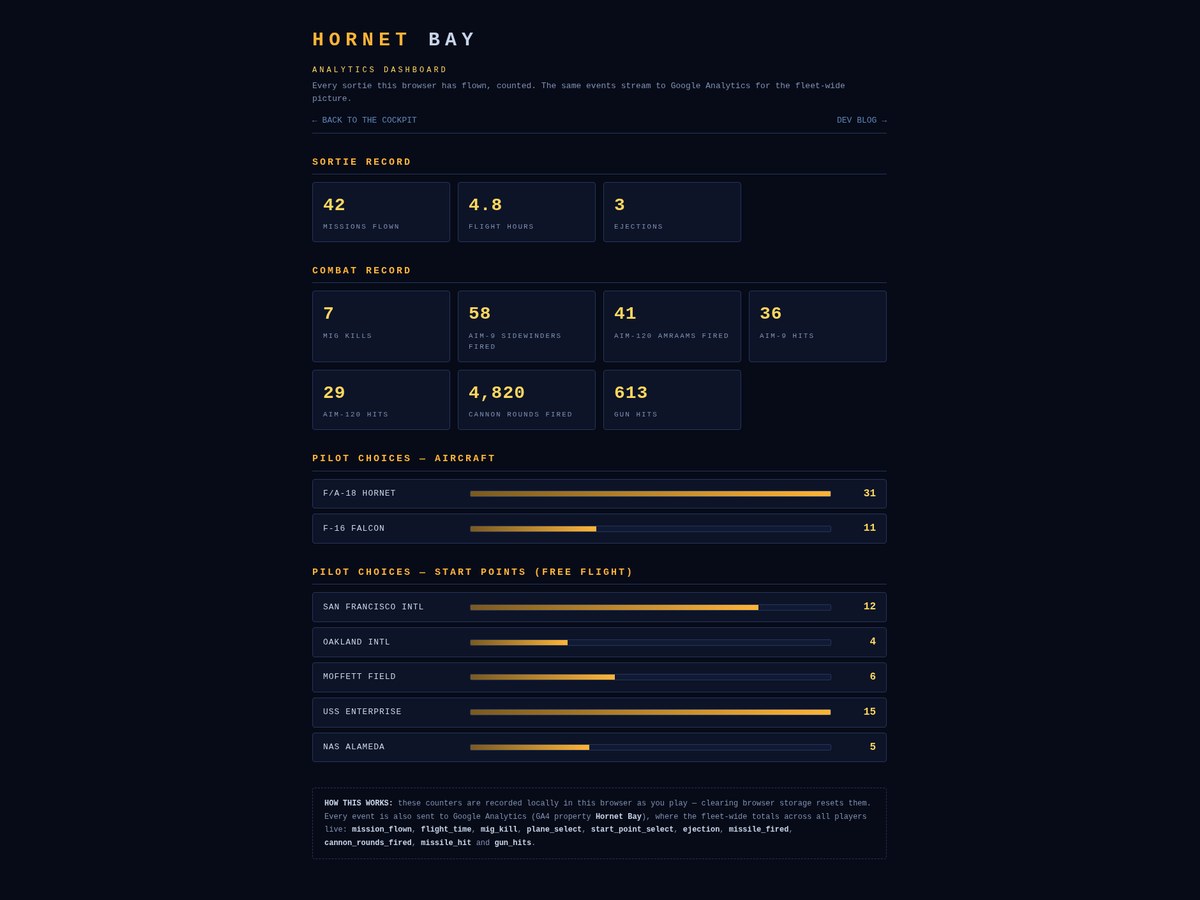
Analytics were homepage-only. The GA tag only ever loaded on the front page, so every blog entry, tag page, the store and the assets shelf were invisible to it. The tag now ships on every page, through a loader that’s ready for Google Tag Gateway — it tries the first-party path first and falls back to Google’s CDN until the gateway is switched on.
The mission desk wants numbers, so numbers it gets — a proper analytics dashboard, plus the plumbing that feeds it:
New dashboard at /analytics, styled to the squadron: SORTIE RECORD (missions flown, flight hours, ejections), COMBAT RECORD (MiG kills, AIM-9 and AIM-120 fired, hits by type, cannon rounds, gun hits) and PILOT CHOICES — Hornet versus Falcon picks, and how often each free-flight start point gets the nod, bars and all.
Every metric is counted as you play. Missions, flight time, MiG kills, plane and start-point selections, ejections, missiles by type, cannon rounds, missile hits by type and gun hits are all tracked live and kept between sessions. One honest caveat: the dashboard reads the counters in your browser — clear your storage and your record starts over.
Every metric also fires as a Google Analytics event — mission_flown, flight_time, mig_kill, plane_select, start_point_select, ejection, missile_fired, cannon_rounds_fired, missile_hit and gun_hits — so the fleet-wide picture across all players builds in the GA4 property. High-frequency streams (flight seconds, cannon rounds, gun hits) batch up and report once a minute and at the end of every sortie; the rest report the moment they happen.
ANALYTICS DASHBOARD is a main-menu item (key A, opens in a new tab) — and DEMO has left the menu; the attract loop still runs behind the menu as always, it just no longer takes up a row.
Two menu-router bugs surfaced while wiring all this up, and both are fixed:
One keypress was being spent twice. Hitting 2 for FREE FLIGHT used to open the start-point map and — in the very same instant — let that same 2 fall through to the map and pick Oakland for you. The menu now swallows any key it consumes.
F1–F7 work in MISSIONS again. The rows always said F1, F2, F3… but the keyboard router wasn’t listening for F-keys — mouse or nothing. Now the keys do what the badges promise.
A big batch of small doors and corridors this time — plus one very big grey hull:
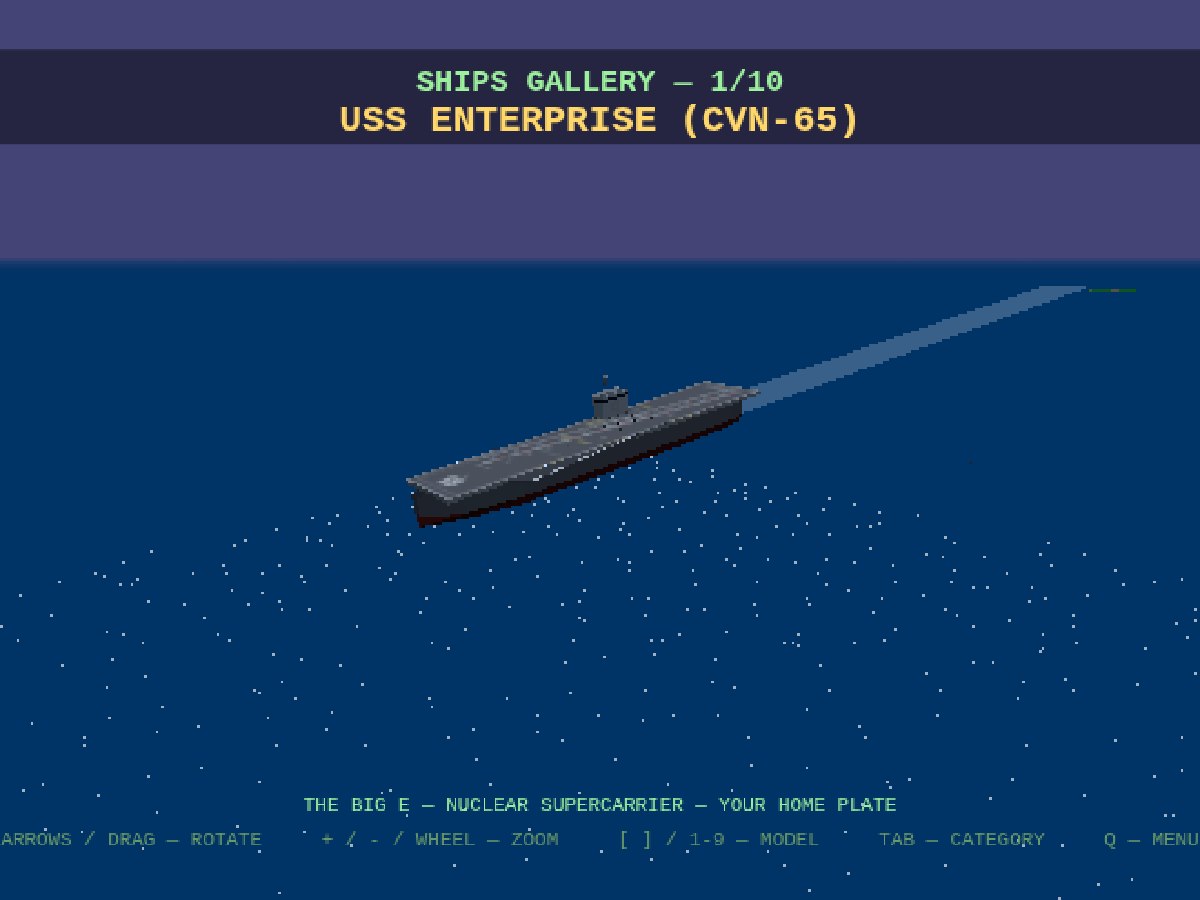
The gallery now covers every aircraft and every ship in the game. Eight airframes and ten hulls: the Big E, her cruiser, destroyer and frigate escorts, MT PETRO PACIFIC, MS BAY MONARCH, MV BAY TRADER, and the fishing boat, sailboat and motor cruiser that clutter the weekend lanes.
It is split into two categories — AIRCRAFT and SHIPS. TAB jumps between them; [ ] or 1–9 still step through the exhibits, and every model remembers its own sensible viewing distance.
SELECTABLE MISSIONS is now simply MISSIONS, and NEXT ACTIVE ADVANCED MISSION has left the menu — the missions speak for themselves.
BLOG is a main-menu item (key B, opens in a new tab), and the homepage link is retitled to match.
HORNET BAY STORE is a main-menu item (key S, new tab) — the old Exchange link is retitled too.
Every blog tag is now a page. Each tag chip links to its own stub — /blog/tag/ships and friends — and the blog carries a tag sub-menu up top, so you can read by topic: FEATURE, CONTENT, SHIPS, SITE and the rest.
One housekeeping note: from now on, every model screenshot you see here comes straight from the gallery — and any new model that joins the game joins the gallery at the same time.
Long transits just got shorter — time acceleration is in:
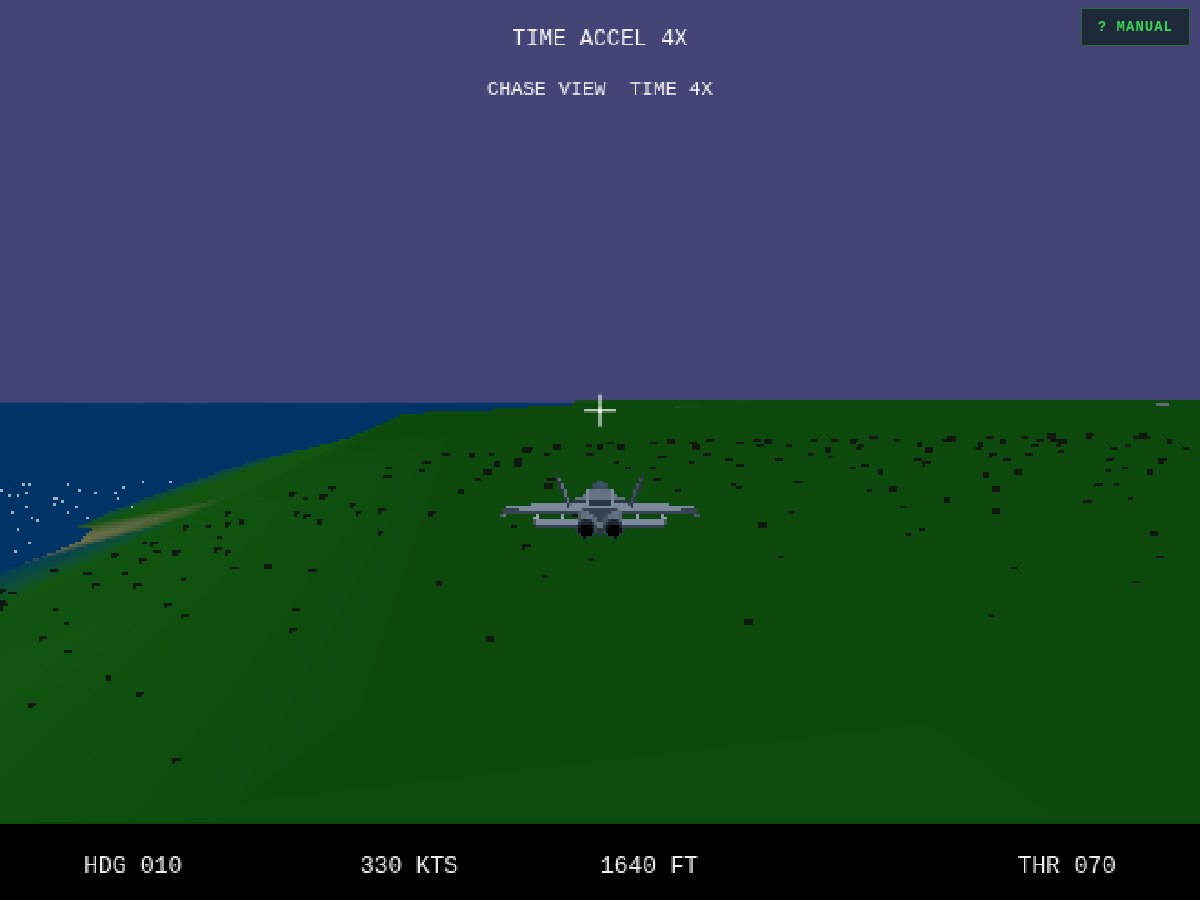
Z toggles 2x / 4x / 8x / normal time. Everything runs faster together — your jet, the carrier, bandits, airliners, the new lane traffic and the mission clock — so a mission’s choreography stays in step; it all just plays out sooner. Handy for the climb-out, handier when the action is three counties away.
Physics steps in sub-frames, so carrier landings and dogfights stay stable at any speed, and one-shot keys (views, weapons, the lot) still fire exactly once per press at any tempo.
A TIME readout rides the HUD while acceleration is engaged — TIME 2X / 4X / 8X beside the view label, and on the cockpit data block too.
The shipping lanes between the Bay and the Pacific have gone heavy. Four new hulls now work the lane in both directions — three deep-laden supertankers and a cruise liner — each one named and typed in the traffic system, each trailing a wake scaled to its length. Meet the new traffic, largest first:
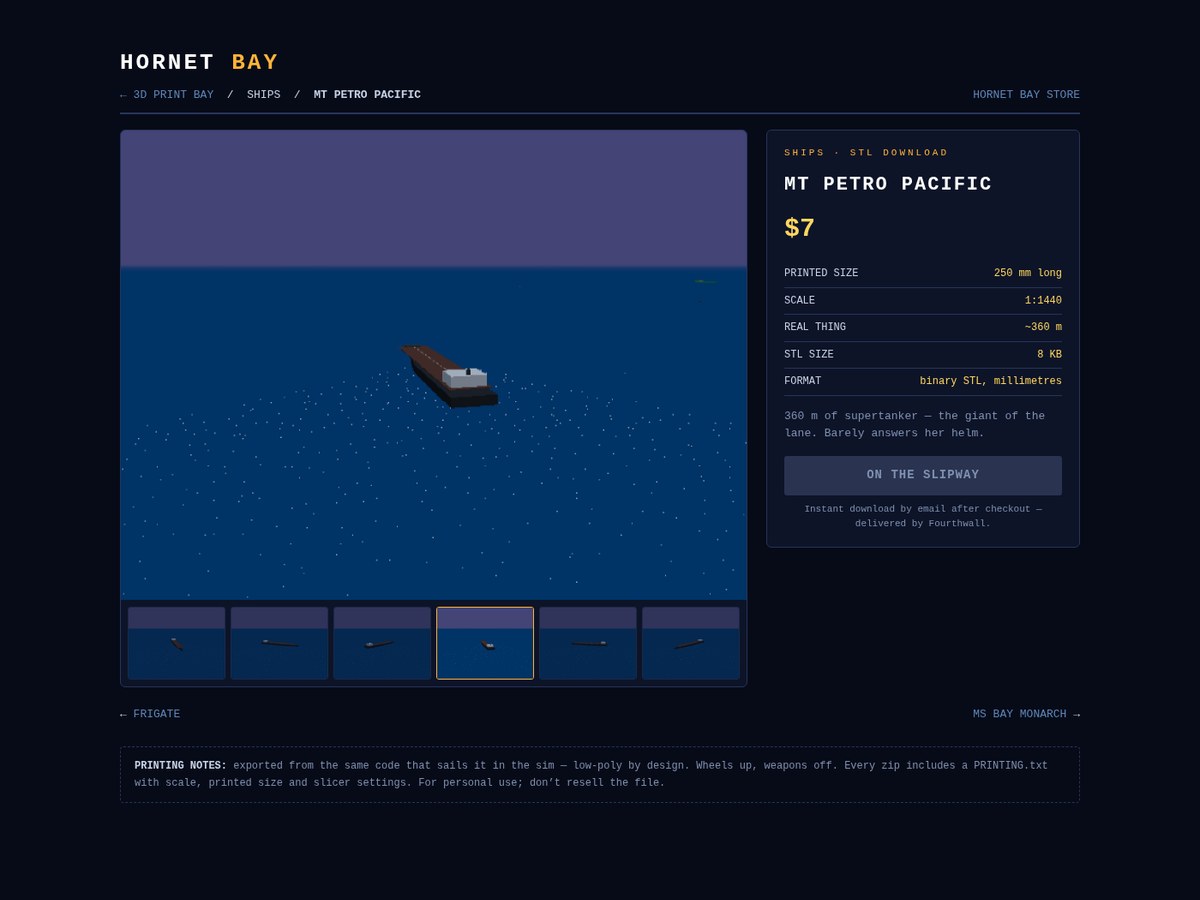
MT PETRO PACIFIC — 360 m overall, 54 m beam, 3.5 kt on the lane. The biggest hull in the bay; she barely answers her helm.
MT GOLDEN CRUDE — 340 m, 50 m beam, 3.8 kt. Black hull, rust-brown deck, pump manifold amidships, accommodation castle right aft.
MT ATLANTIC BULK — 320 m, 48 m beam, 4.0 kt. The sprinter of the tanker trio — which, granted, is not saying much.
MS BAY MONARCH — 230 m, 30 m beam, 6.8 kt. The cruise liner and the fast mover of the lane: stacked white decks, window bands, and the line’s amber band on the funnel.
Seamanship notes: after dark all four show proper lights — white masthead, red to port, green to starboard — and every hull leaves a wake you can pick out from altitude. They share the water with the existing freighters, fishing boats and yachts, so the Golden Gate is properly busy now.
One word to the wise, pilots: file these names away. The mission desk has been asking an unusual number of questions about lane schedules of late — best to know a supertanker from a cruise liner before the tasking orders start mentioning hulls by name.
Row numbers retired. The main menu no longer prints a digit against each row — the list reads cleaner for it. The number keys themselves still work, if your fingers remember them.
Three rows struck. TRAINING: DEMO OF MANEUVERS, TRAINING: PRACTICE MANEUVERS and QUALIFICATION: REQUIRED FOR MISSIONS are removed from the menu.
Laurel refit. The Squadron Laurel roundel has been re-framed — the Hornet is zoomed out and centred so the whole airframe, wingtip missiles included, sits inside the ring with clear sky all round. The roundel file has been refreshed wherever the site serves it.
View system overhaul: V now cycles cockpit → cockpit-off → chase → orbit → tower. Cockpit-off is the pilot’s-eye view with full symbology and no glass or panel in the way. Spectate (J) no longer shows your own jet or the cockpit furniture while you ride along — just a clean SPECTATE banner, and X drops you straight back into the cockpit. The F1–F10 throttle row has been retired from the flight manual (the bindings themselves are untouched), and the title screen now reads Carrier Ops Flight Simulator.
The shipping lanes are getting heavy: three supertankers — MT PETRO PACIFIC (360 m), MT GOLDEN CRUDE (340 m) and MT ATLANTIC BULK (320 m) — plus the cruise liner MS BAY MONARCH now ply the lane between the Bay and the Pacific. All four are named and typed in the traffic system, ready to be tasked in future missions.
Brand desk: the Squadron Laurel roundel has been re-shot — the complete Hornet now appears from the original emblem’s camera angle, whole airframe inside the ring. Files on the assets page.
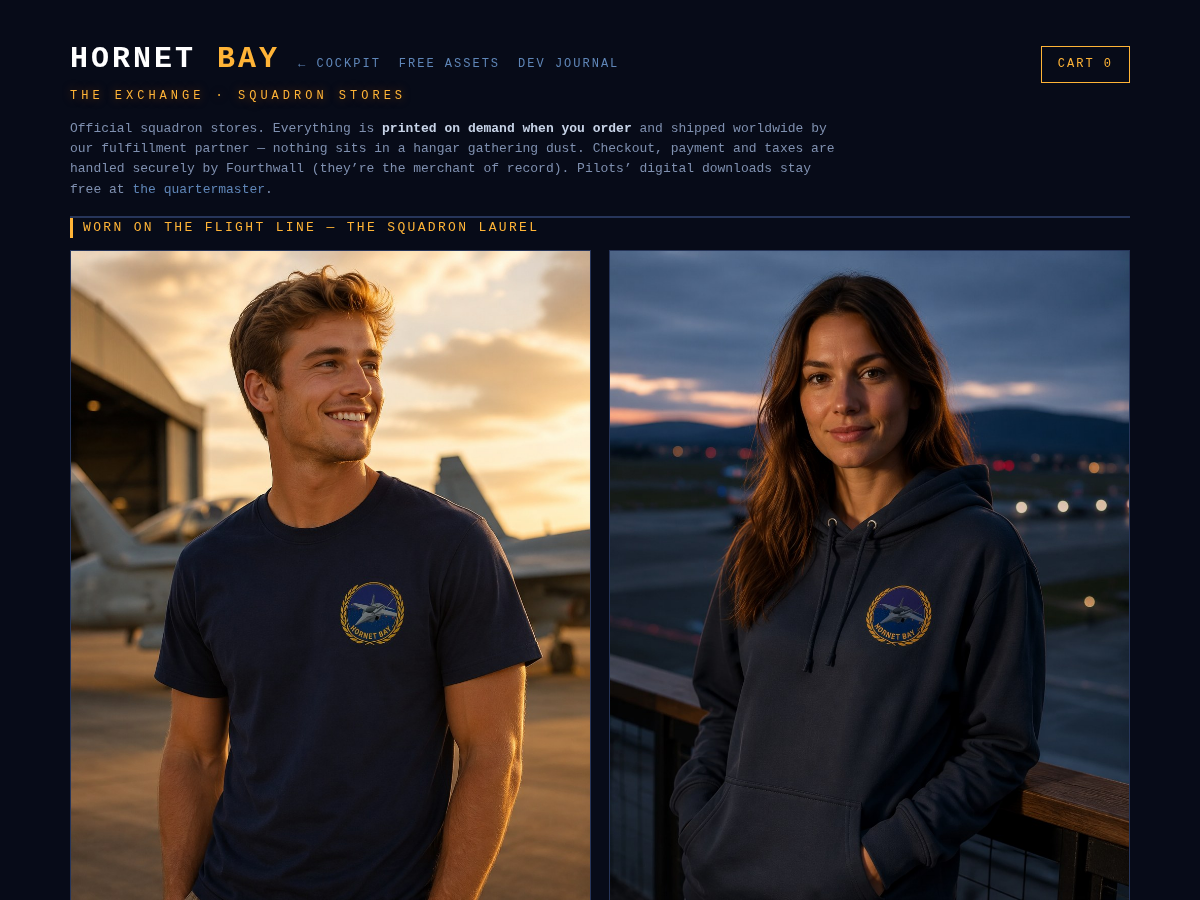
Hot on the heels of the emblem rebuild: the whole-Hornet laurel is now flying on all four Squadron Laurel products at The Exchange — mug, kiss-cut sticker, left-chest tee, and left-chest hoodie. The clipped-nose editions have been retired to the archives; same prices, same placements, complete airframe.
The lookbook got a fresh sitting too — new concept photography for the tee and the hoodie, roundel on the left chest where a patch belongs.
Sharp eyes on the flight line noticed the squadron laurel had its Hornet flying out of the frame — the radome was clipped where the source screenshot ended. No longer. The emblem has been rebuilt with the whole Hornet: full pointed nose, canopy, twin tails, wings and rails, all of it inside the laurel ring, over the new flat navy that lets the airframe stand out.
The jet is no illustration — it is the game’s own F/A-18 model, posed for the portrait. Two new capture hooks in the aircraft gallery made the sitting possible: the model can now be rolled into a bank for hero angles (?gr=), and a chroma-key backdrop (?chroma=) lifts it clean off the sky for cutout work. Same trick as the fleet orbits, one degree finer.
New insignia, four new ways to wear it. The Squadron Laurel — the Hornet over the starlit bay, wrapped in gold — now flies on a mug (printed front and back), a kiss-cut sticker, a tee, and a hoodie. On the clothing the laurel rides on the left chest, where a patch belongs — not splashed across the front like a billboard.
And because flat product renders only tell half the story, The Exchange now opens with a lookbook: the tee on the tarmac at golden hour, the hoodie on the dusk watch. Concept photography generated for the squadron — the exact print is always in the product renders below. That makes ten products on the shelf; coffee included.
Ever wondered what the sky looks like from a cable’s length behind a 747? Press J in flight and find out: you hop out of your own cockpit and ride along with the next aircraft in the area — airliners on their routes, MiGs on patrol, tankers, wingmen, the whole cast. Keep tapping J to cycle through everyone airborne; after the last contact you’re handed back to your own cockpit, and V or X brings you home instantly at any point. If your ride gets splashed or leaves the area, the camera lets go and you’re back in your own seat — no falling out of the sky required.
Press U to make the HUD vanish entirely — clean screenshots, clean footage, just you and the view — and again to bring every gauge back. And the fuel trucks have been generous one more time: burn is halved again, with the Hornet sipping 20 at military power and 47.5 in burner (the Falcon 18.75/43.75), so the long haul out to the fleet no longer ends as a glider lesson. Both keys are written up in the in-game manual (?), as regulation requires.
Two more channels report for duty: Hornet Bay on Facebook and @hornet_bay on Instagram are live, wearing the squadron badge and flying the launch post. They join X and YouTube in the home-menu footer and at the bottom of every journal page — one look, one squadron, everywhere. Follow along for fleet videos, tutorial lessons, and the occasional court martial.
The squadron is standing up its Facebook page and Instagram account, and the quartermaster now issues the full kit: the profile badge at a crisp 1000×1000 (the head-on Hornet roundel, safe in any circular crop), the Facebook cover with the URL tag, the existing X cover and YouTube banner, and a new square launch post (1080×1080) sized for the FB and IG feed — “FREE IN YOUR BROWSER — HORNETBAY.COM.” Same sky, same water, same Hornet: one look across every channel.
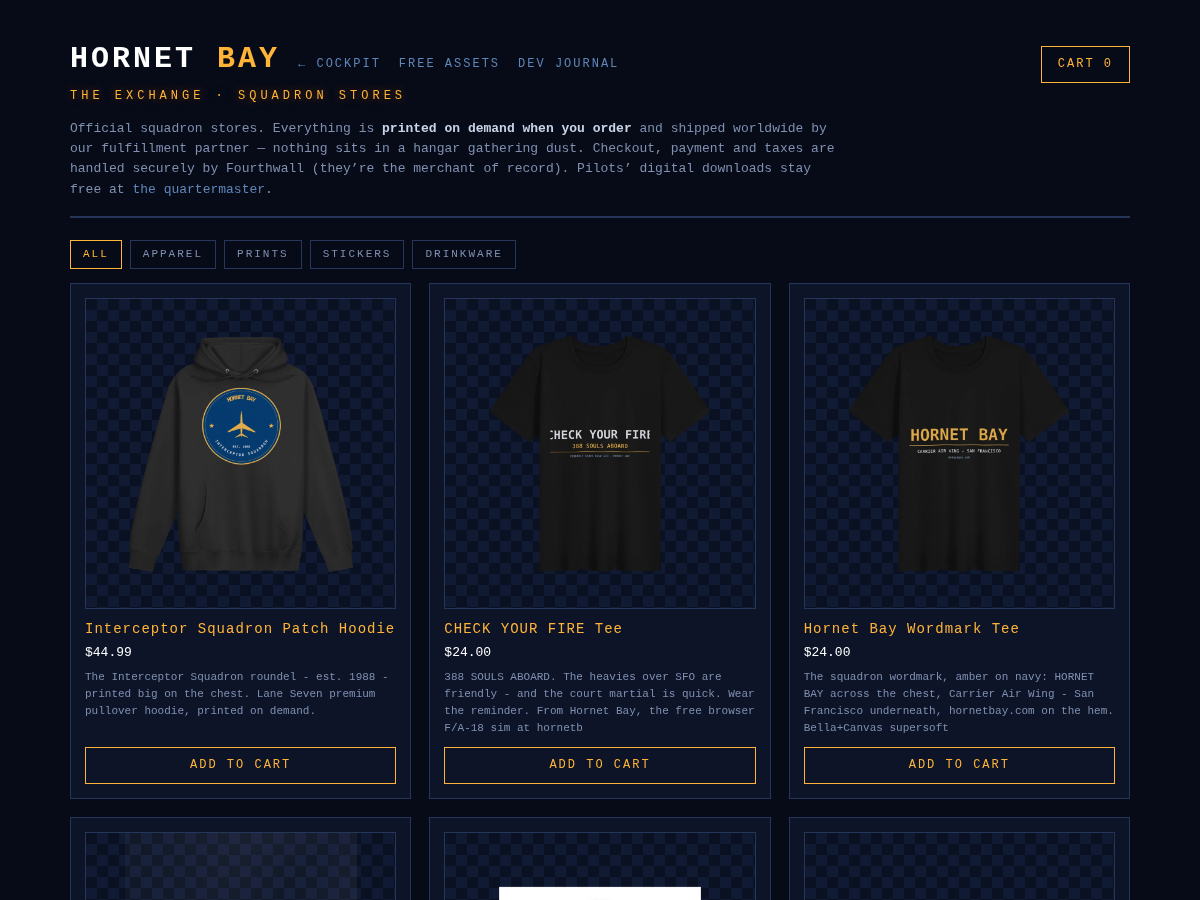
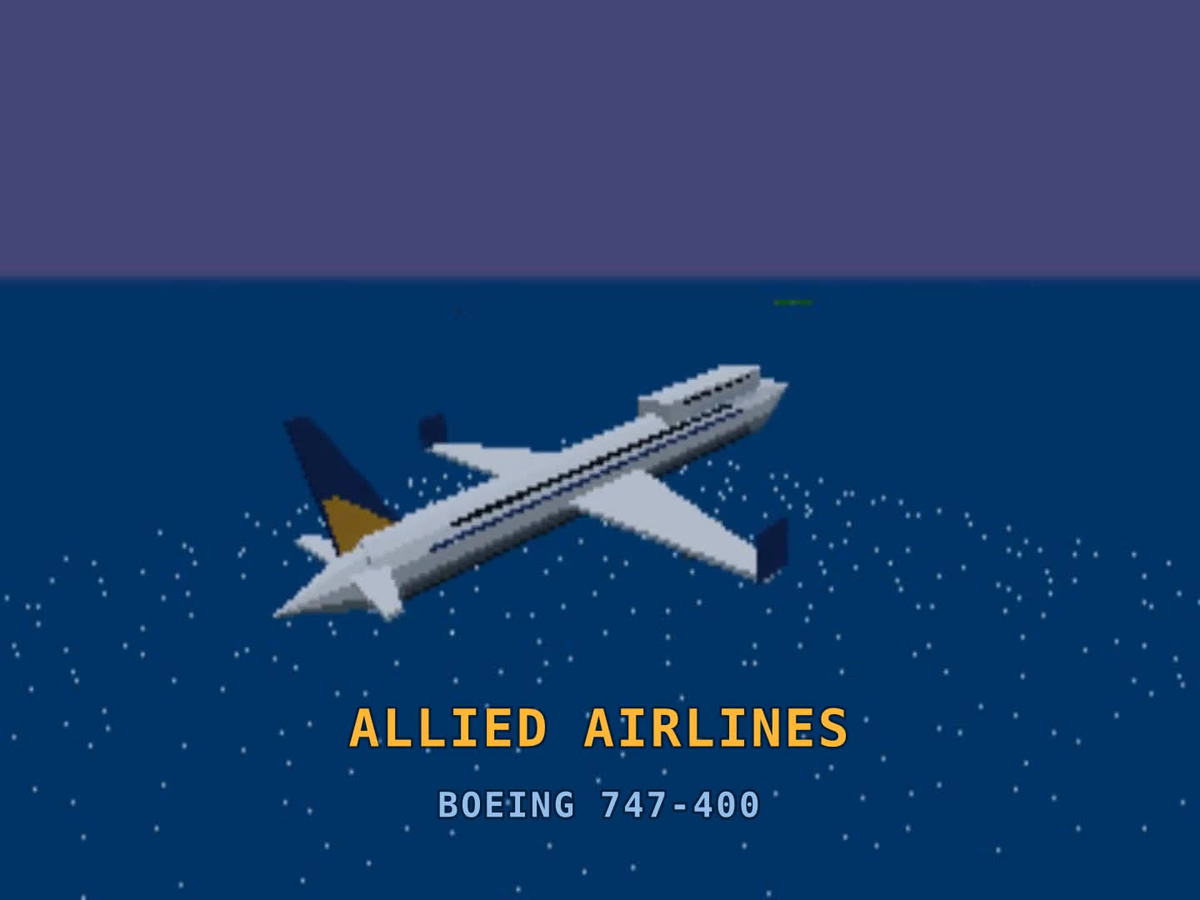
The Exchange has restocked. The preview shelf is gone — hornetbay.com/store now draws its catalog straight from the new Hornet Bay squadron store: the wordmark tee and the CHECK YOUR FIRE tee ($24), the Interceptor Squadron patch hoodie ($44.99), the Meet the Fleet mug ($15.99) with all four SFO airlines on the wrap, the kiss-cut squadron patch sticker ($5.99), and the Meet the Fleet poster ($17.99) with ALLIED’s 747-400 over the Bay. Category filters up top, a cart that follows you around the site, and secure checkout through Fourthwall — everything printed on demand and shipped worldwide.
The catalog, prices and mockups are managed live, so new gear lands on the page the moment it’s designed. One formality remains before the doors swing all the way open: the squadron store itself is finishing setup at Fourthwall (payouts and the final launch switch) — until then you can browse, fill a cart, and window-shop the full lineup. Digital downloads stay free, as always, at the quartermaster.
The fleet profiles deserved more than stills. The new MEET THE FLEET video puts the camera in a slow 360° orbit around every airliner in the Bay — all sides of the ALLIED 747-400, the LIBERTY AIR 737-400, the PACIFIC EMPRESS DC-10 and the CASCADE AIR MD-90, wheels up over open water. Each orbit opens with a hold on the hero angle while the airline’s name and aircraft type fade in, then swings all the way around the airframe.
The whole thing flies to the Hornet Bay anthem, opening with a genuine in-game flyby whoosh. It ships in two cuts: a 47-second widescreen cut for the Hornet Bay YouTube channel, and a vertical Shorts cut with the specs riding under every aircraft. The four fleet profiles — ALLIED, LIBERTY, PACIFIC EMPRESS, CASCADE — have the full specifications.
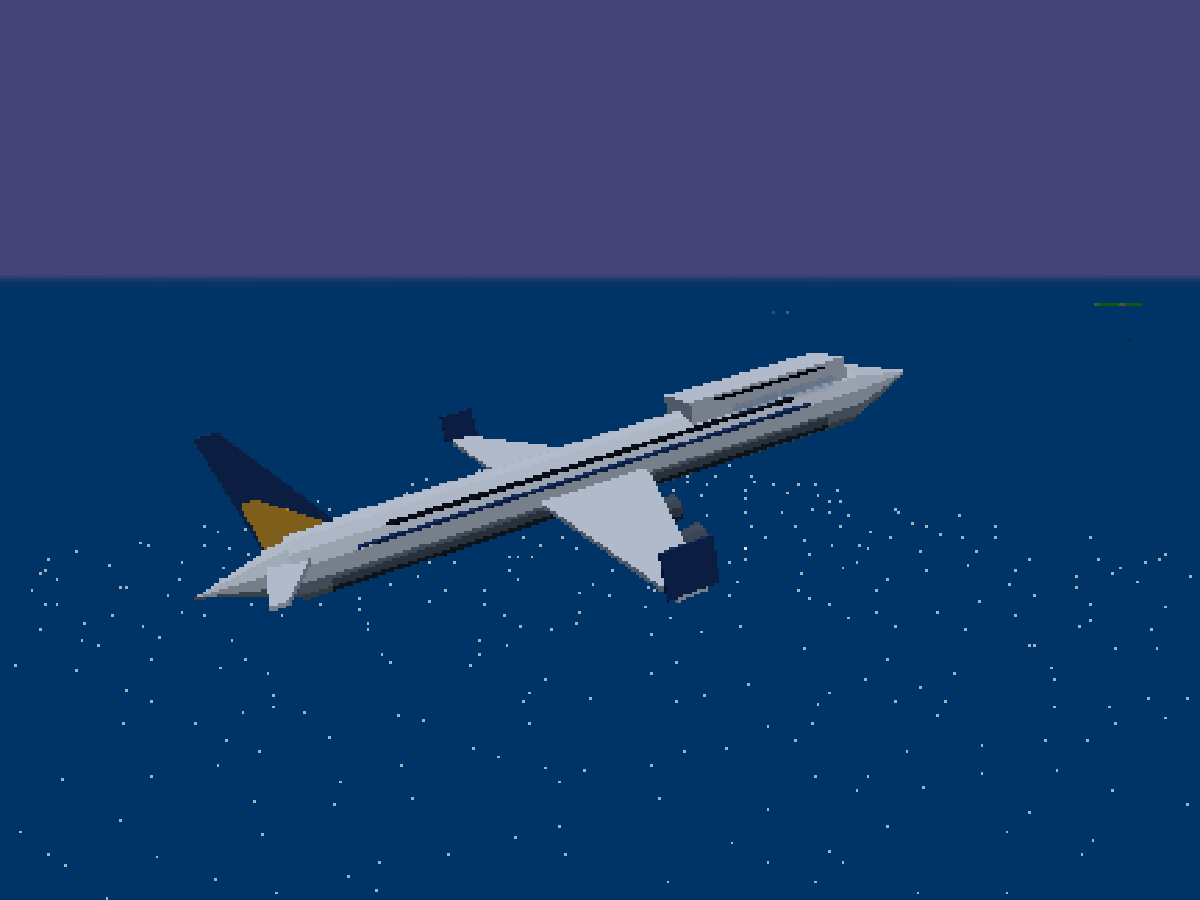
The flag carrier of the Bay. ALLIED’s 747-400s run the trans-Pacific trunk — Tokyo, Hong Kong, Sydney — every departure threading the Golden Gate on climb-out, every arrival letting down over the East Bay for SFO’s 28s. 388 souls aboard, four big fans at a rumble you can feel from your own cockpit. Navy pilots know her as the big friendly on the scope: ALLIED 412 HEAVY and her sisters, squawking their way in at all hours, in all weather.
THE AIRCRAFT — Boeing 747-400 · length 231 ft 10 in · wingspan 211 ft 5 in · four engines (PW4000 / CF6 / RB211 family, about 63,000 lb of thrust apiece) · cruise Mach 0.85 · range 7,285 nautical miles · 416 seats in a typical three-class cabin · first flight 29 April 1988 — a contemporary of a certain Amiga simulator — in airline service since 1989.
Where to meet her: heavy departures off SFO climbing through 4,000 over the ocean, or arrivals on long finals to the 28s. Intercept her, formate on the wing, count the windows — then check your fire, because the court martial is quick and the debrief is unforgiving.
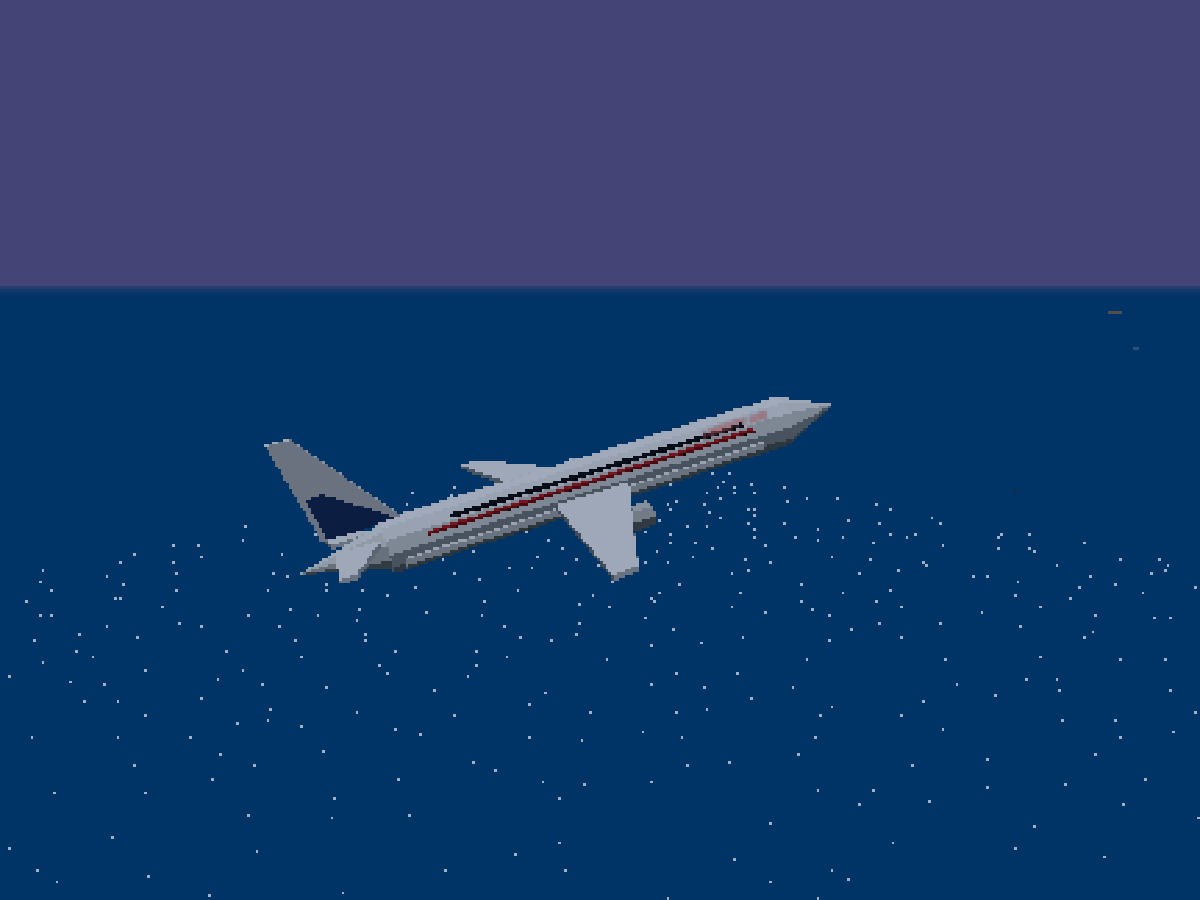
The shuttle. LIBERTY AIR’s polished-silver 737-400s with the red cheatline run the coast milk route — Los Angeles, San Diego, Seattle and back — a rotation every hour, 146 souls a hop. If ALLIED is the flag carrier, LIBERTY is the bus service: always in the pattern, always on time, and always exactly in your way when you’re boresighting a bogey over the Bay.
THE AIRCRAFT — Boeing 737-400 · length 119 ft 7 in · wingspan 94 ft 9 in · two CFM56-3 turbofans · cruise Mach 0.74 · range about 2,060 nautical miles · 146–168 seats · first flight 19 February 1988, in service the same year — the stretch that kept the classic 737 line relevant into the nineties.
Where to meet her: low and slow over the Peninsula, gear down and flaps out on a long straight-in. The easiest intercept in the Bay — and the most expensive mistake if you get trigger-happy.
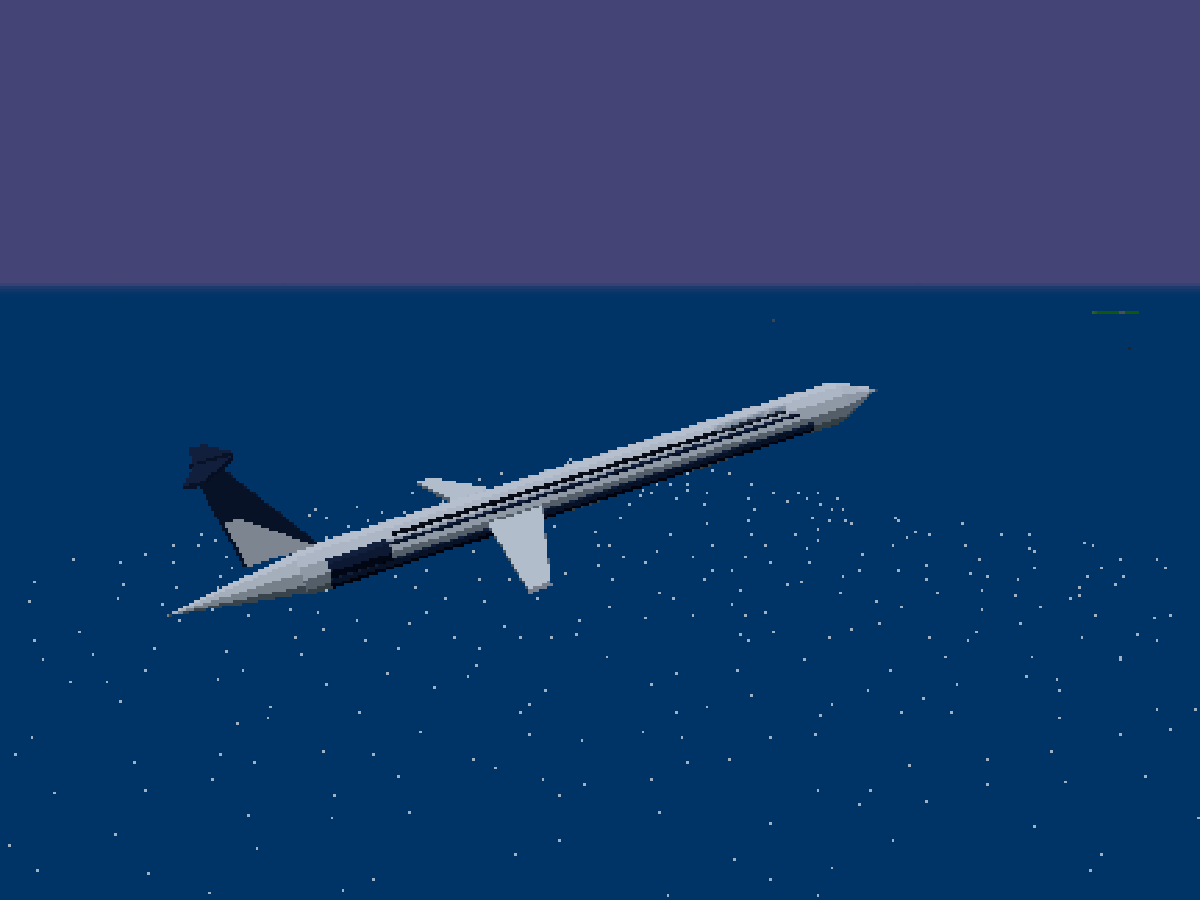
Down from the Northwest. CASCADE AIR feeds SFO from Seattle, Portland and points north, and it does it with the quietest Mad Dog ever built: the MD-90, with its T-tail and rear-mounted V2500s whispering in over the hills where the older jets roar. 158 souls aboard. Spot her by the long fuselage, the high tail, and engines exactly where the tail ought to be.
THE AIRCRAFT — McDonnell Douglas MD-90 · length 152 ft 7 in · wingspan 107 ft 10 in · two IAE V2500s — the first airliner ever certified with them · cruise Mach 0.76 · range about 2,085 nautical miles · 153–172 seats · first flight 22 February 1993: the last and quietest of a line stretching straight back to the DC-9.
Where to meet her: descending out of the north on the arrival flow, all day, every day. Formate, wave at the cockpit, remember the souls aboard — and let her land.
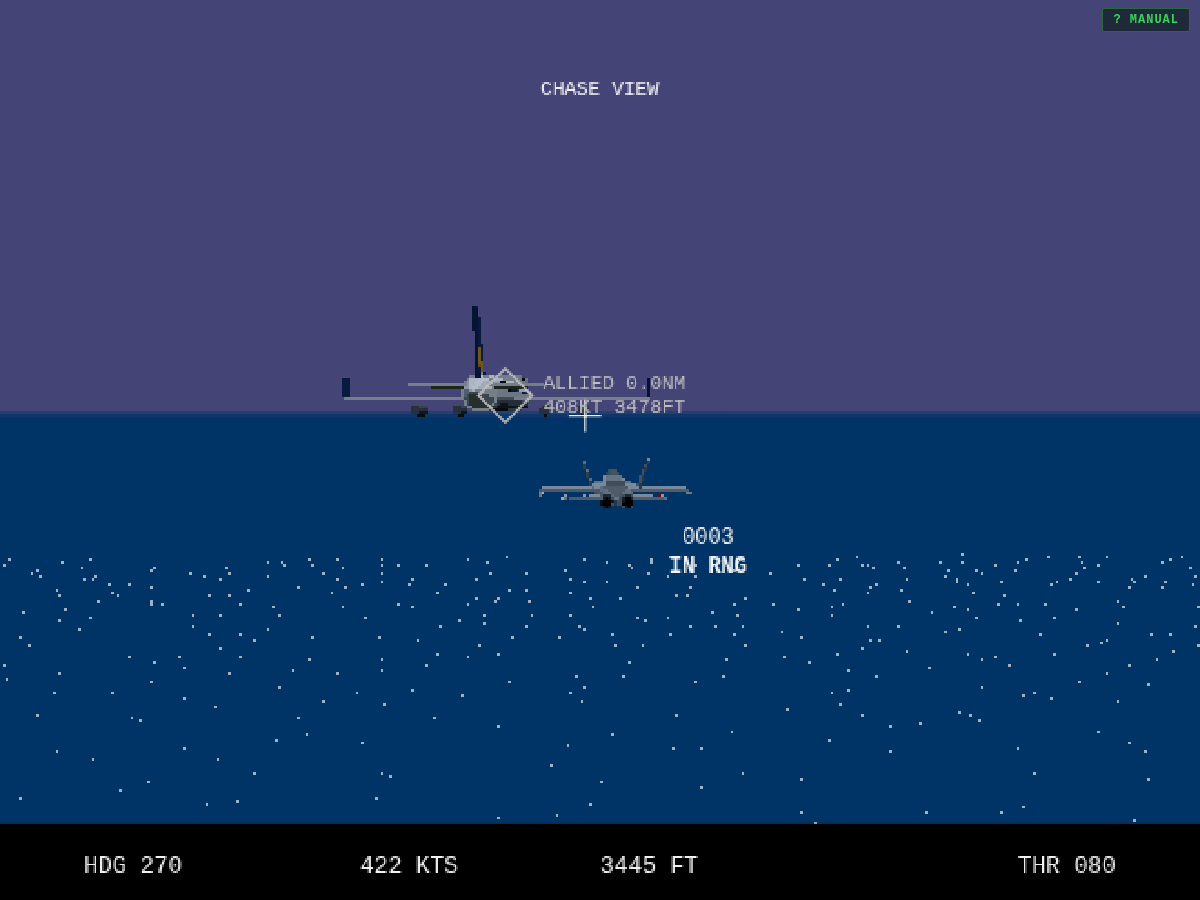
San Francisco International is open for business. Around the clock and in every weather, the heavies now work the bay: ALLIED 747-400s, LIBERTY 737s, CASCADE MD-90s and PACIFIC EMPRESS DC-10s, climbing out and letting down on the corridors real traffic flies into SFO. They squawk on the radar with airline callsigns, they hold their routes like professionals, and they will absolutely ruin your merge if you cut across final at the wrong moment.
The Hornet’s fire-control computer doesn’t care what you lock — an airliner tracks, designates and takes a missile like anything else. The Navy cares. Splash a civilian and the sortie doesn’t end with a score line, it ends with a COURT MARTIAL. Fly the intercept, make the visual ID, and keep your finger off the pickle.
Which brings us to MISSION 7: one of those Pacific Empress DC-10s is carrying a defector the other side very much wants back, and bandits will vector in to make sure he never talks. Get to him, see off the welcoming committee, and put him safely on the ground. And because a sky this busy shouldn’t keep moving while you’re reading the menu, the whole bay now freezes when you hit Q — traffic, bandits, carrier and all — and picks up exactly where you left it.
A pilot request, granted on the spot: X snaps you straight back to the cockpit from any camera — chase, orbit, tower — without cycling the whole carousel with V. The two keys sit side by side for a reason: V wanders out, X comes home. The flight manual says so, in writing.
Radar range now steps the way a pilot actually fights: it starts wide at 40 miles and each tap of R tightens the noose — 40, 10, 2, and back around to 40. Fuel burn has been halved again, roughly doubling your legs: loiter far, chase long, and still make the deck with something in the tanks. And when it all goes wrong — crash or eject — there’s no paperwork anymore: the wreck settles, your best score is banked, and you’re back at the menu ready to launch the next one.
Also aboard: a console chirp when you pause or call up the menu, so the bay answers when you ask it to hold — and the aircraft gallery swells to eight, with all four airliners in their house liveries, so you can get a proper look at the traffic before you try very hard not to shoot it.
Third report from the iPhone pilot: motion permission granted, still stuck on ROTATE YOUR DEVICE. Verdict: iOS Portrait Orientation Lock was holding the WebView portrait, and no web page — ours, or a from-scratch rewrite — can override that switch. Even a home-screen PWA can't: Apple ignores the manifest's orientation member. So instead of fighting the lock, the game now ignores it. Once the gyro (permission-gated on iOS, one tap) reports the phone is physically landscape while the viewport is stuck portrait, sideways mode engages: the entire game — canvas, HUD, menus, touch controls — is laid out as landscape and spun 90 degrees inside the portrait viewport with CSS. Touch input is mapped through the same rotation, so the throttle lever and stick read true. Hold the phone sideways, rotation lock on or off, and you fly. Turn it upright and the rotate overlay returns. Hysteresis plus a 300ms settle keep it from flip-flopping in your hands.
And the "separate mobile app" question got its proper answer: Hornet Bay is now installable. There's a real manifest, home-screen icons, standalone display (no browser chrome), and a service worker — network-first for code so deploys land instantly, cached art for offline. On Android the manifest's landscape orientation gives a true OS-level lock; on iOS, sideways mode covers the gap Apple left. Bonus while the hood was open: a screen wake lock keeps the display from dozing off on final approach. The emulated gate now streams synthetic gyro data and verifies the whole sideways flow — engage, suppress the overlay, swap the canvas to landscape dims, rotated throttle drag, release — 51/51.
Portrait mode on a phone was never going to work for a two-thumb flight sim — stick, throttle slider and fire cluster simply don't fit a tall narrow viewport. So mobile is now officially landscape-only: rotate to portrait and a full-screen overlay steps in front of everything, menus included, with an animated phone and a clear ROTATE YOUR DEVICE message. Every tap lands on the overlay (verified with elementFromPoint in the suite), so nothing behind it fires by accident; rotate back and the flight deck returns instantly. On Android the game goes further — after the fullscreen handshake it requests a real orientation lock, so the OS itself holds the phone sideways. iOS Safari doesn't allow that, so the overlay does the job there.
The same build ships a safety fix the virtual phone uncovered mid-suite: tapping GEAR while parked on the deck used to retract the gear and drop the jet onto its belly — a crash. The lever now has a weight-on-wheels interlock, exactly like the real jet: on the ground the gear stays down, with a WEIGHT ON WHEELS — GEAR STAYS DOWN warning if you try. Airborne, it works as before. The automated touch gate is now 41 checks — detection, menus, attract mode, map/plane select, quick-start, the interlock, throttle slider, brakes, stick axes, weapons, gun burst, airborne gear, views, pause, the portrait overlay and quit-to-menu — all green against a virtual iPhone driving the real game over CDP.
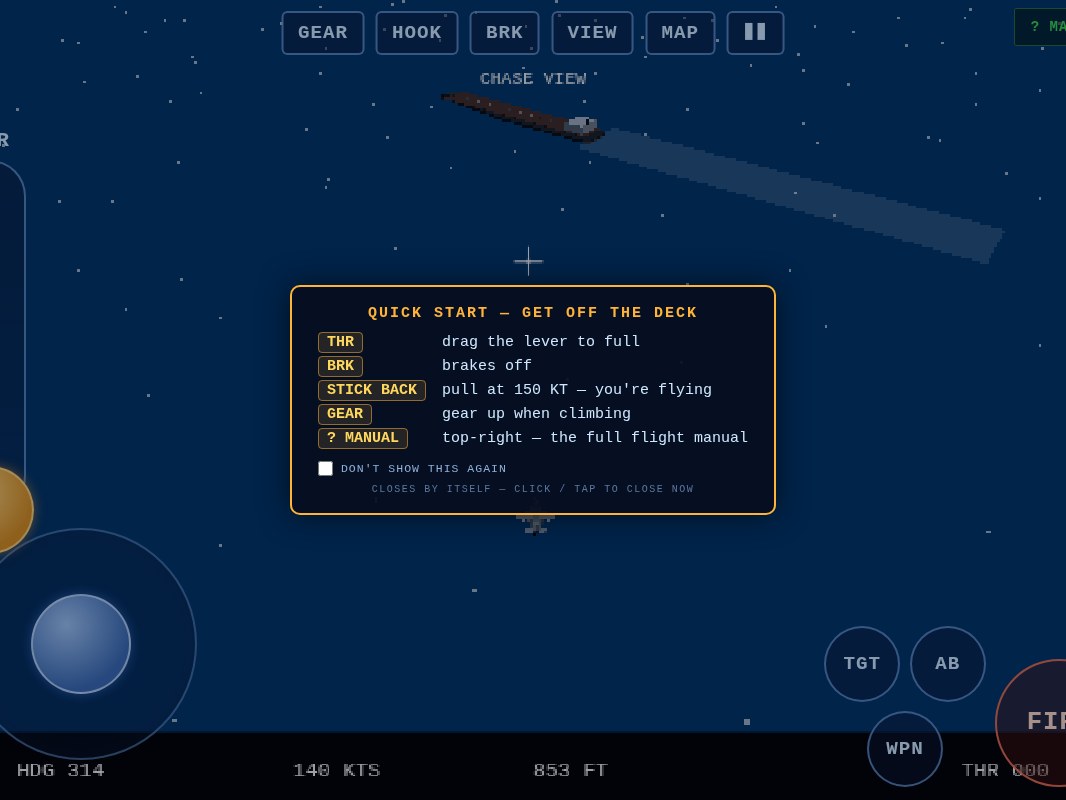
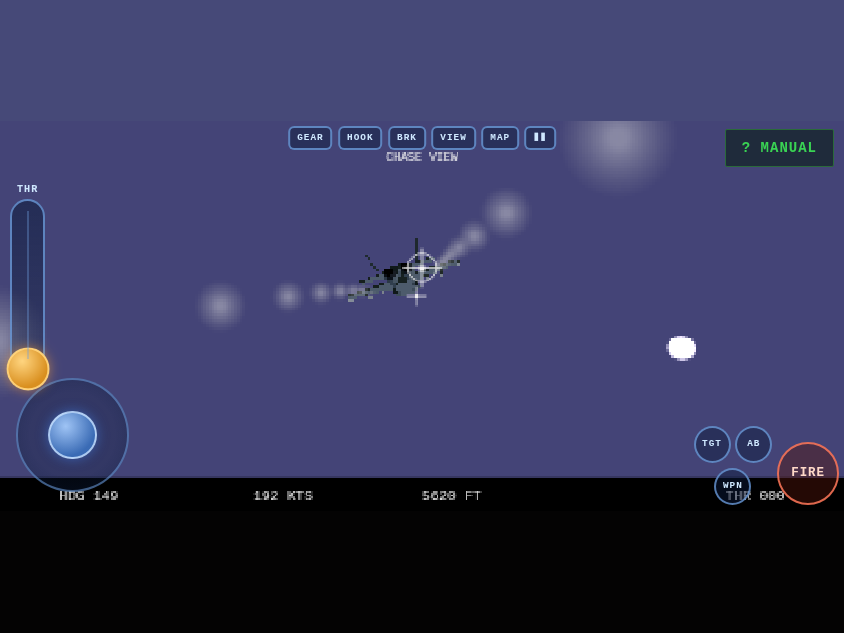
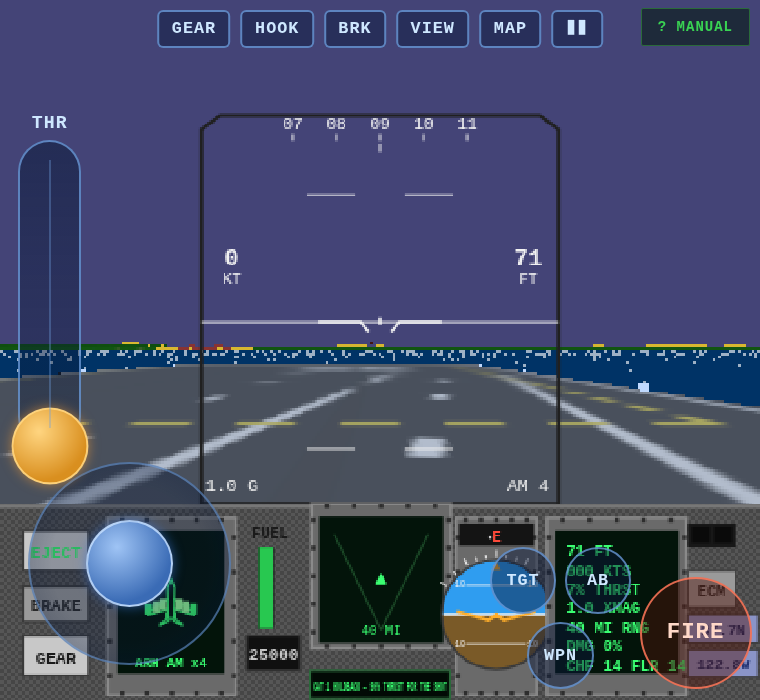
Open hornetbay.com on a phone or tablet and the deck crew rolls out a touch cockpit: a left-thumb stick for pitch and roll (drag down = pull back, like the mouse stick), a big FIRE button under the right thumb that holds a gun burst or pickle one missile per tap, hold-to-burn AB, WPN and TGT for weapons and radar targets, THR +/− on the left edge, and GEAR / HOOK / BRK / VIEW / MAP / pause along the top — everything a carrier trap needs. The canvas-rendered intro states get their own tappable bars: SCRAMBLE on the briefing, airplane and day/night/weather picks on plane select, and the five free-flight start spots on the map. The title screen compacts itself on short landscape windows, every menu button gets a bigger tap target, the gallery rotates with a finger drag, audio unlocks on the first touch, and portrait pilots get a gentle rotate-to-landscape nag. Detection is automatic (coarse pointer); desktop pilots can preview the deck with ?touch=1.
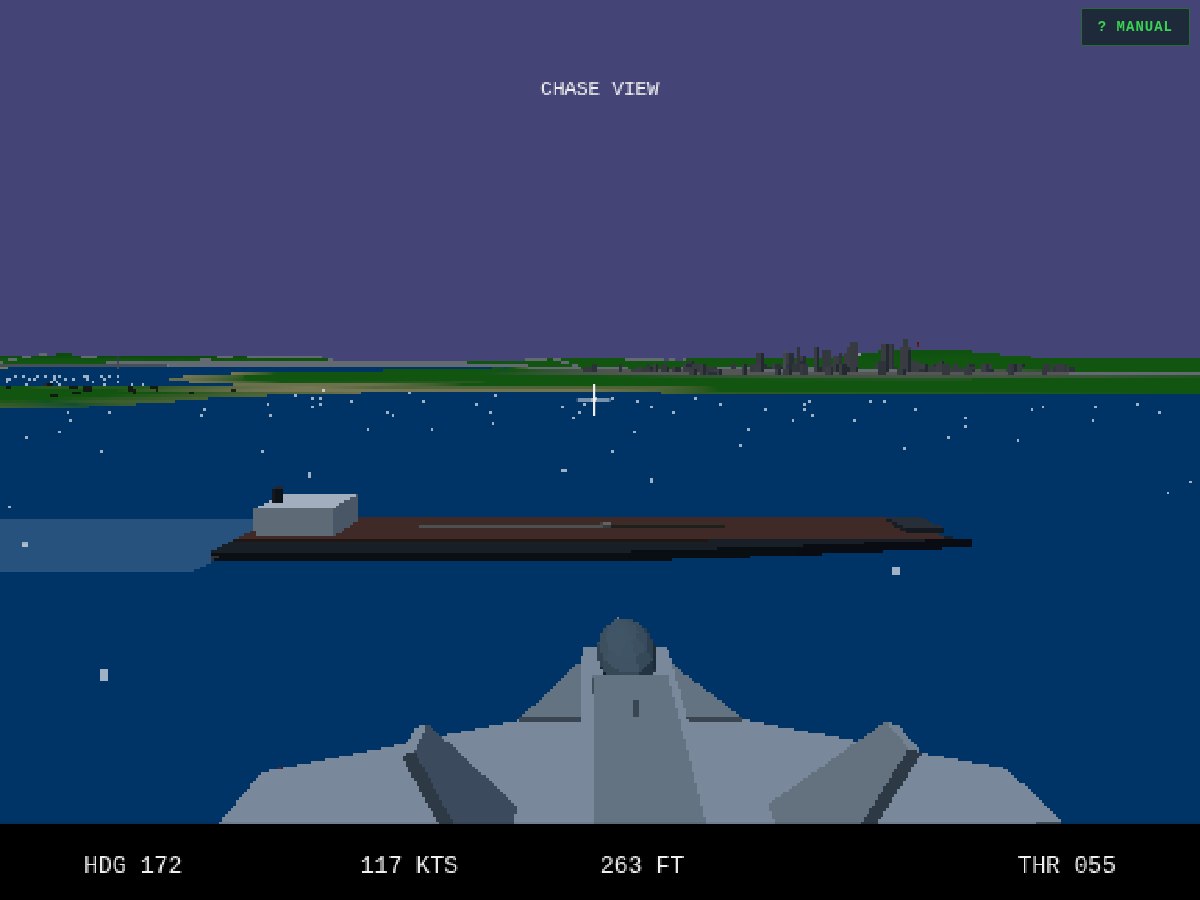
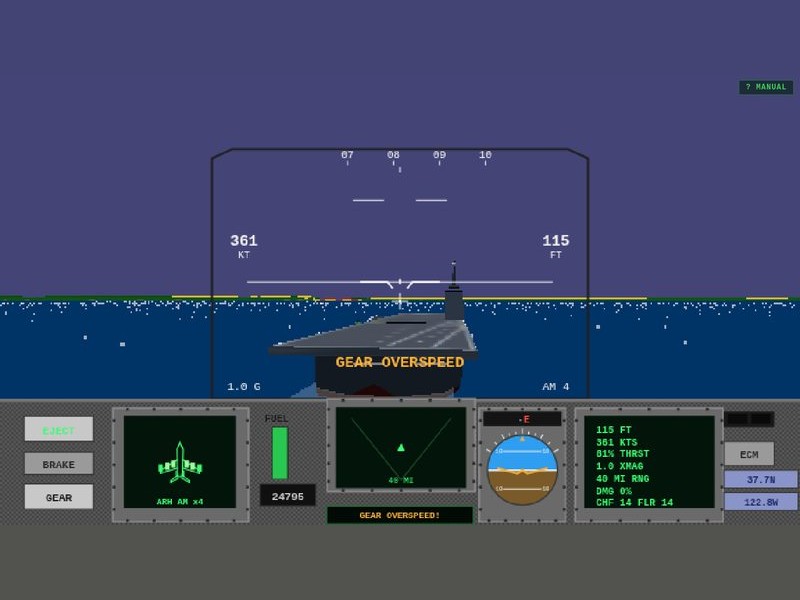
The carrier finally looks like a carrier. The landing strip now runs onto a proper port-side sponson — every full-deck carrier angles its landing deck to the left — with edge stripes and lights to match, and the deck footprint for traps extends over it. Bolted to the port edge abeam the wires is a functional IFLOLS: an amber ball rides five cells against the green datum row to show where you sit on the 3.5° glideslope, and red wave-off lamps flash if you come aboard dirty (gear or hook up) or badly off slope. Two smaller tells: at 100% thrust with the burner lit, the cockpit thrust readout gets the original's bright yellow underline, and the aircraft position lights, strobes and beacons are shrunk to realistic size. (This journal itself is now titled NEW FEATURES & BUG FIXES.)
A new R — TOGGLE CLEAR or RAIN WEATHER row on the main menu (and on the plane-select map). Rain streaks slant past the canopy with your speed, the sky closes over in overcast gray, and visibility drops. Missions are still authored clear unless you ask for weather.
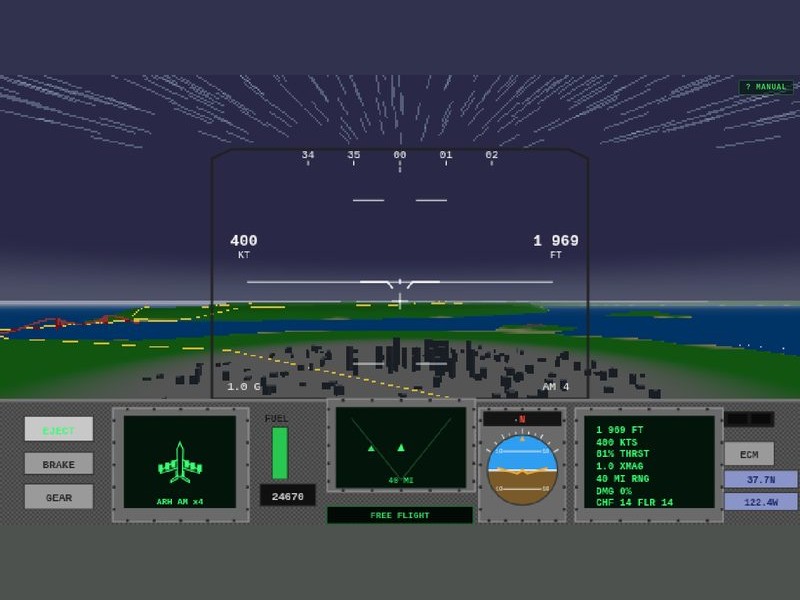
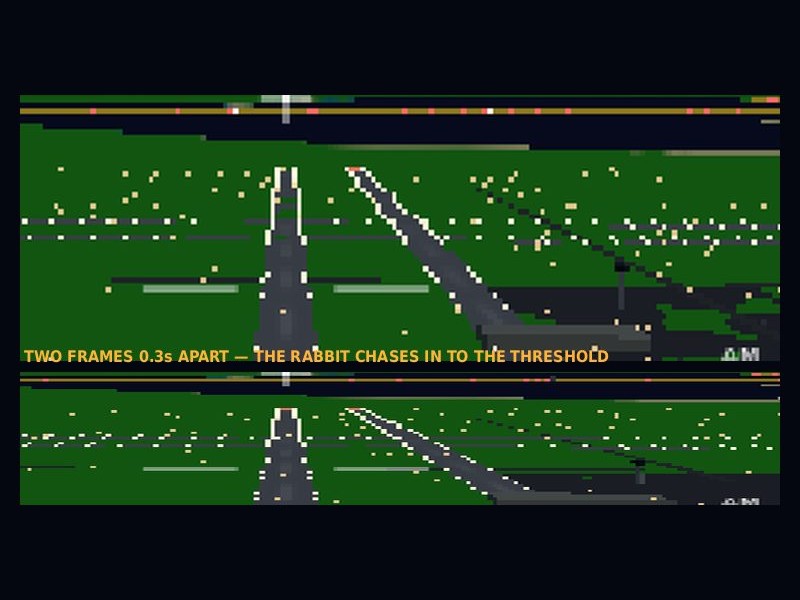
Every runway end now has the real approach-lighting choreography: a sequenced flasher chain — the rabbit — chasing in toward the threshold twice a second over the last 750 m, a 300 m crossbar, and REIL strobes flashing at the threshold corners. Edge lights stay steady, per the real books.
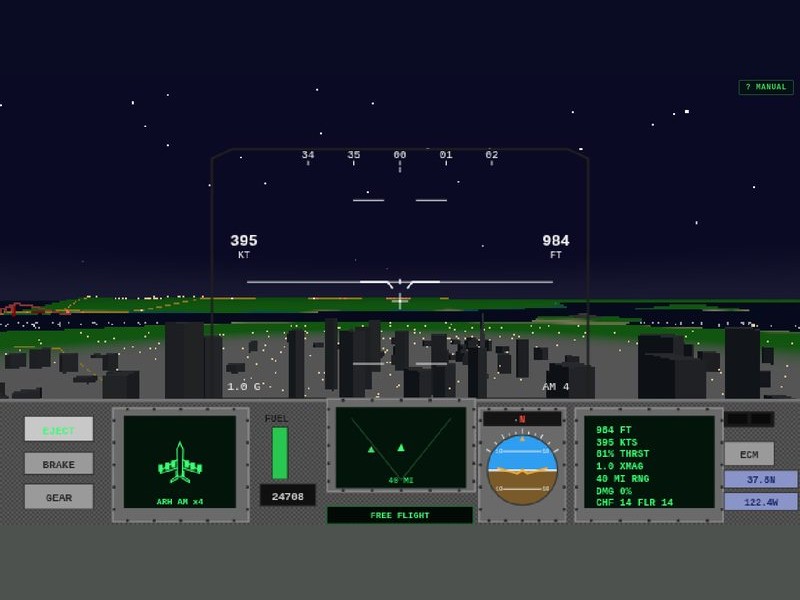
Aircraft now run proper night lighting: steady red/green position lights, the white tail strobe double-flashing, and a red anti-collision beacon. The tall stuff fights back too — red obstruction beacons blink on the downtown towers, the Transamerica tip, and the top of Sutro, warning you how close the skyline really is.
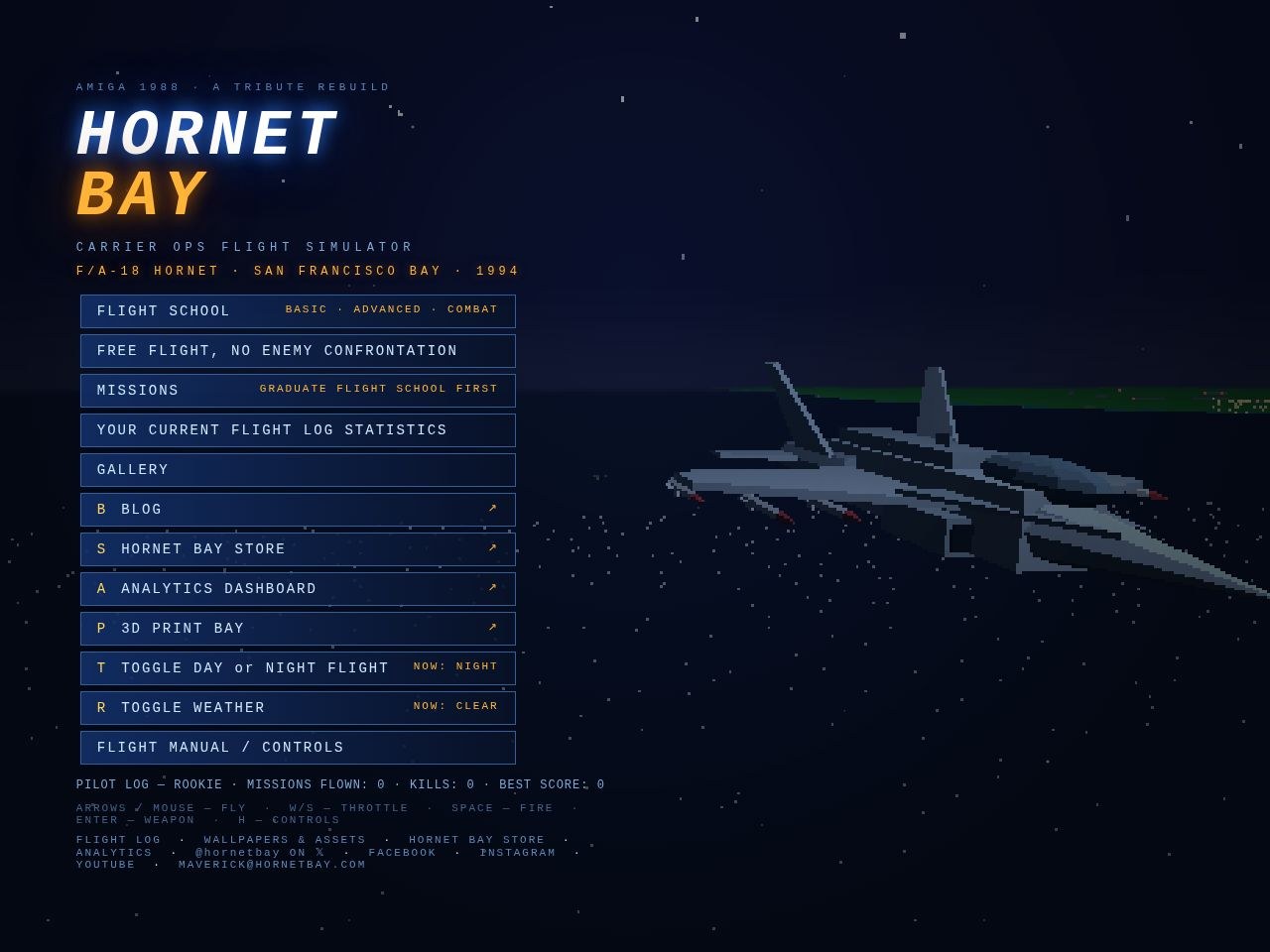
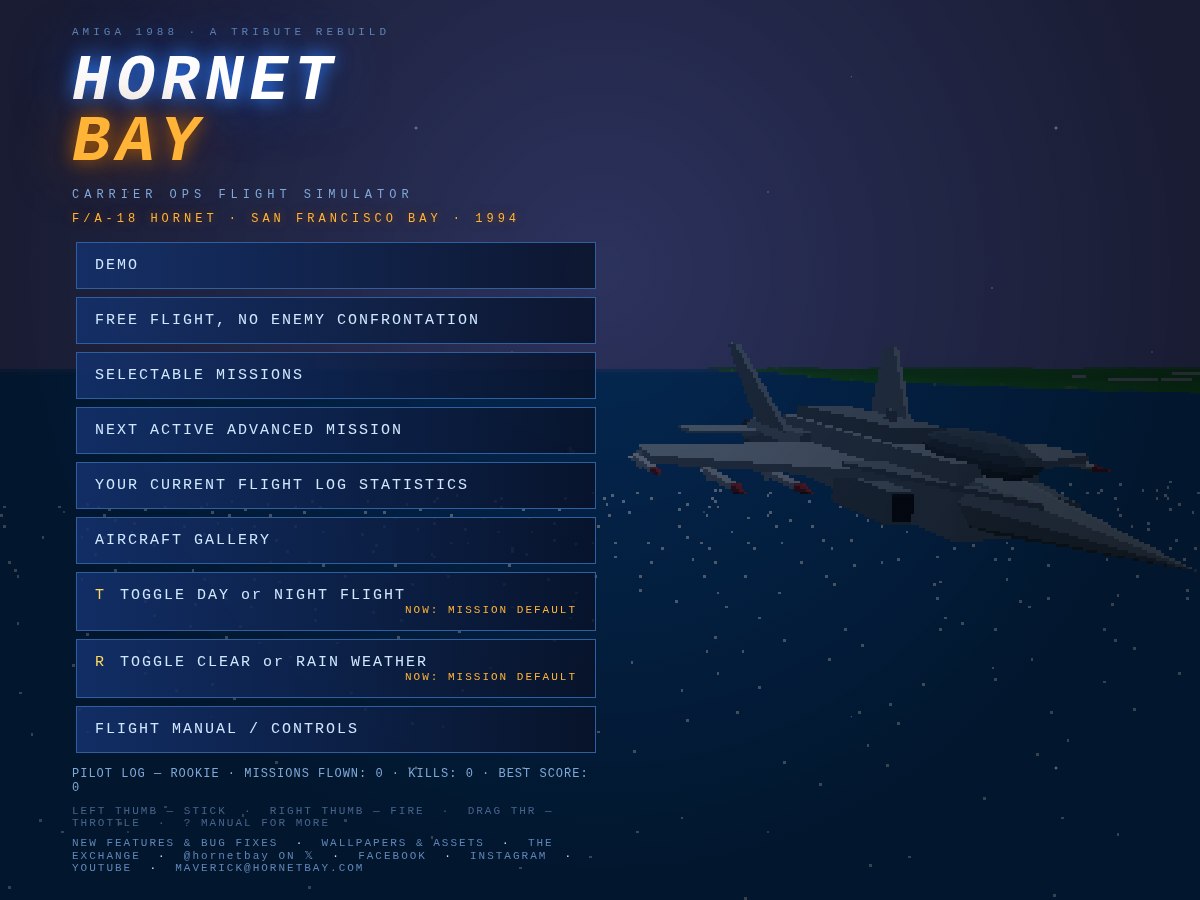
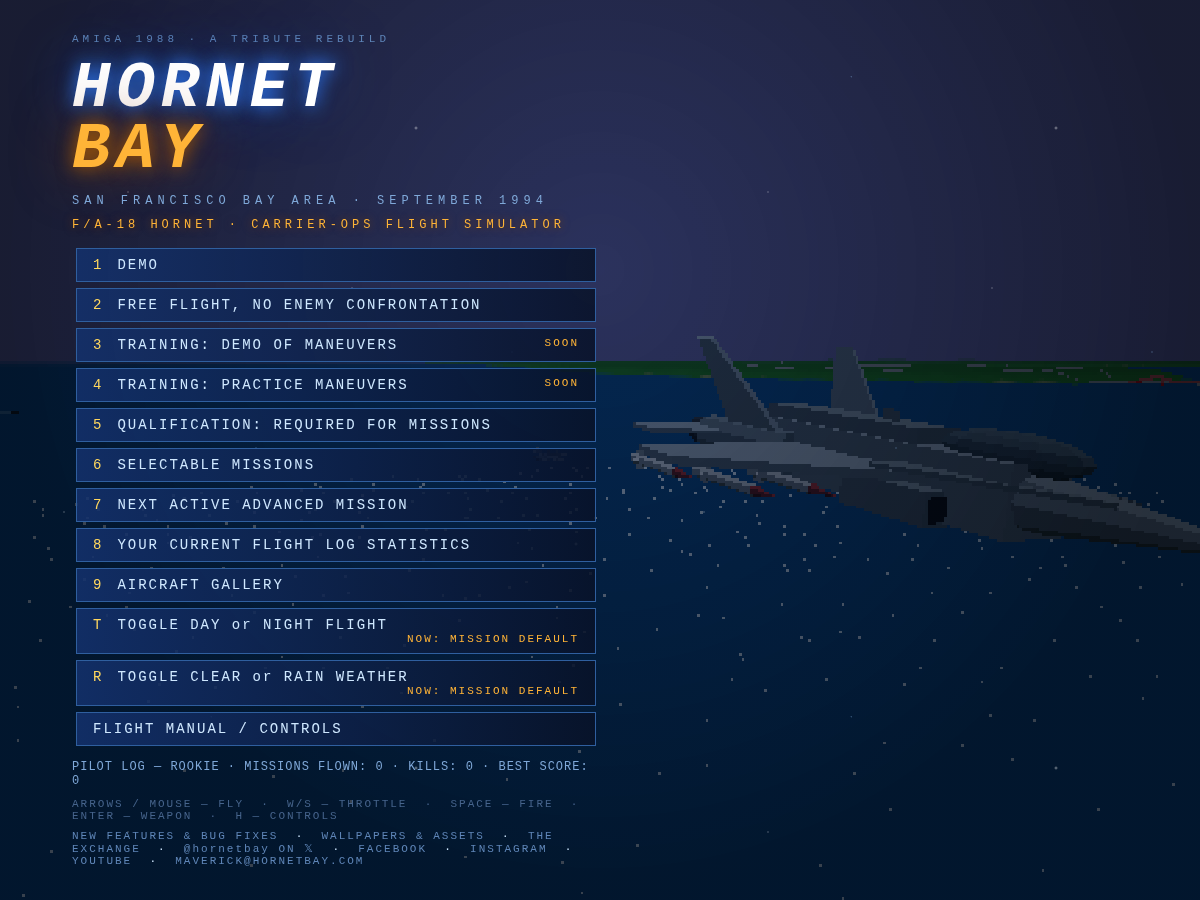
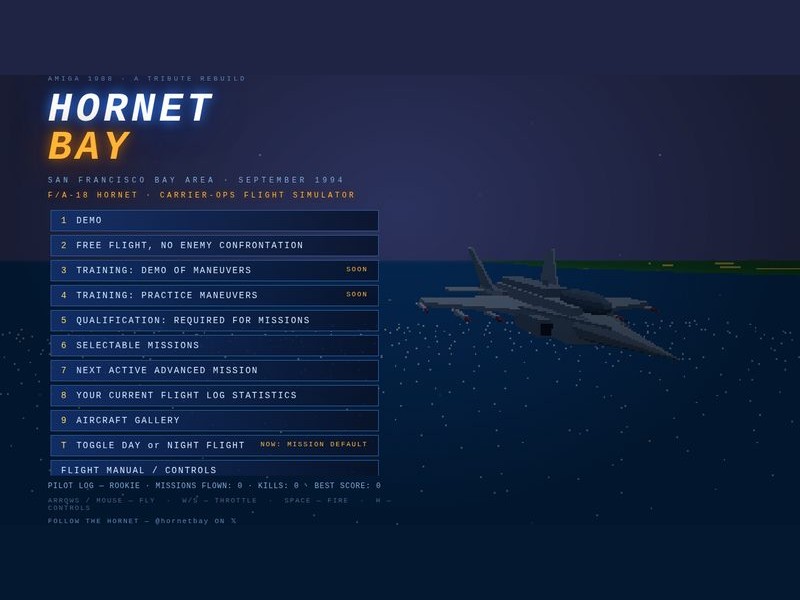
The menu never said “flight simulator” loudly enough — so now the star of the show greets you the moment hornetbay.com loads: an F/A-18 slowly turning on the right of the screen (spotlit after dark), while the menu slides over to the left. No doubt what this game is about, or who the star is.
Time of day is now a first-class citizen: TOGGLE DAY or NIGHT FLIGHT sits right on the main menu, and flipping it re-lights the scenery behind the menu live. Night ops over the glittering city are worth the trip on their own.
Every machine in the game gets its pedestal: arrow keys rotate, +/− zooms, number keys switch airframes, and each gets its name plate and a line of flavor text.
The Bay Area highways carry live traffic now — cars glued to the asphalt in their lanes (no more driving on the grass), over roads painted with center dividing lines and lane dashes, draped over the terrain including the bridge decks.
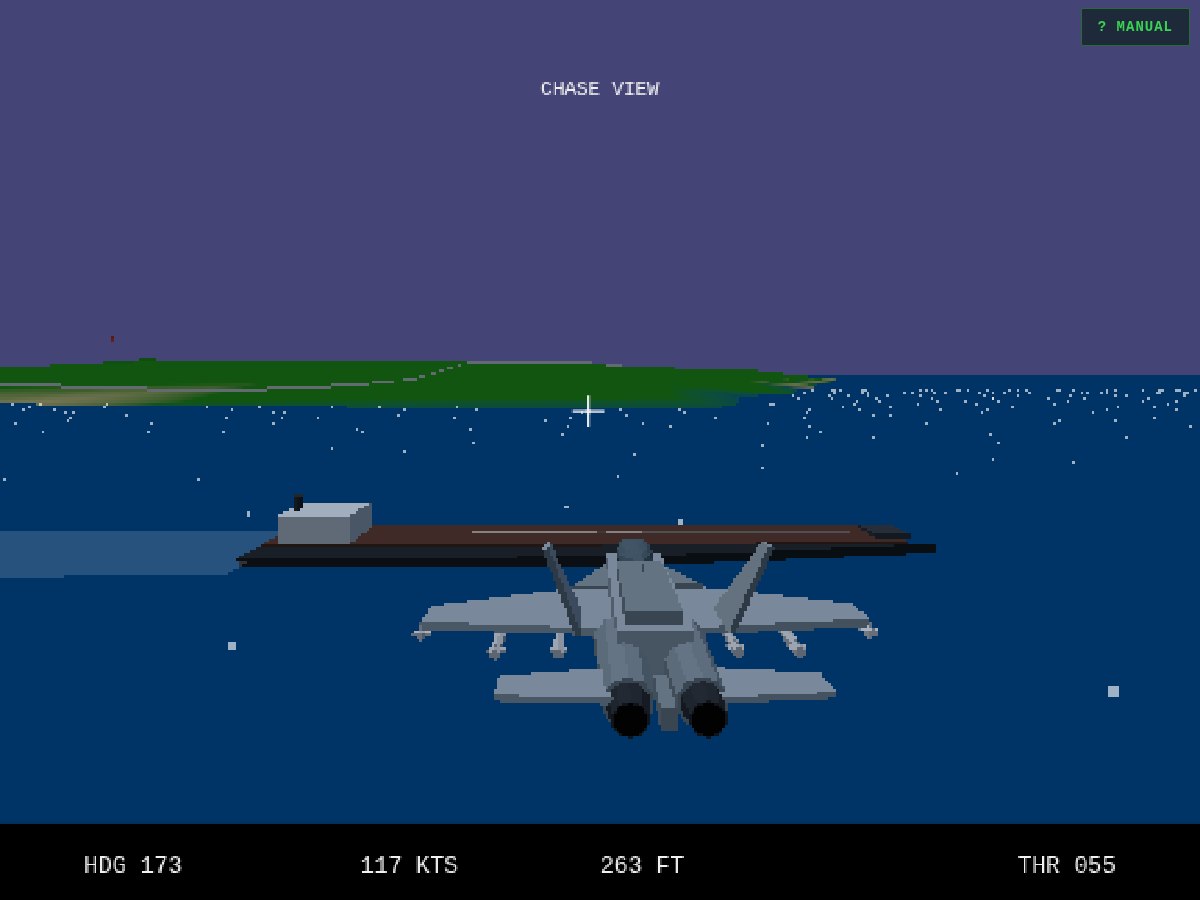
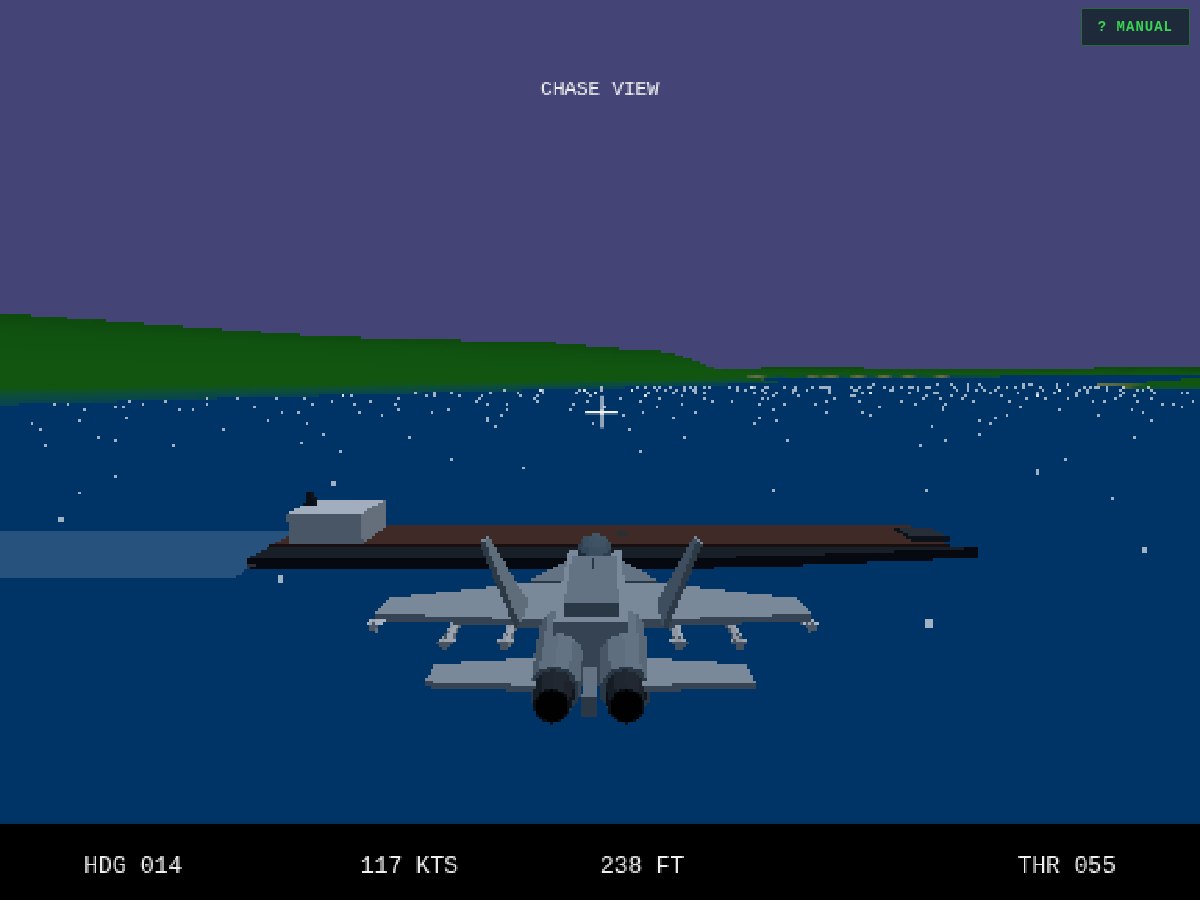
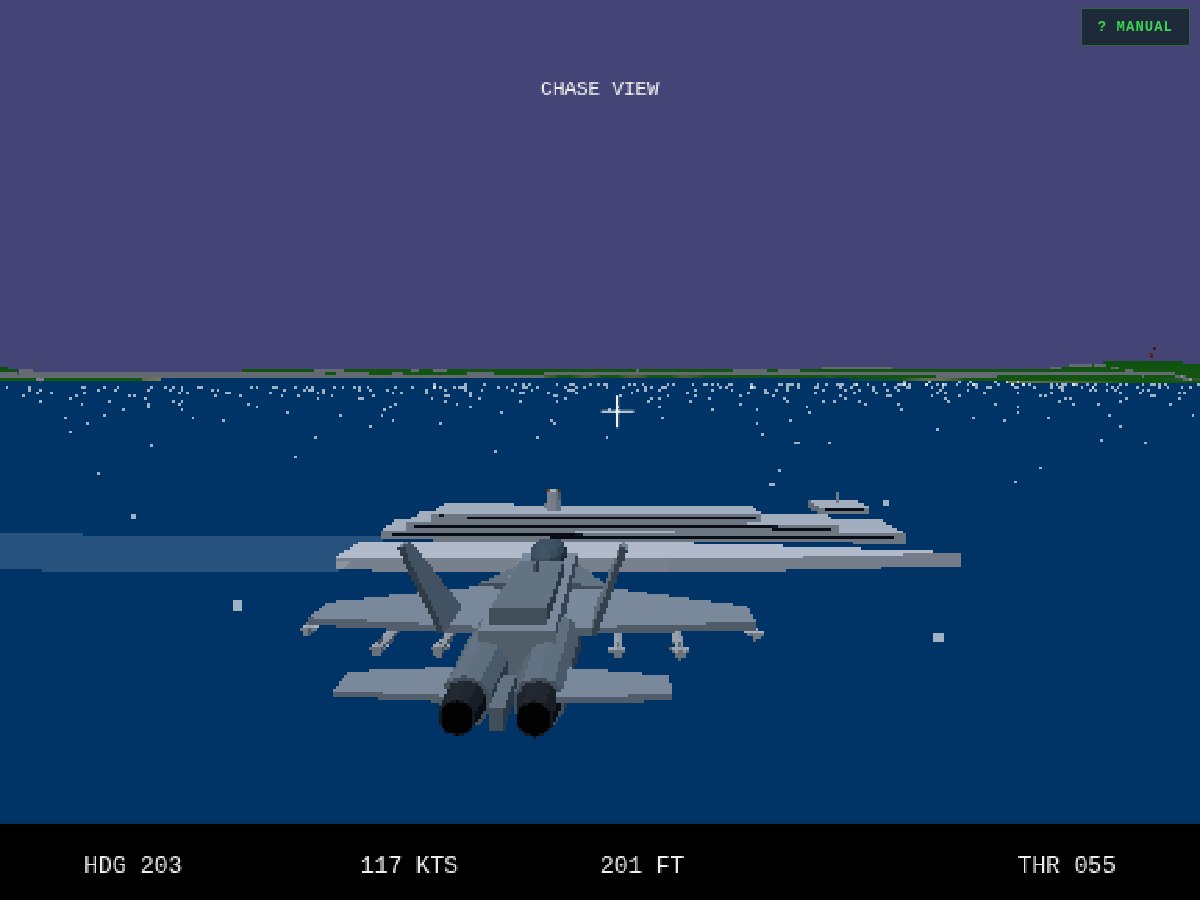
Carrier departures run off the C-13 catapult now: taxi to the shuttle, tension, holdback release, and the stroke flings you off the bow. The deck crew parks the other jets clear of the catapult track.