Twenty-six years. Nine deployments aboard the USS Enterprise — the Med, the Gulf, the Indian Ocean, the Western Pacific. Four thousand nine hundred hours in the Hornet and 1,140 arrested landings, better than three hundred of them at night. Commander Ray “Rex” Barlow was shot at over four oceans and, on one black night over Iraq in ’91, shot back: when a SAM found his wingman’s jet on the way in to the target, Barlow rolled back into the envelope, put the site down hard, then escorted the crippled Hornet two hundred miles home and talked him aboard the boat to a one-engine trap. For that night he wears the Navy Cross. He never once brought it up. The citation did all the talking.
This morning the Enterprise gave it back to him. Borrowing a long-standing tradition from the French Navy’s Charles de Gaulle, twelve of his squadronmates formed a guard of honor along cat one in flight suits and helmets, and as Rex’s Hornet went into tension the ship’s CO stepped out beside the track and raised a saber. The burner lit. The saber fell. The guard snapped to a salute, and thirty-four thousand pounds of Hornet went down the stroke and off the bow — last catapult, last climb-out, the whole deck watching. Fair winds and following seas, Commander. The pattern is yours.
The full ceremony lives in the sim now as a standalone scene:
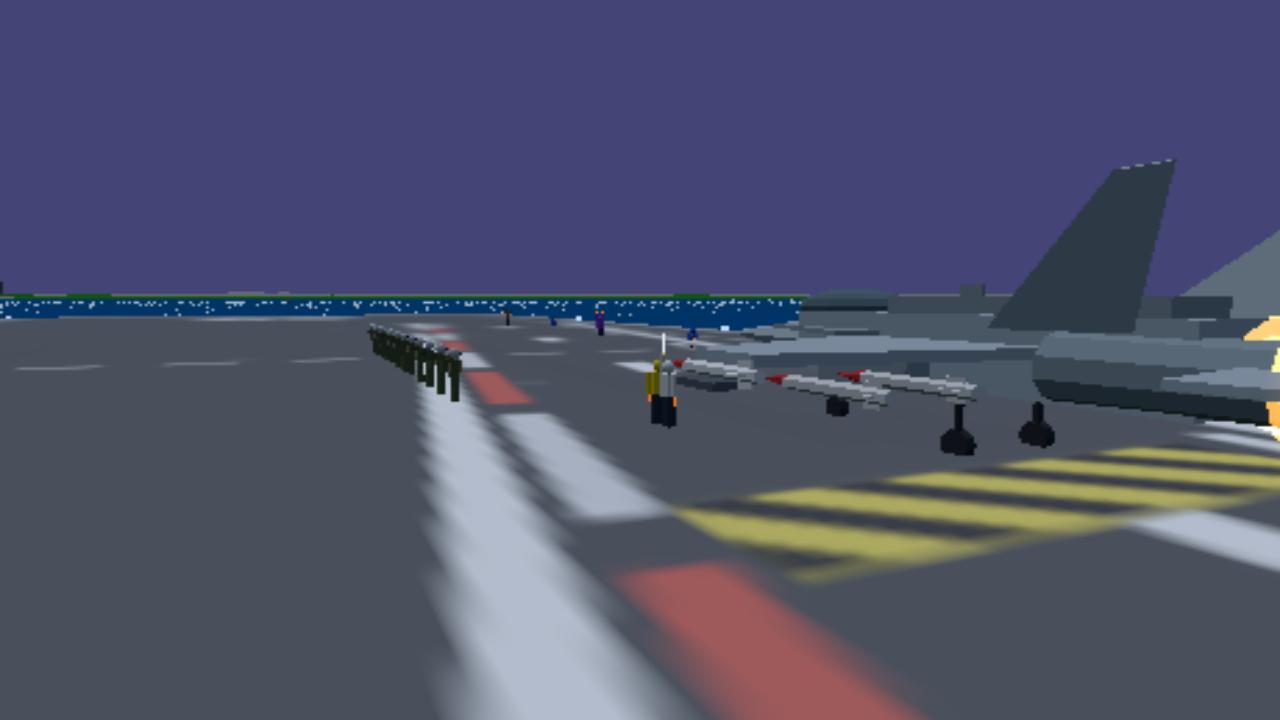
Watch it here:/?scene=final-launch&auto=demo — eighteen seconds, three camera beats: a wide establishing shot of the Enterprise pushing through the swell, a dolly down the flight deck past the saluting guard, then a chase cam orbiting right through the stroke before settling ahead of the jet to catch the climb with the carrier square behind.
On film: the same flight, cut for the YouTube channel with the anthem on the bed.
Under the hood: new pilot figures in flight suits, helmets and visors with a keyed salute; a saber-armed commander whose raised blade is the launch signal; steam curling off the catapult track while the jet holds in tension; the regular deck crew holding their stations, wands high, to wave the old man off.
Some scenes we build for the sim. This one we built for Rex.
Housekeeping day at the bay — four jobs, one push:
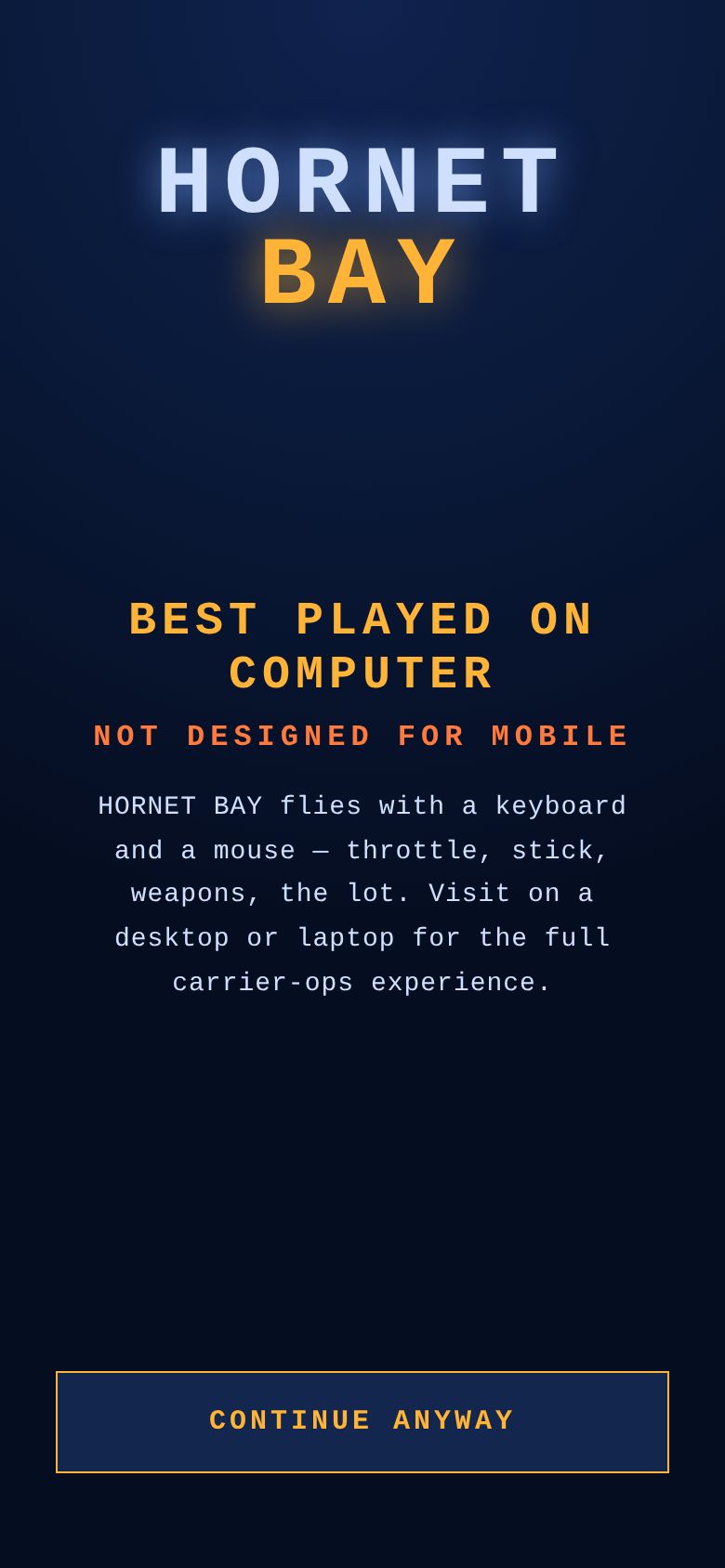
The mobile notice learned portrait. Phones in portrait used to meet the BEST PLAYED ON COMPUTER warning spun ninety degrees with the rest of the page. Now the warning alone counter-rotates and serves upright — the HORNET BAY wordmark glowing up top, the message centred, CONTINUE ANYWAY full-width down where your thumb actually is. Landscape phones keep the compact card.
The anthem player wears its full title. The top-right pill now reads HORNET BAY ANTHEM - LIVING ON THE EDGE (collapsing to a bare ♪ on narrow screens, so it never crowds the menu).
The airliner is stood down. The commercial departure out of SFO is pulled from the attract reel — twenty-three scenes in the loop now, all naval, all the time.
The reel went vertical. Every scene clip got a 1080×1920 portrait cut for YouTube Shorts, plus titles, descriptions and tags for the lot — the channel’s upload sheet is written.
The reel just grew to twenty scenes, and the three new ones are the heaviest metal in the loop:
The battle group throws steel. Night on the line — SM-2s ripple off the escorts’ decks under their own smoke pillars while every Phalanx on the Gettysburg hoses the dark in long, continuous fountains of tracer. The camera flies one unbroken 360° around the flagship the whole time, zooming as it wheels: hulls sliding by below, garden-hose arcs of fire crossing the sky above.
Torpedoes under silk. The P-3 and the S-3 run the datum together now — and this time they don’t just listen. Each drops a Mark 46 with a retarder chute that cracks open the instant the weapon leaves the rack, brakes it to a soft splashdown, then collapses on the sea while the fish runs hot toward the contact. Two wakes converge on the prowler and the water comes up.
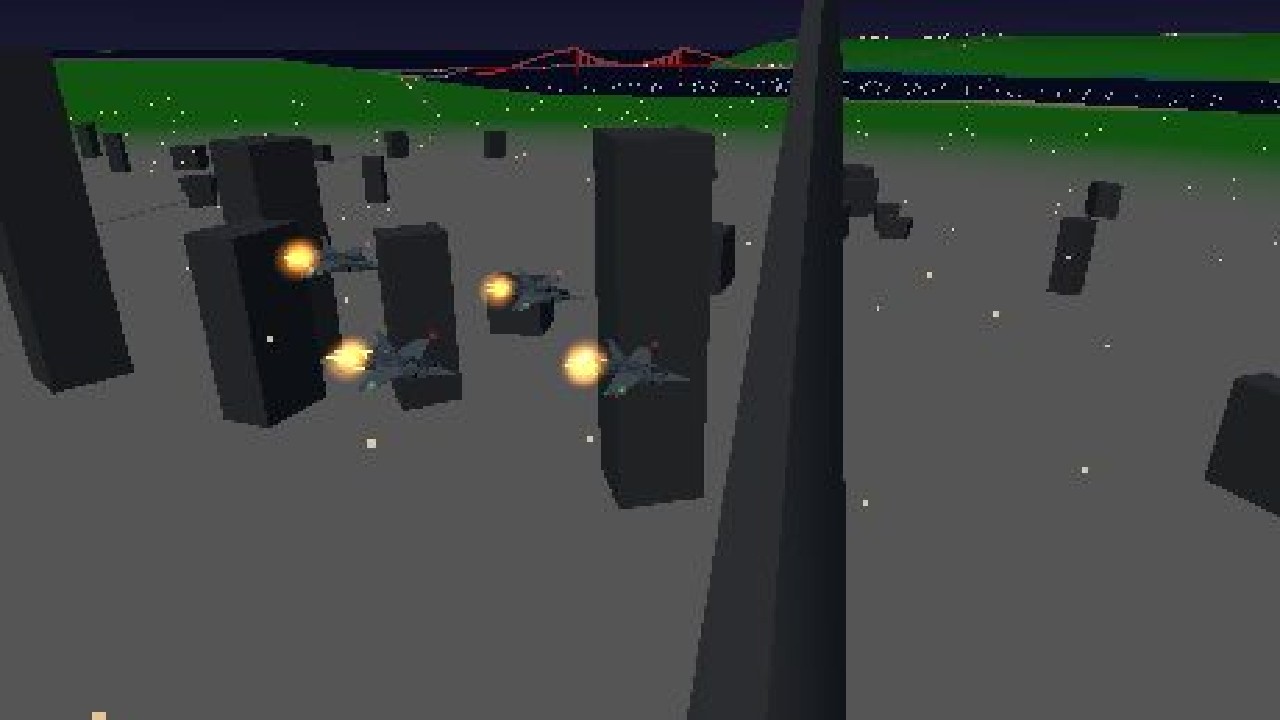
The downtown burner run. Four Hornets in a tight diamond, burners lit, 300 knots across the rooftops at night — fast cuts between a swinging arc off the formation, a rooftop that gets buzzed by twenty feet, the Transamerica perch as they carve past below the tip, and the whole lit skyline receding behind four orange glows.
Fresh clips for the socials are in the works… actually, they’re done — all twenty scenes, cut and exported. Refresh the homepage and watch the group defend itself.
The attract loop behind the menu got its director’s cut. Same seventeen scenes, same bay — but the pulse is faster: the full lap now runs about 170 seconds instead of 197, and almost nothing inside a scene sits still:
Four full 360° orbitals. Screwtops’ turning dome, the Seahawk holding its hover off Gettysburg’s quarter, the Harrier riding its pillar over MV BAY TRADER, and a wave-top circle around the prowler’s sail — each one a complete lap of the subject before the cut.
Every camera wears a zoom. Each beat pushes in on a long-lens ramp, so even the quiet shots are going somewhere — the LSO platform tightens on the Tomcat as it crosses the ramp, the deck cam compresses the catapult shot, the 747 rotates into a narrowing frame.
Flybys from both sides. The fleet run opens on the lead’s wing, burners trailing, then cuts to the island as the whole vic comes down the throat overhead. The Golden Gate run cuts from the wing to a boat in the strait — he swells out of the west with the north tower behind him, blasts past overhead — then back to the jet for the pull over the towers.
The Hog turns and bears down on the lens; the missile cam kills, then orbits the falling wreck; the jink scene’s R-73 now arrives while the flares are still burning — and gets fooled on camera.
Fast cuts, tight action, relentless — as requested. Refresh the homepage and hold on.
The old attract mode was one Hornet touring the bay at a polite 210 knots. Polite is over. The menu now backs onto a five-scene cinematic reel — a director that cuts between carrier ops, a dogfight and a bridge run, day, dusk and night, with a flash cut between takes:
The cat shot, at night, full burner. Steam wisping off the track, deck crew in their jerseys, and the Hornet goes from the hold to 78 metres a second in 128 feet of deck — twin fireballs you can read from the LSO platform. The camera rides the bow ramp for the tension, alongside for the shot, then chases the climb-out.
The furball. A MiG-29 and a Hornet circle over the bay. The bandit shoots first — the Hornet flares it off, pulls the reversal, and its Sidewinder does not miss. Watch the fireball, the smoke bloom and the death spiral into the headlands; the camera rides with the winner until the kill, then with the loser all the way down.
The trap, at dusk, under a full moon. A Tomcat in the groove, hook down, 2.4 kilometres of final at three and a half degrees — into the wires, smoke off the deck, rollout on the angle.
The fleet flyby. An F-14, an F-16 and an A-10 in echelon come down the deck axis at 250 knots and forty metres — burner glows on, sonic crack as they cross the island.
The bridge run. Night again, 290 knots at 46 metres, straight through the Golden Gate gap with the burners lit — then the pull, vertical over the towers, vapor puffing off the wingtips. The camera rides the left wing the whole way.
Every scene owns its sky. The reel sets its own time of day per take (the menu day/night toggle no longer fights it), and the burners got the cinematic treatment — bigger, angrier flames than gameplay, with a glow sprite that reads from any angle, day or night.
And a key to the whole board: MALCOLMSONLY. Press U on the menu and enter the code — every school sortie and every campaign mission signs open from the first boot, no syllabus, no progression. Named for the skipper’s toughest critic. The board reads ALL ACCESS when it takes.
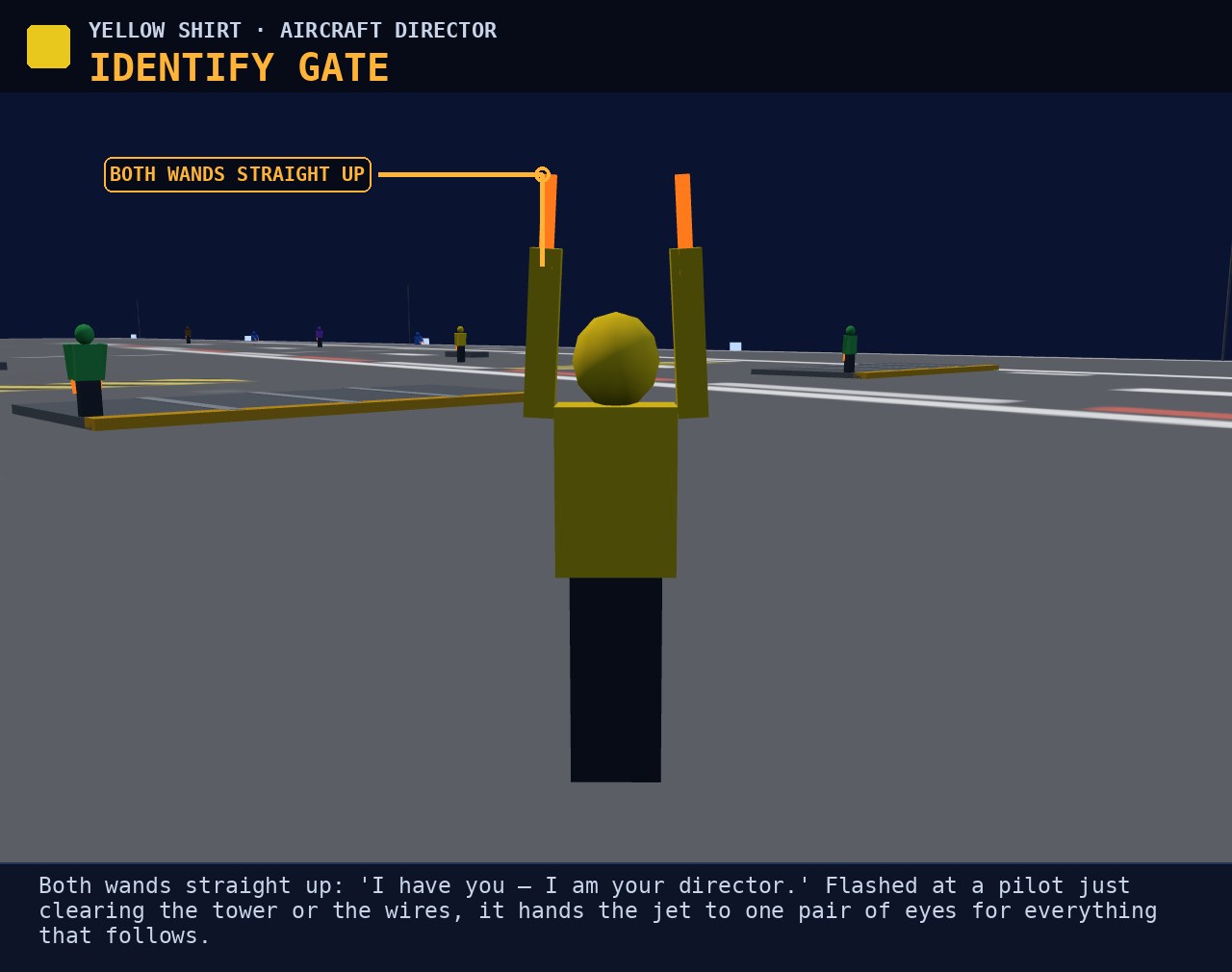
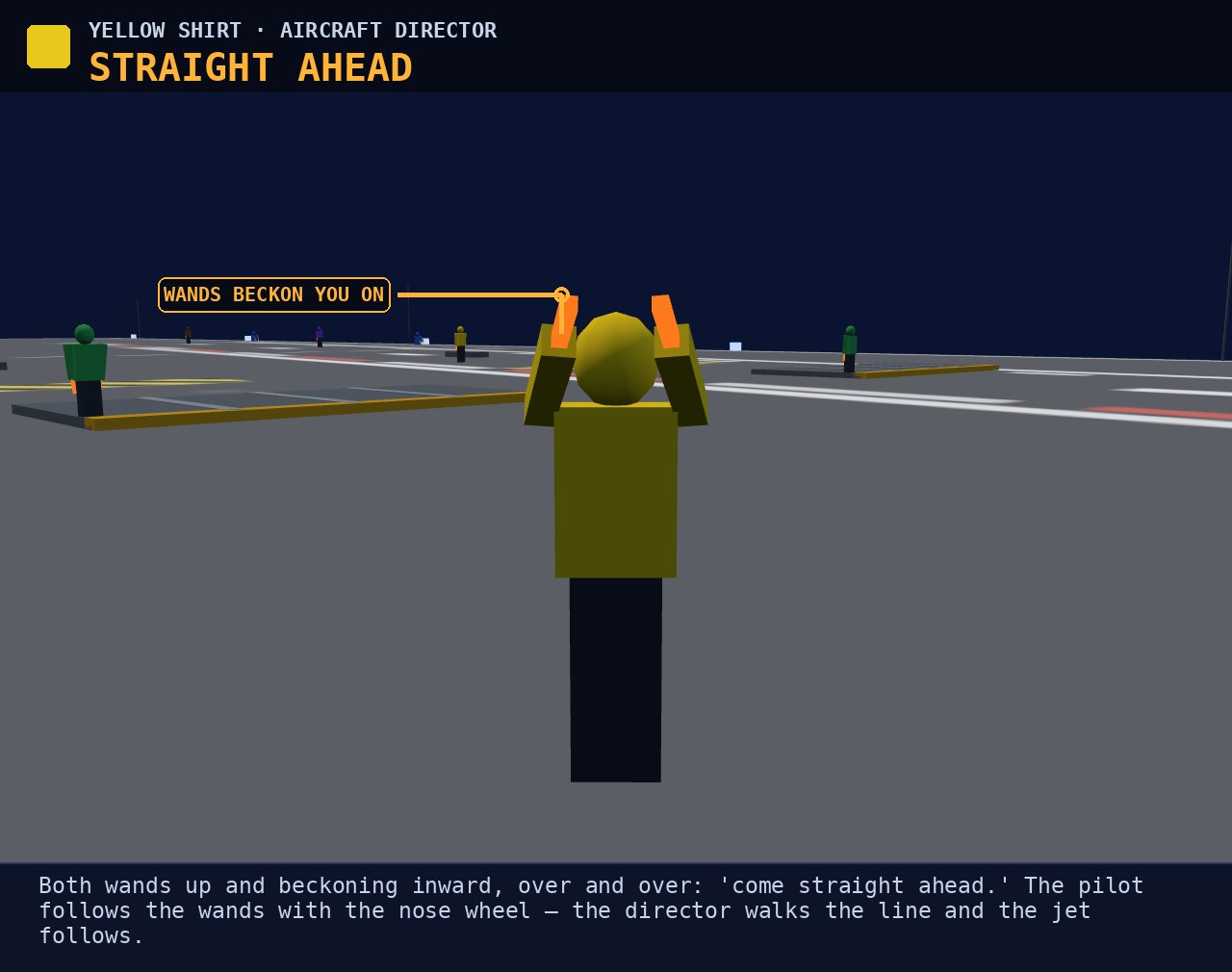
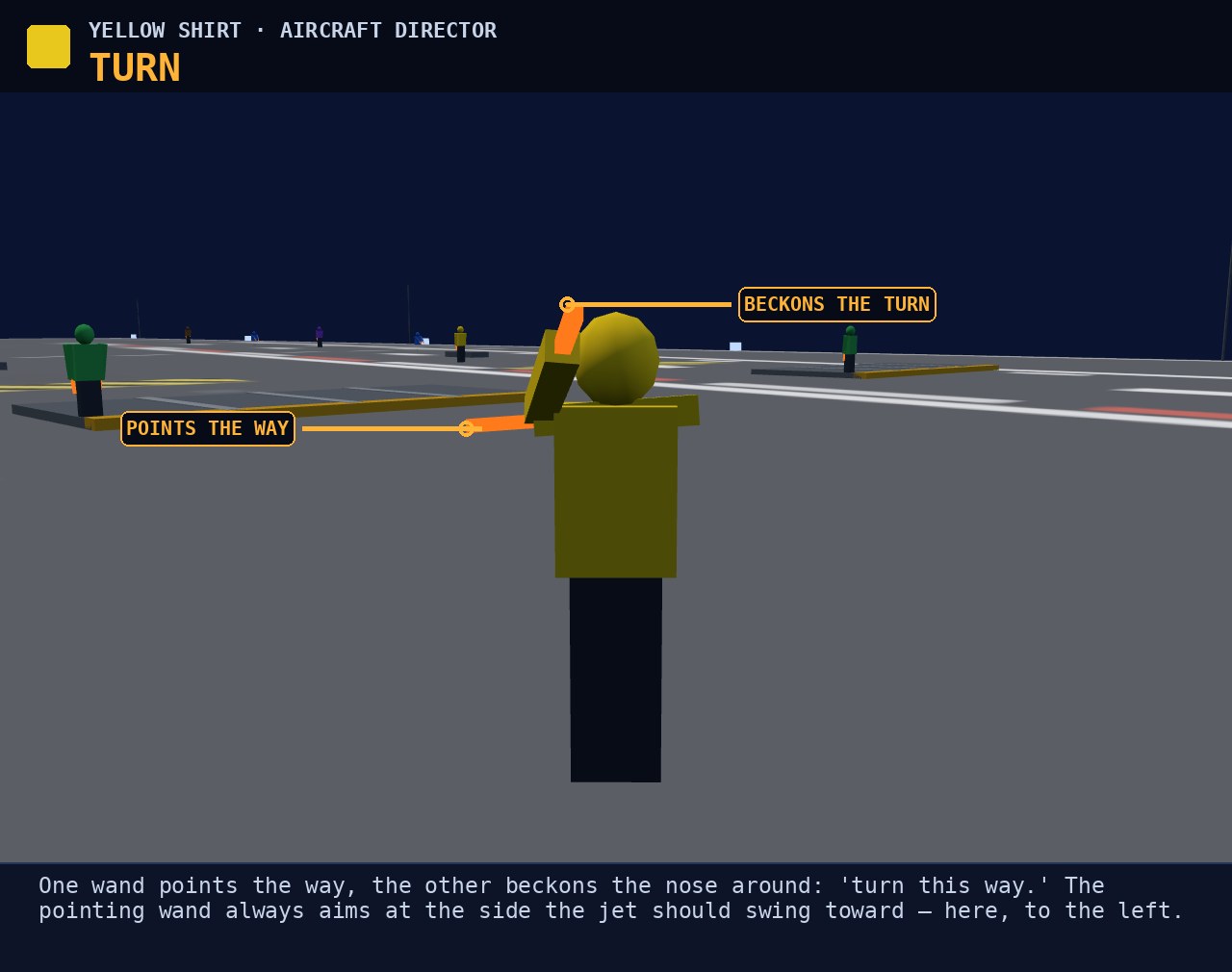
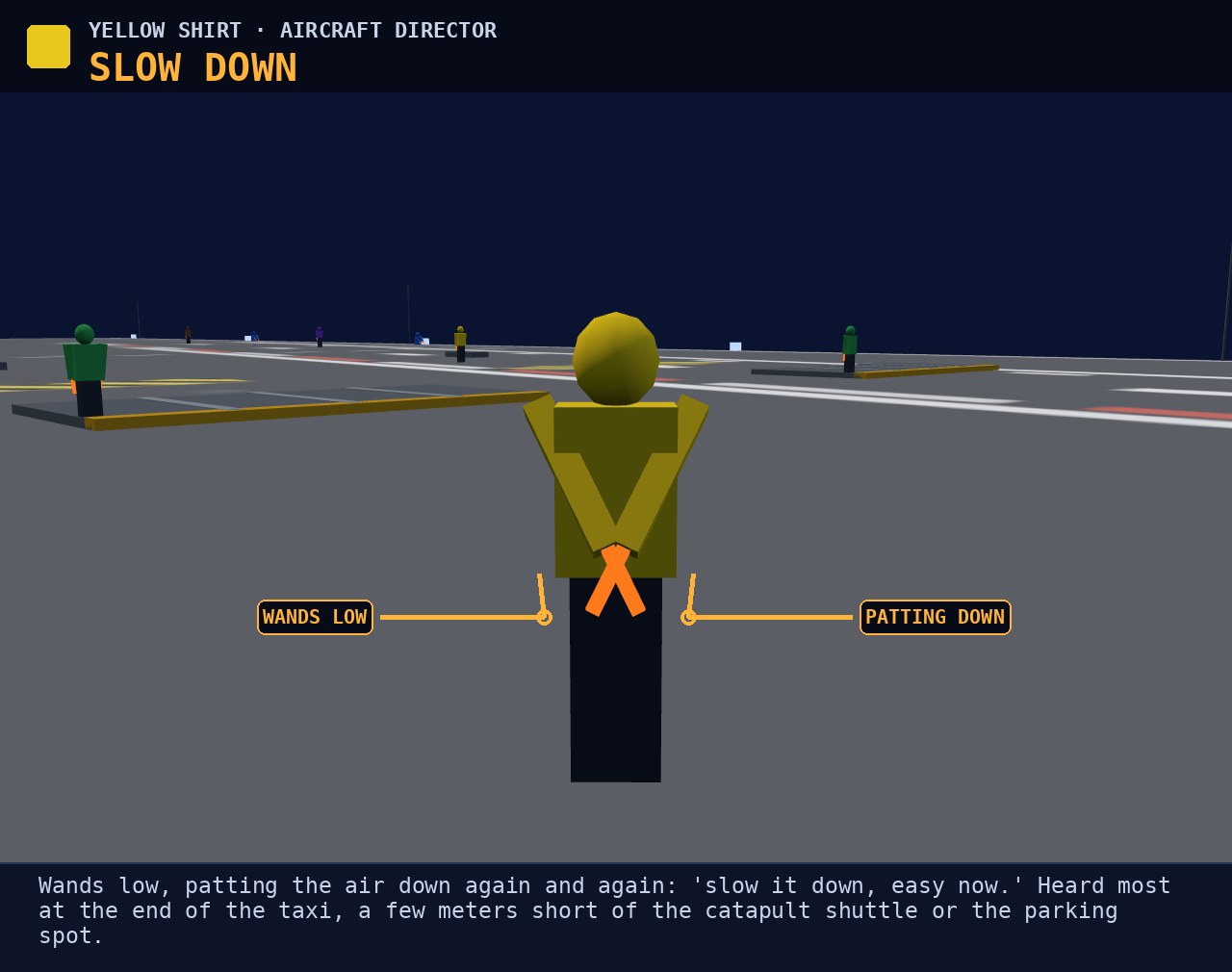
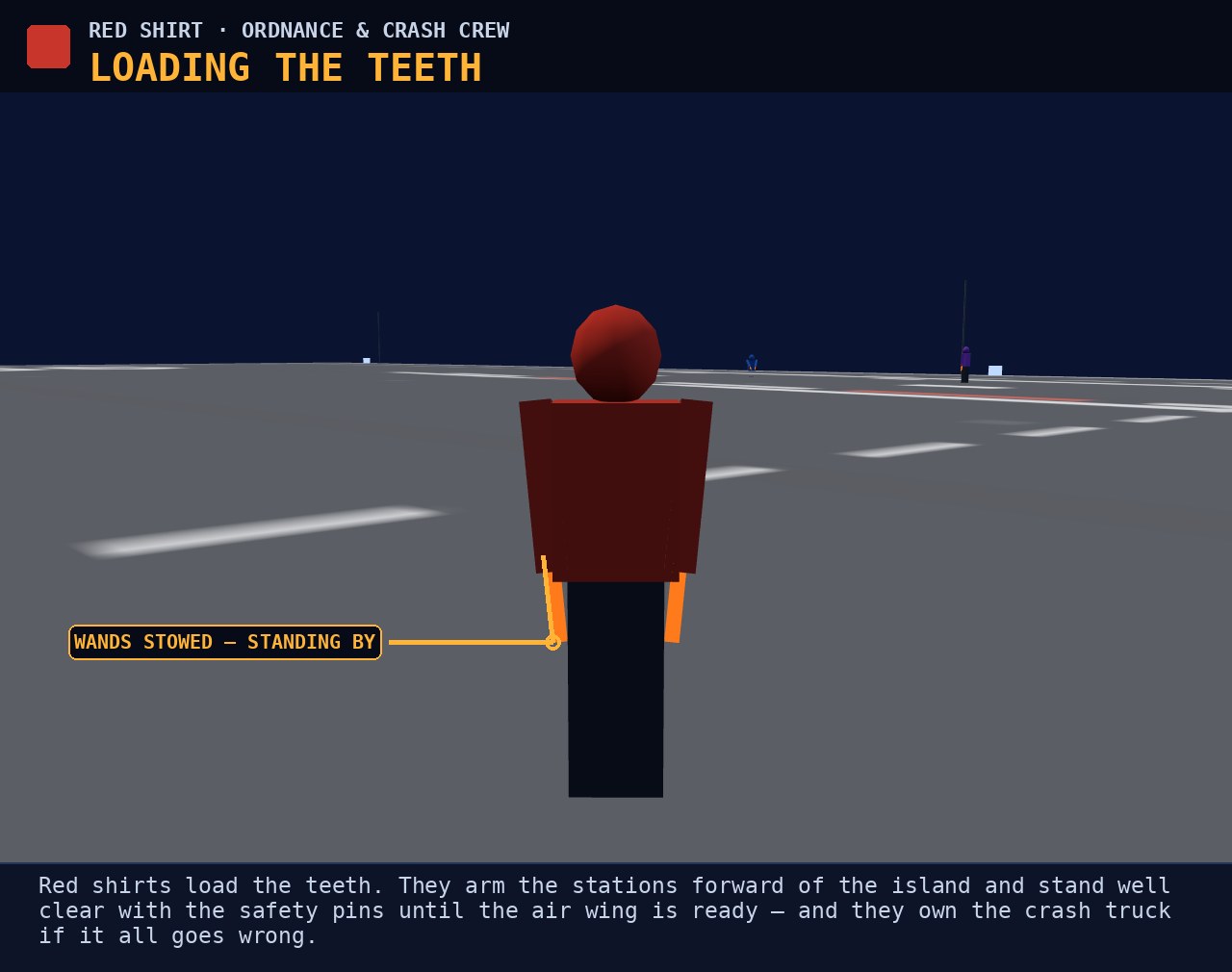
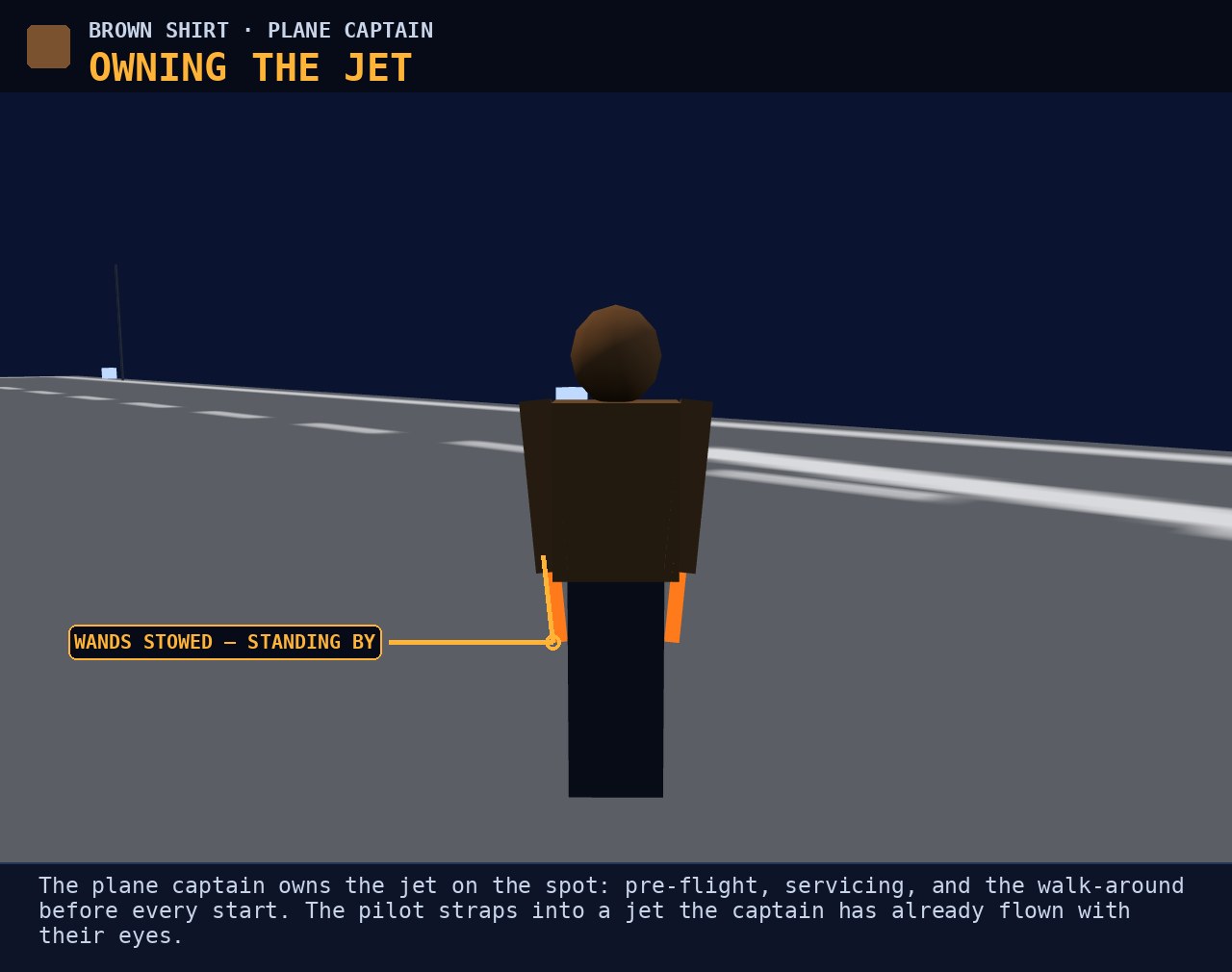
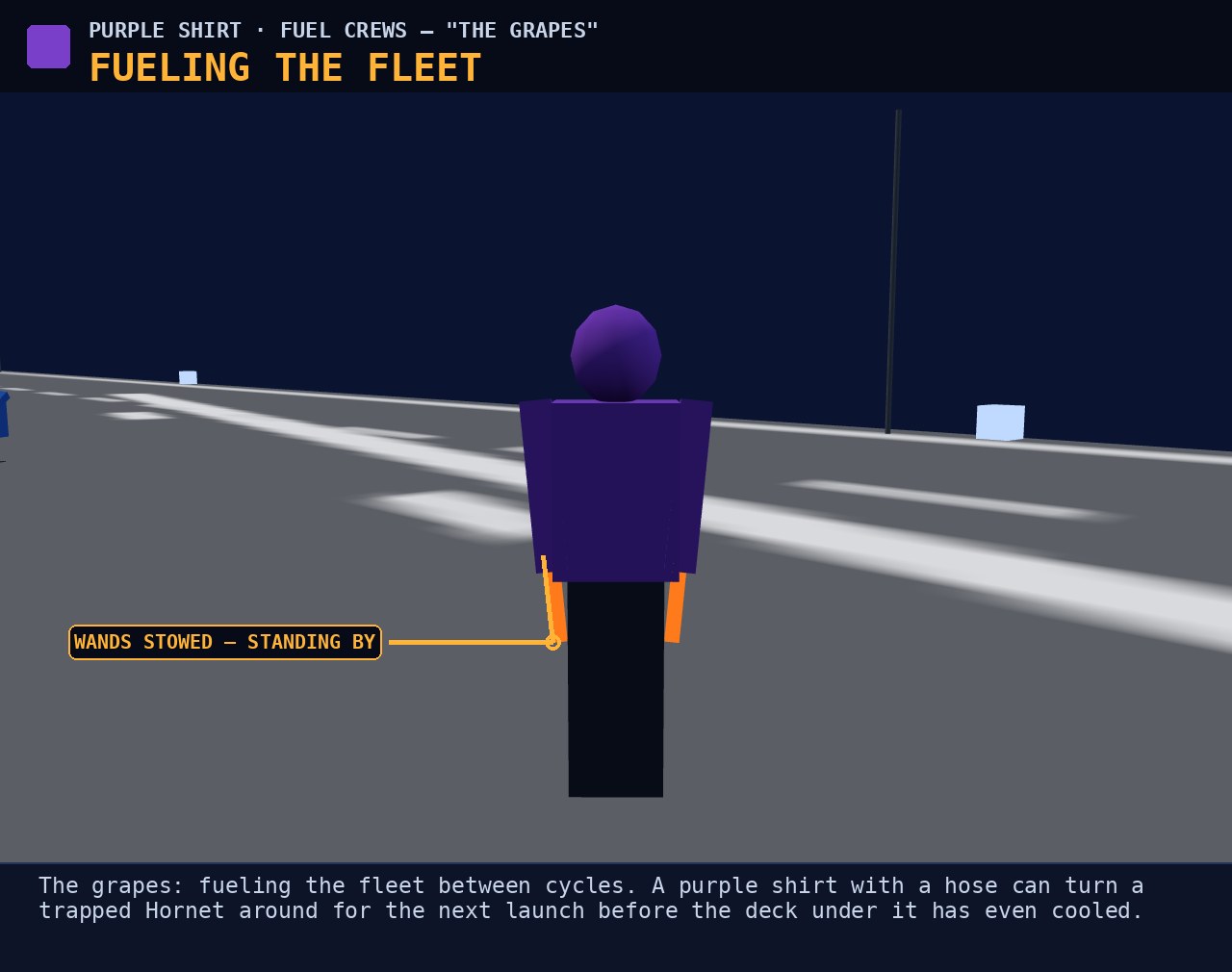
Follow-up to wands up, by popular request: the full vocabulary, frozen frame by frame with the signals arrowed. A carrier deck is too loud for radios and too busy for hesitation, so the Enterprise’s crew talks with wands — and every shirt color is a different trade. Here is the whole rainbow, caught in the act on the roof.
Yellow shirts — the aircraft directors
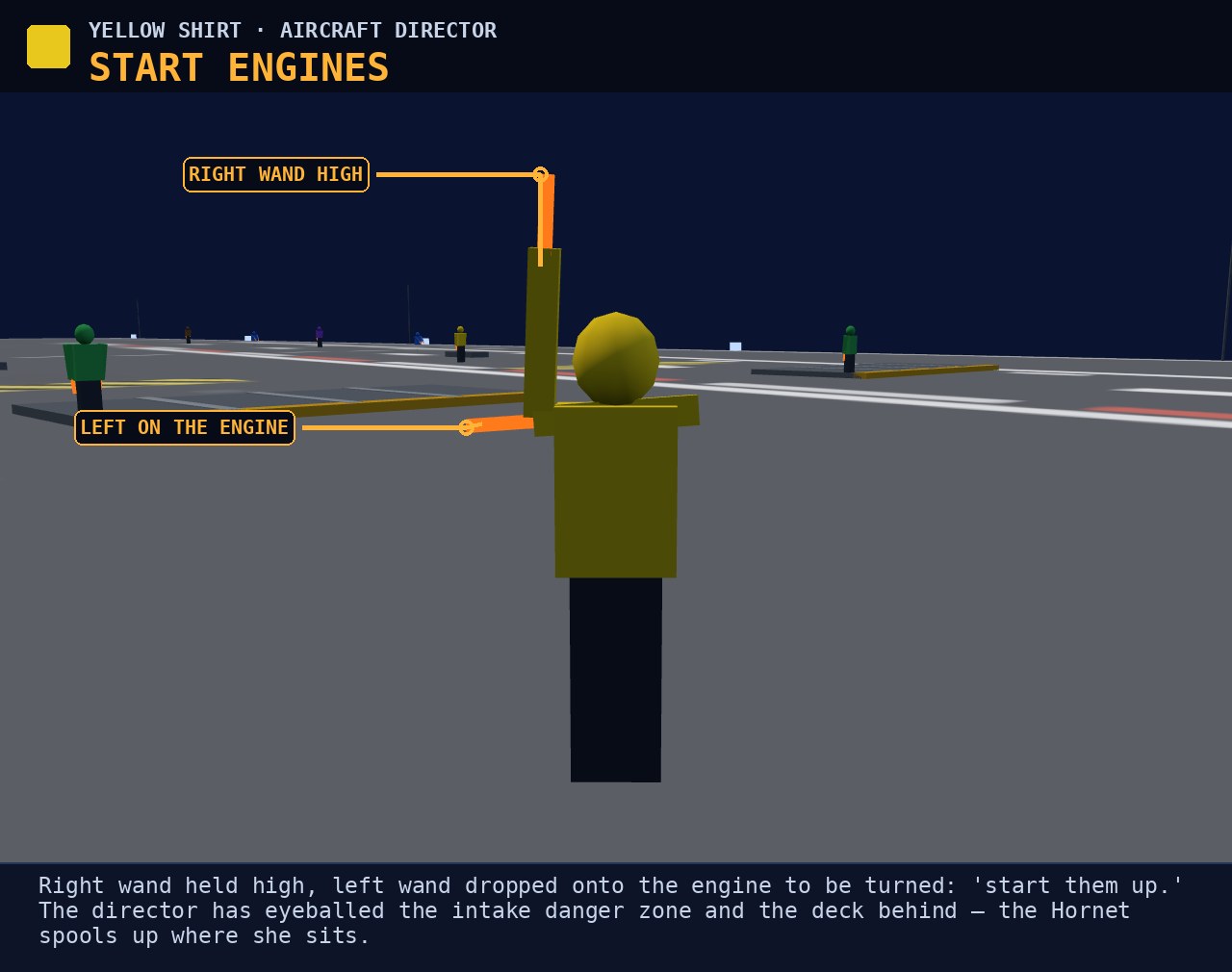
Yellow owns every moving jet. From the moment your engine lights to the moment the chocks go in, a director’s wands are the only traffic law that matters:
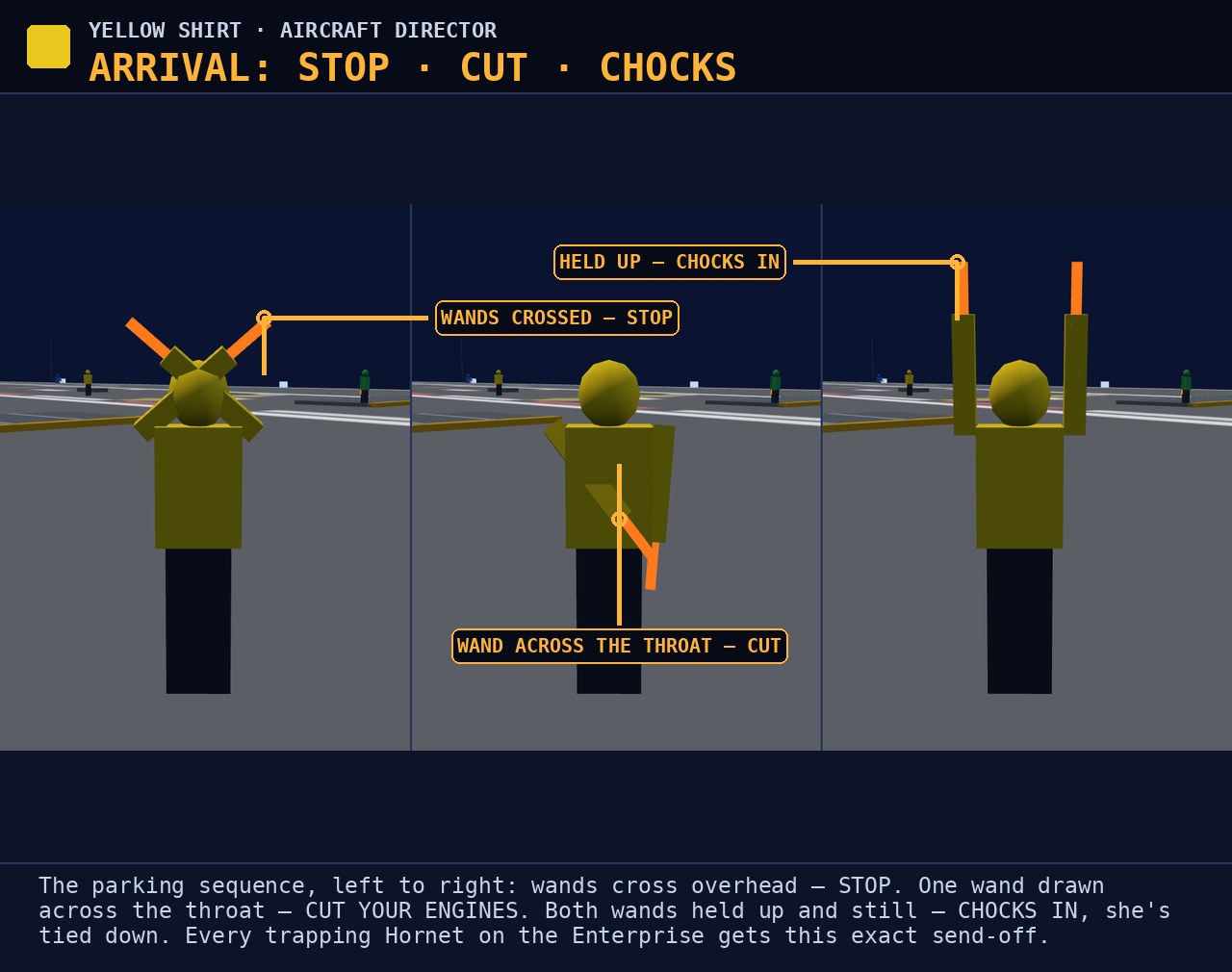
And when you come back aboard, the parking sequence is always the same three beats — stop, cut, chocks:
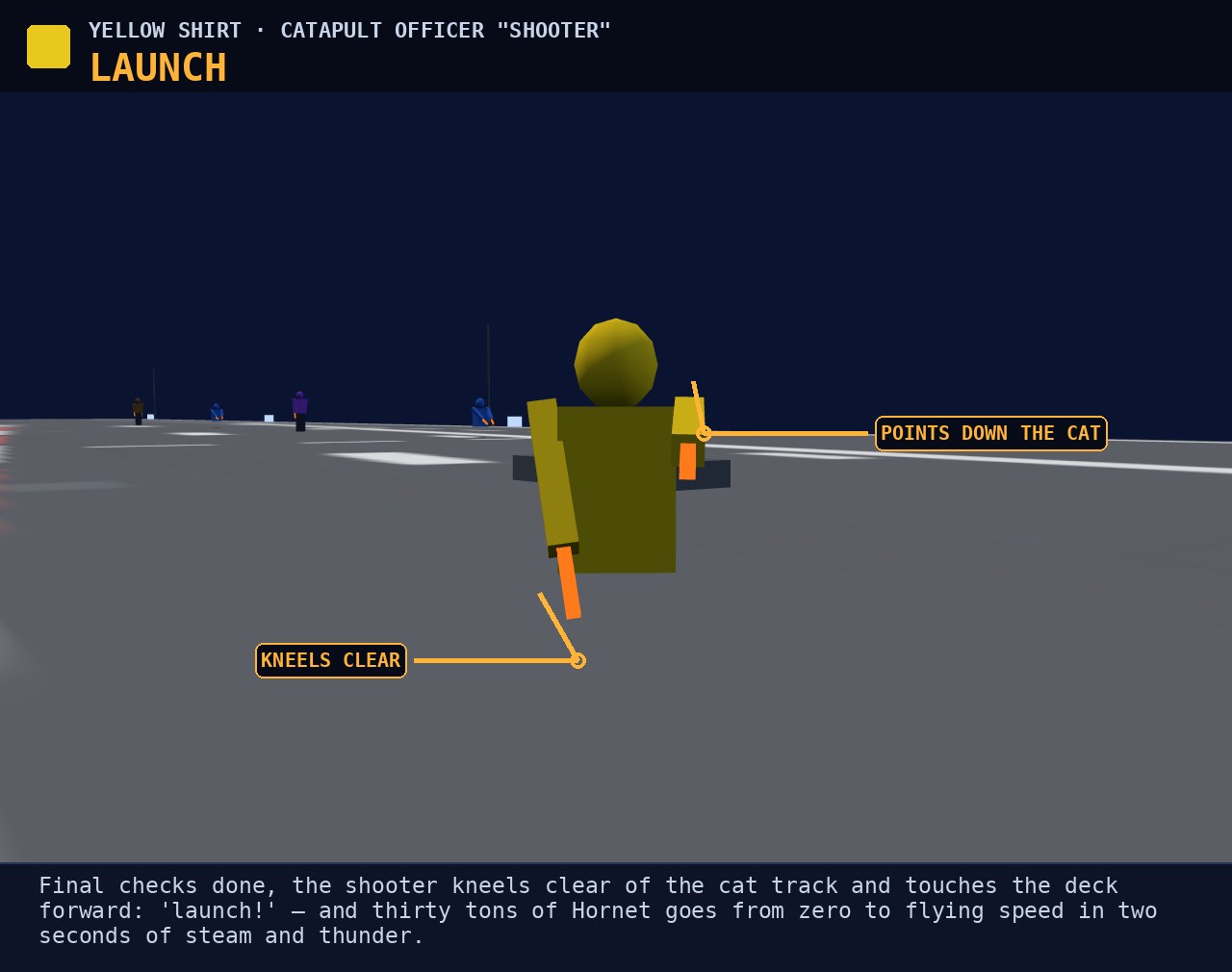
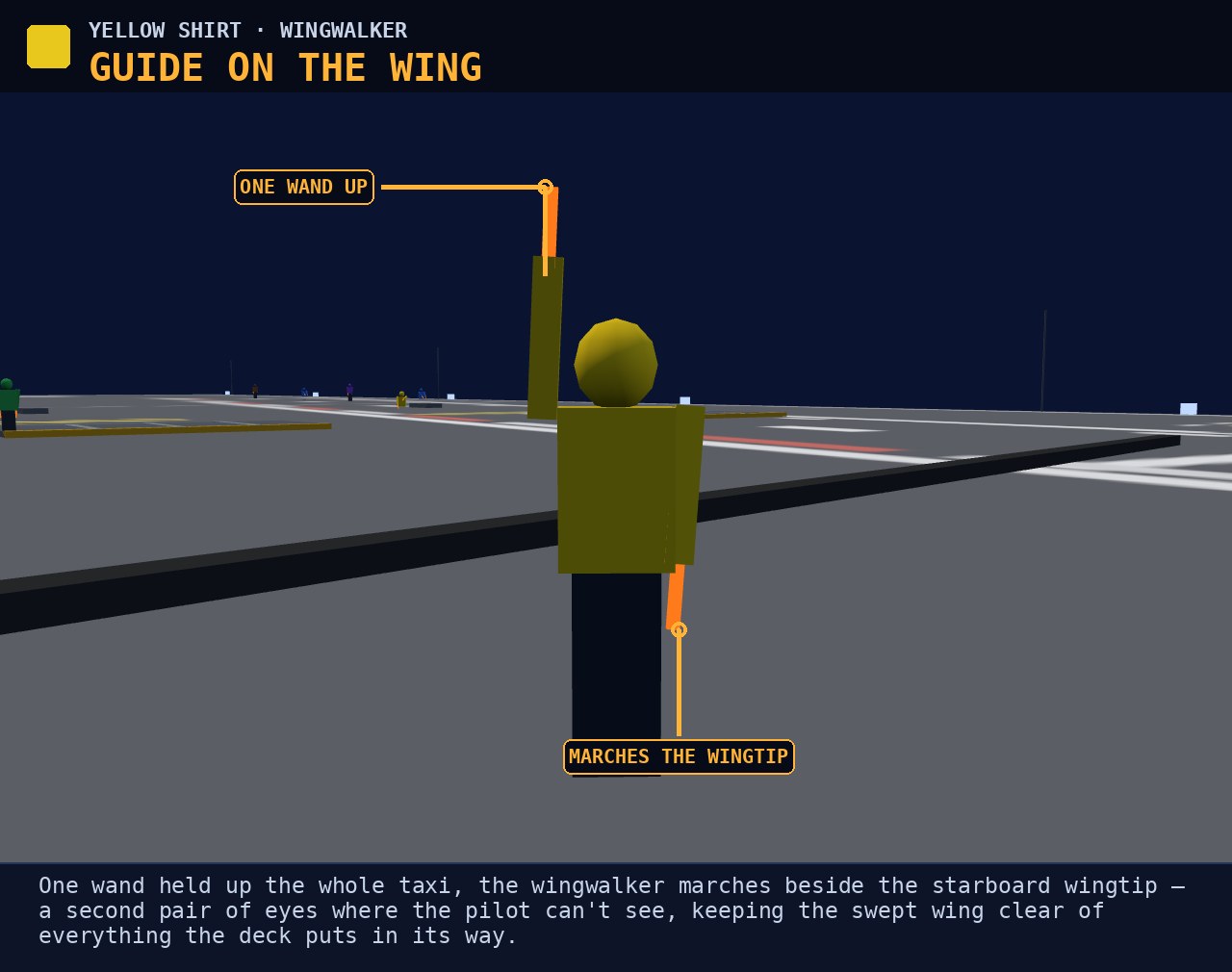
Two yellows work solo acts. The shooter — the catapult officer — sends every jet off the bow with the most famous gesture in naval aviation, and the wingwalker marches the starboard wingtip through the crowded taxi pattern where the pilot is blind:
The rest of the rainbow
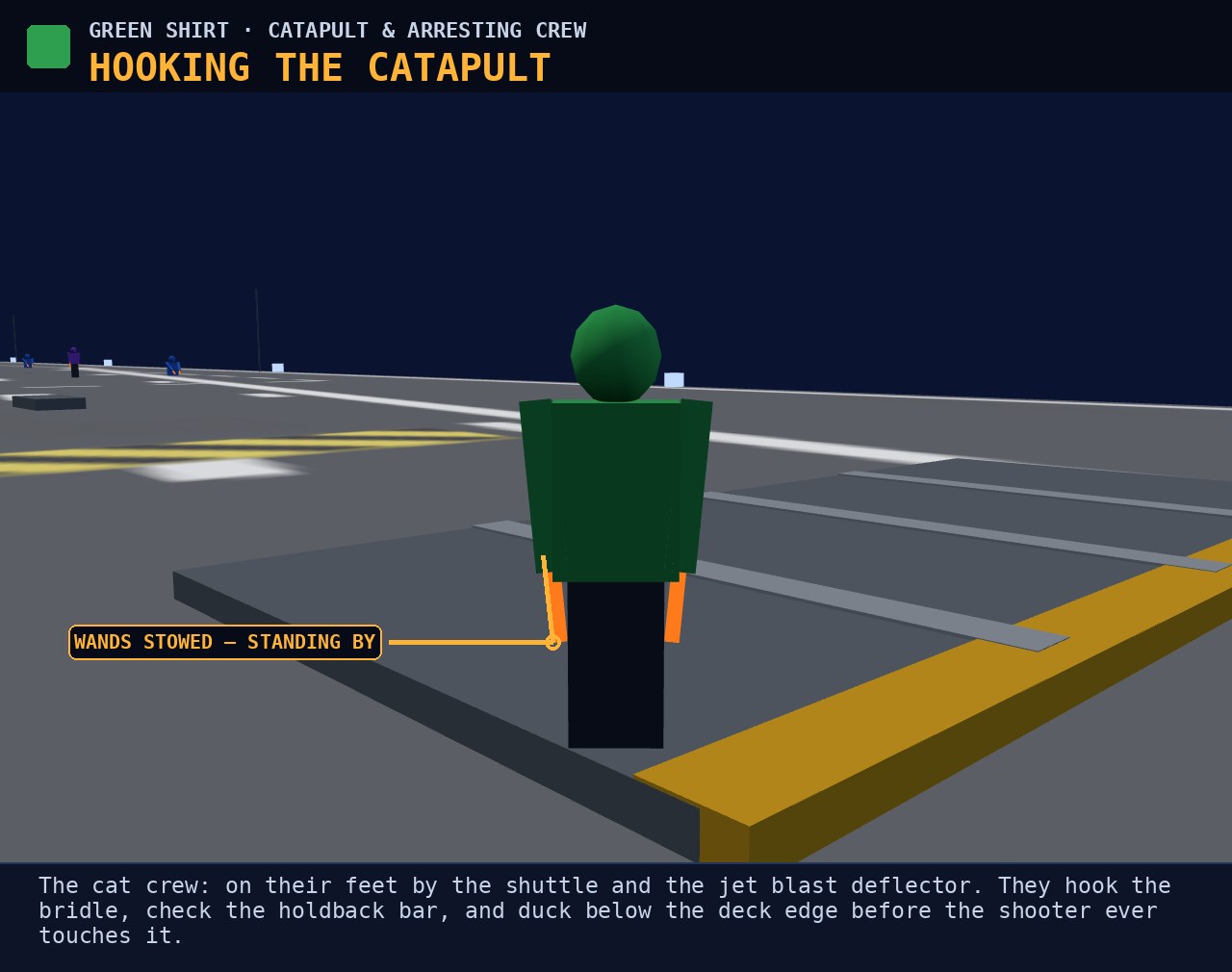
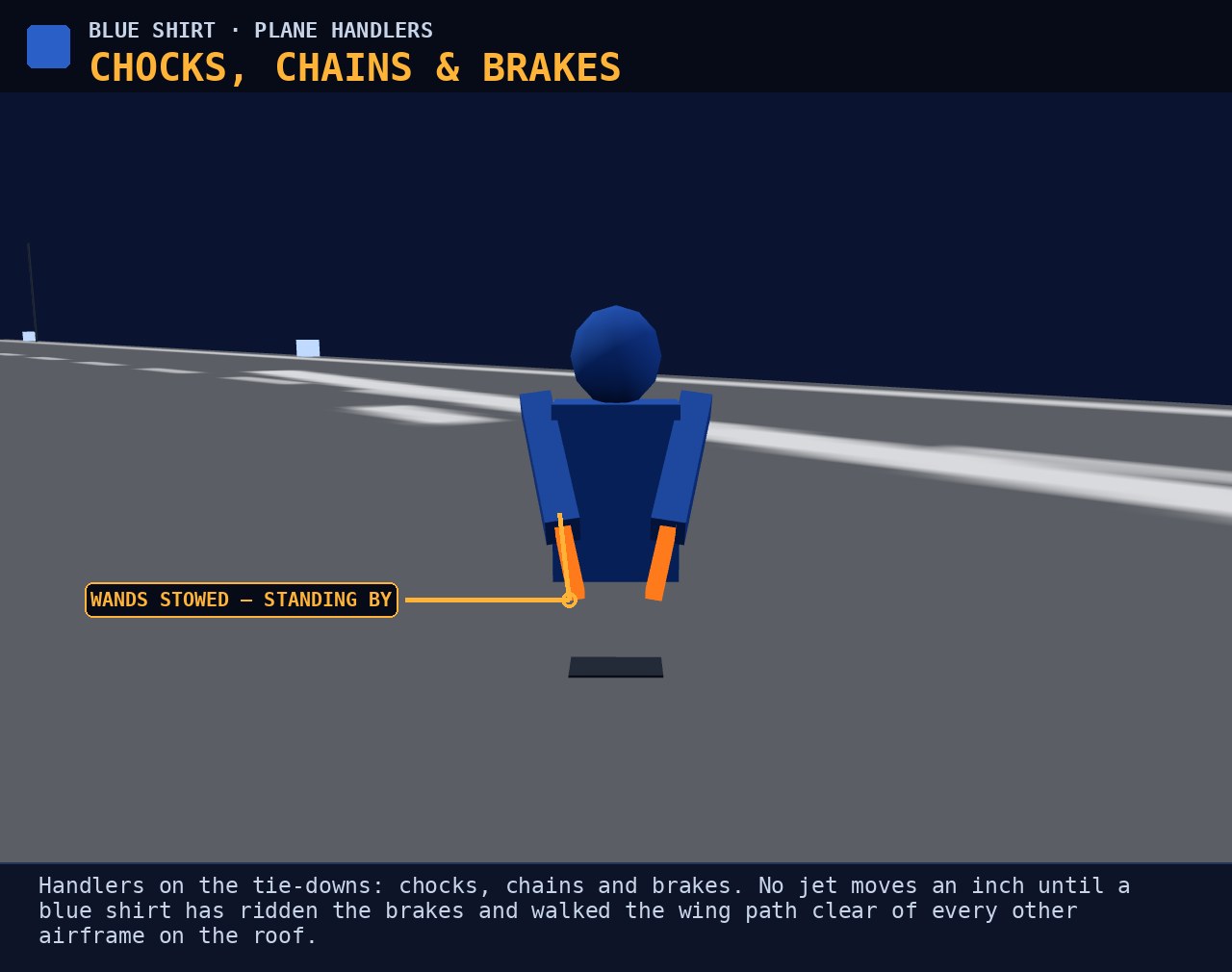
Everybody else keeps the machine turning around the directors. Wands stowed, jobs very much not:
All of it is live on the flight deck right now: spawn on the roof and watch the directors pick you up with the identify gate, taxi to the cat and take the launch signal, or just spectate the air wing cycling — every jet that traps gets the same stop-cut-chocks send-off. Eleven months of flight school, and the deck still says it best with two orange sticks.
Two scopes got smarter and one room got a lot bigger this push:
Big hulls are now radar contacts. Freighters, tankers, container ships, the cruise liner and every warship in the group paint as steel-grey triangles on the radar scope — and on the tactical map (N) they draw with their names: MV BAY TRADER, MT PETRO PACIFIC, MS BAY MONARCH and the rest. Sailboats, crabbers and weekend cruisers stay below notice, exactly as they should.
The map keeps getting busier. Ships join the air picture that already carries callsigns for SCREWTOPS 601, the P-3, the airliners, your wingman and the helicopters — now including the Army’s Apache, K-MAN, orbiting the city.
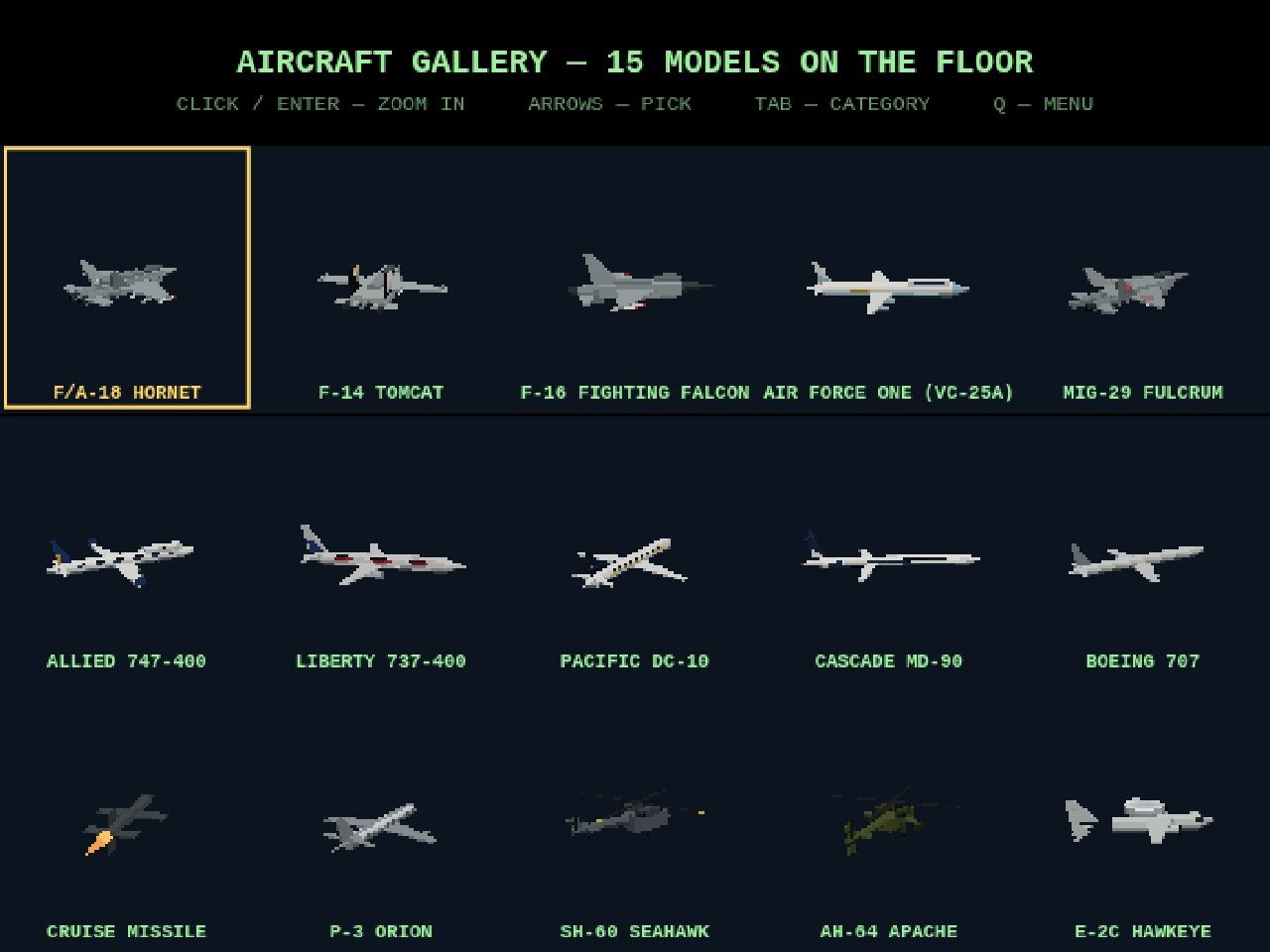
The gallery is a showroom floor now. Open it and every model of the category is on display at once — fifteen aircraft, twelve vessels, all spinning under the lights with nameplates. Click any of them (or arrows + ENTER) to zoom in for the close-up with the old rotate-and-zoom controls; ESC takes you back to the floor. TAB switches categories: AIRCRAFT — planes and helicopters together — and SHIPPING.
Four new printables on the slipway. The P-3 Orion, SH-60 Seahawk, E-2C Hawkeye (Screwtops corkscrew and all) and AH-64 Apache join the store as printable STLs — bringing the Complete Fleet zip to twenty-seven models: fifteen aircraft and twelve vessels. The studio even captured the corkscrew on the Hawkeye’s dome for the box art.
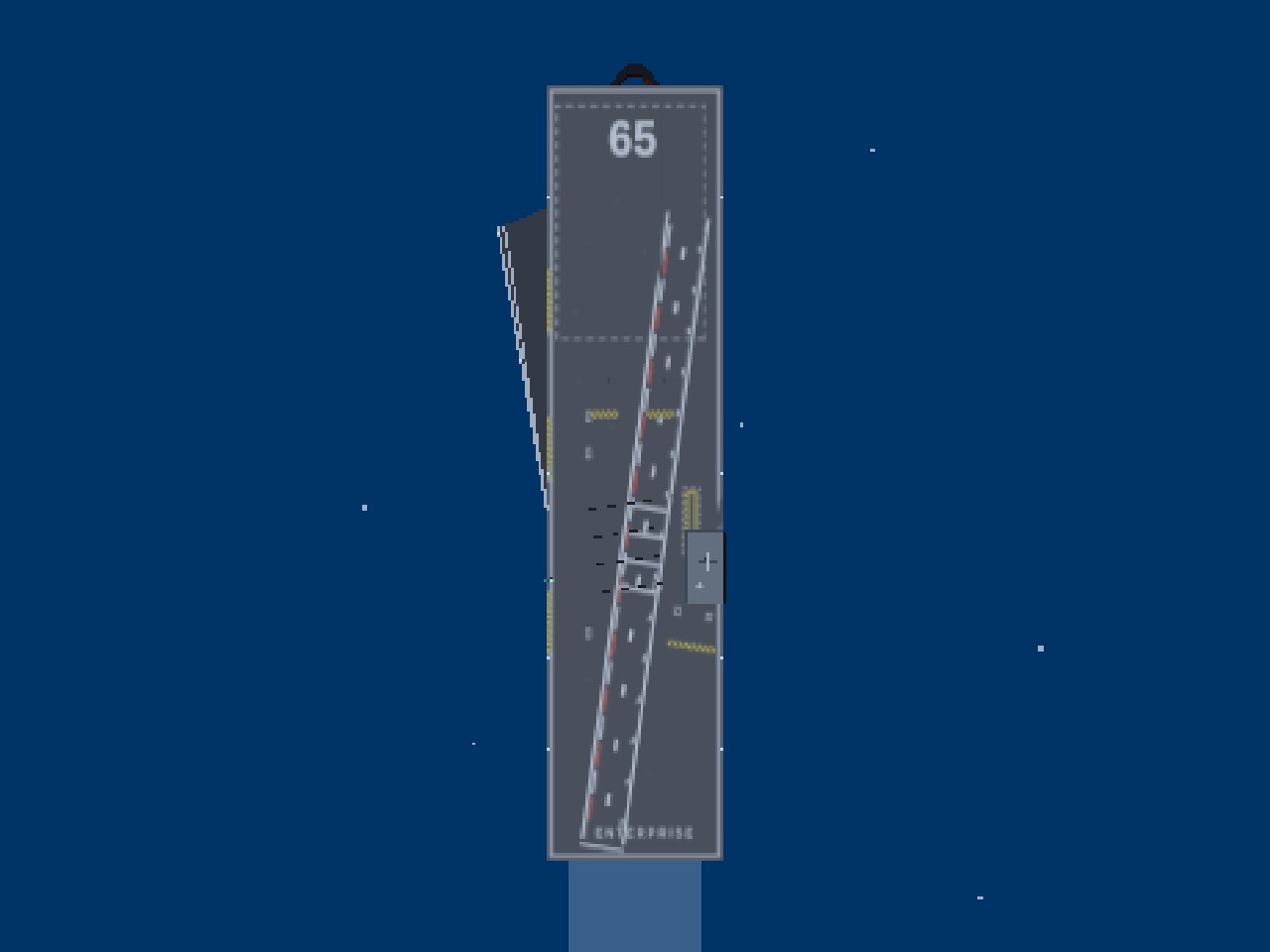
Sharp eyes over the round-down spotted it: the Big E’s deck still wore a straight axial centreline down the middle, which read as the runway. No more — like every real carrier, her runway is now unmistakably the angled deck:
The straight centreline is gone. What remains is the one true runway: the angled landing strip, offset to port so pilots land left of the island — the whole point of the angled deck since 1952.
The strip got the full treatment — bolder edge stripes, bigger centreline dashes, and a threshold bar across the stern end where the pass begins.
Everything still agrees: the arrestor wires, the IFLOLS meatball and the landing aim-point all derive from the same strip geometry, so what you see is exactly what you trap on. Verified from the overhead: strip angles off the ship’s line and passes port of the island, wires square across it.
The printable carrier wears it too — the six-angle shots in the Print Bay were re-taken on the new deck plan.
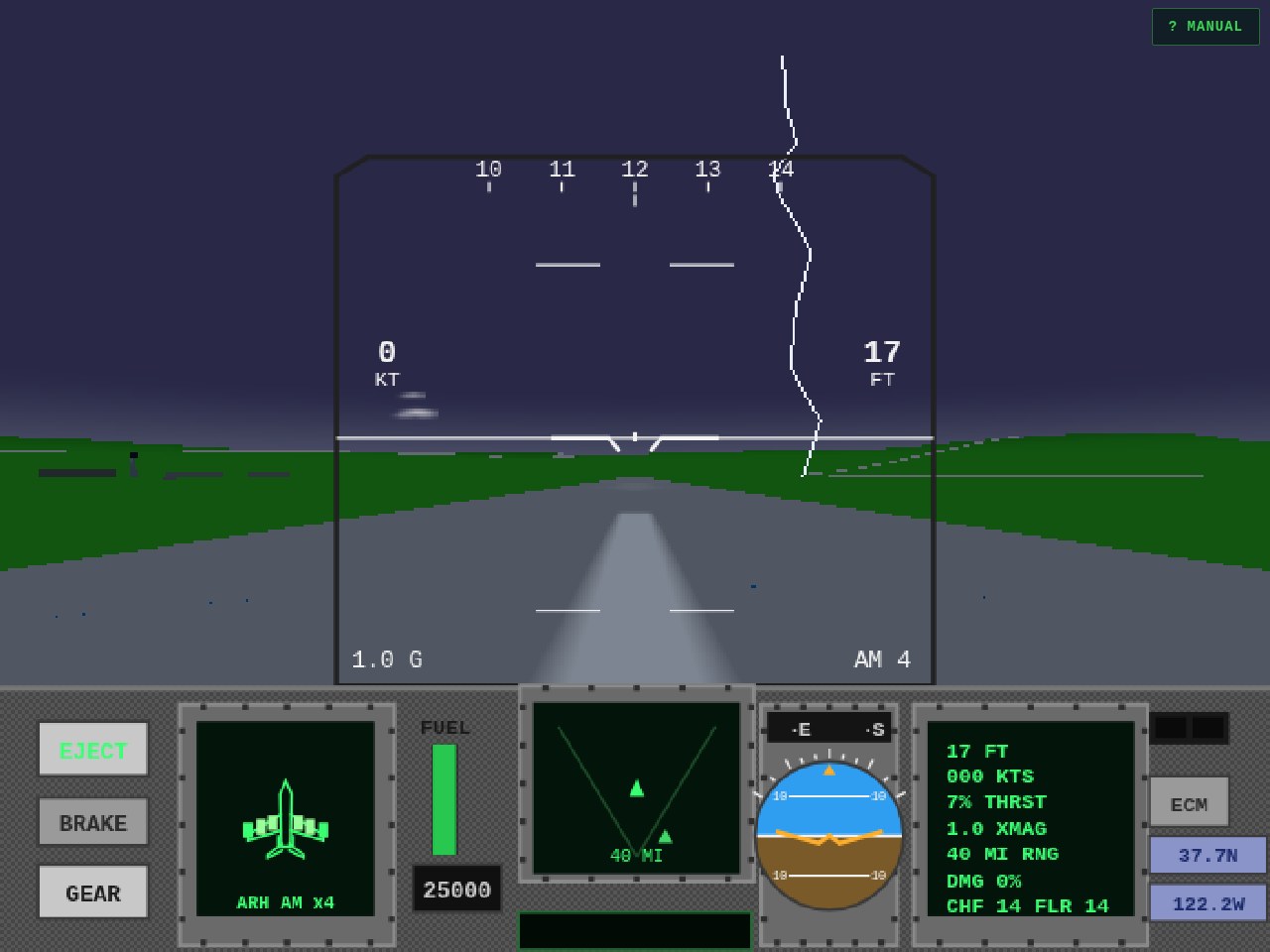
The R toggle just grew a full weather ladder. Where it once flipped CLEAR/RAIN it now steps through five states — MISSION DEFAULT → CLEAR → CLOUDS → RAIN → STORM — on the main menu, on the plane-select map, and saved between visits:
CLOUDS breaks the original’s cloudless sky — the scattered sprite deck that ships with the sim finally gets to fly, fading in over a couple of seconds with a light dimming of the day. Everything eases; nothing pops.
RAIN implies overcast now — the streak rain you know, under the cloud deck, with the usual gloom dragging the murk in close.
STORM brings the lightning. Every few seconds a jagged channel bolt walks down out of the deck somewhere within a few miles, the whole sky answers with a cold blue-white flash, and the thunder arrives late — delayed by true distance at 343 m/s, a crack decaying into a long low rumble through the audio graph.
Clouds got their own weather channel — separate from the rain blend, so overcast days can exist without a drop of rain, and every state fades smoothly through the same sky/fog/sun gloom the rain always used.
Manners kept: satellite planning maps stay free of rain, murk and bolts; pausing still silences the sky; and missions you authored stay exactly as clear as you left them — MISSION DEFAULT never surprises you.