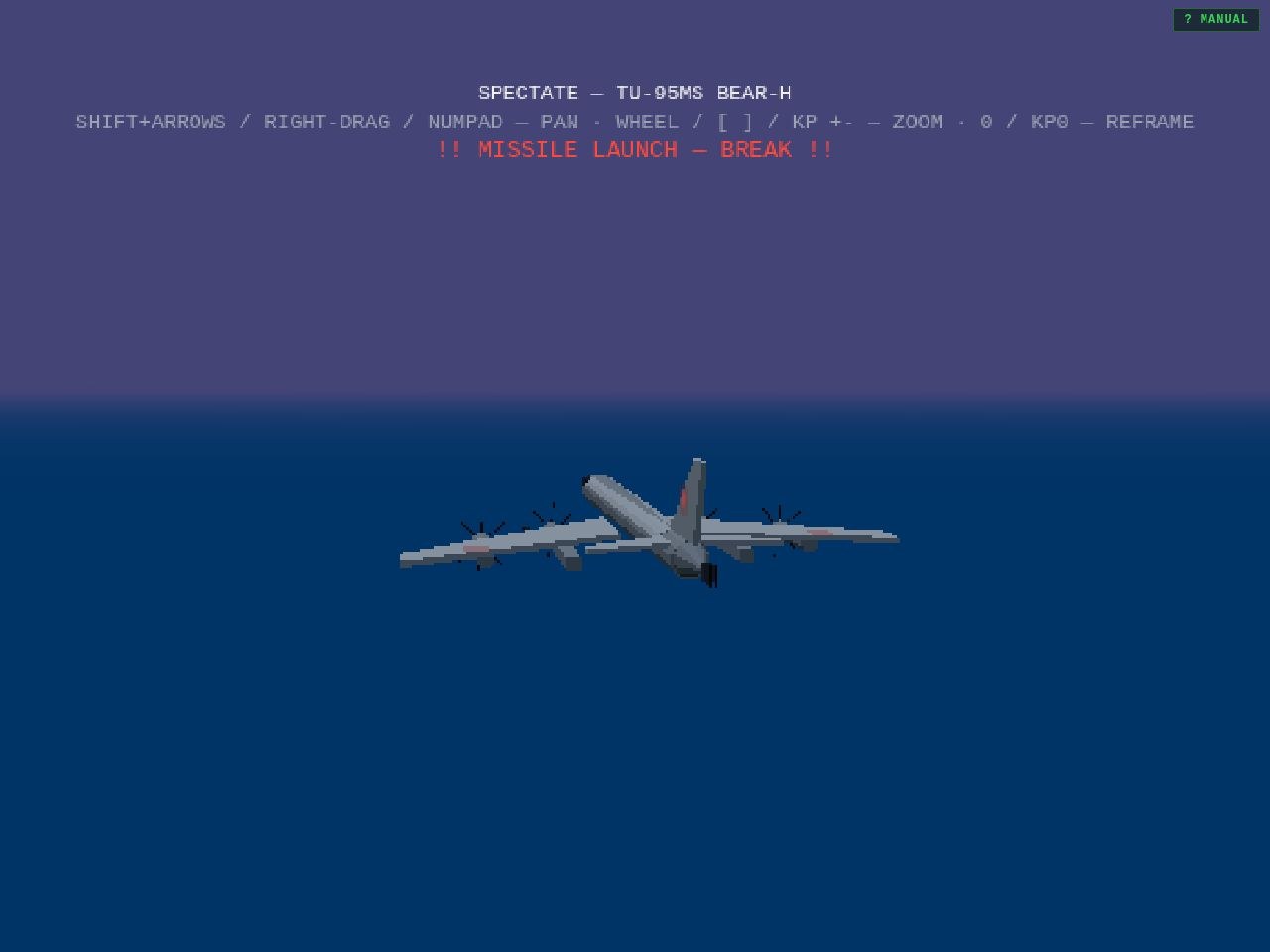
A turboprop contact, bearing 270, a hundred ten miles out, Angels 27 — and she is not out there to take pictures. The Tu-95MS Bear-H joins the sim: four NK-12 contra-props on a 35° swept wing, a glazed bombardier nose, twin guns in the tail barbette, red stars on the fin. She is in the gallery, the print bay, and the store — and she is the centerpiece of the two hardest sorties in the campaign:
M14 BEAR HUNT (80/100). One Bear, two Flankers riding shot — rated 75, aces, cleared for every maneuver in the library. She trucks for her launch point fifty miles off the boat; an expert pilot runs her down and kills the archer with the arrows still on the rails.
If the arrows fly. Two AS-4 Kitchens, eighteen seconds apart, steering for the moving carrier the whole way in. You and Viper Two hunt them — and if one leaks past, the escorts’ Phalanx CIWS is the last wall of lead: mounts pick the closest missile inside 3.8 km, walk tracers onto it, kill odds climbing steeply as the range closes. One Kitchen amidships and the sortie is over.
M15 BEAR PAK (95/100). The demonstration team: two Bears on two axes, four Flankers rated 92, eight killers in the air at once. Bring everything the school taught you. This one is the final exam.
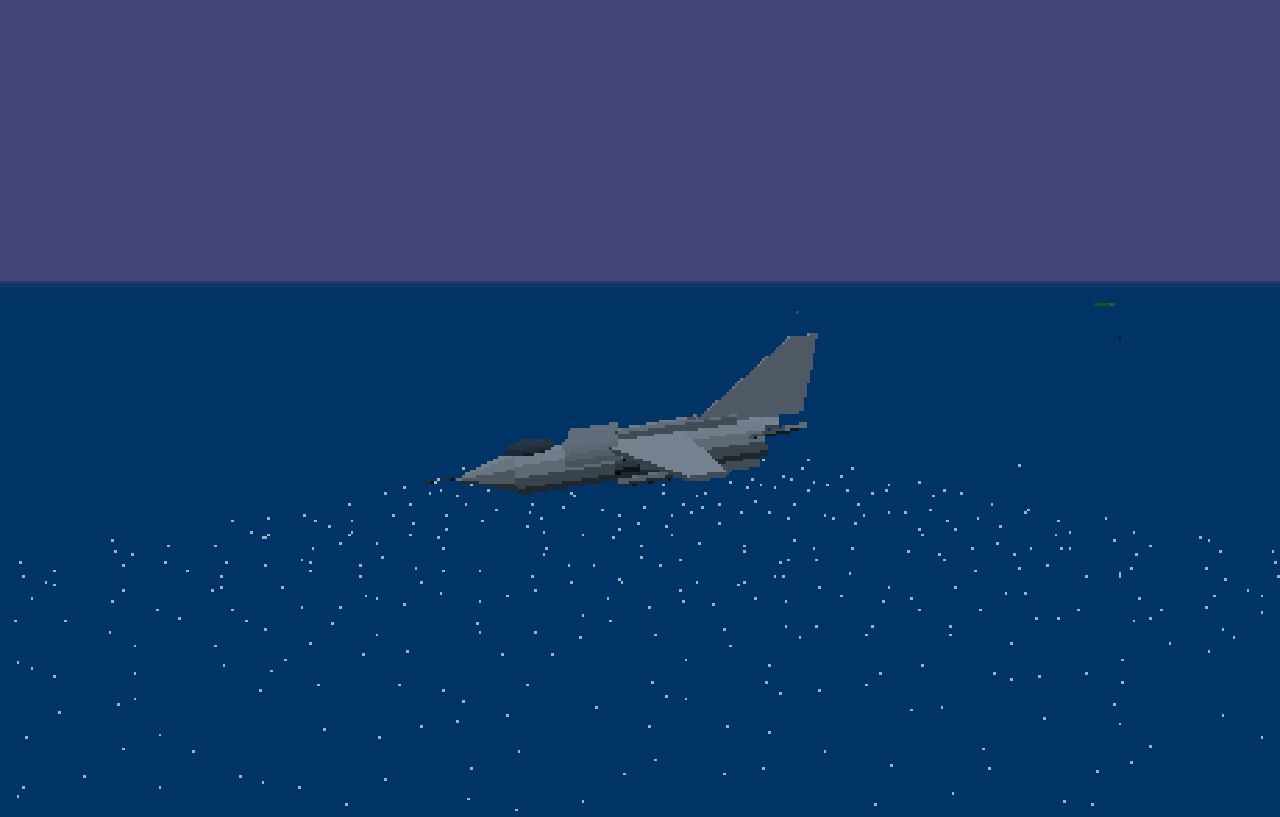
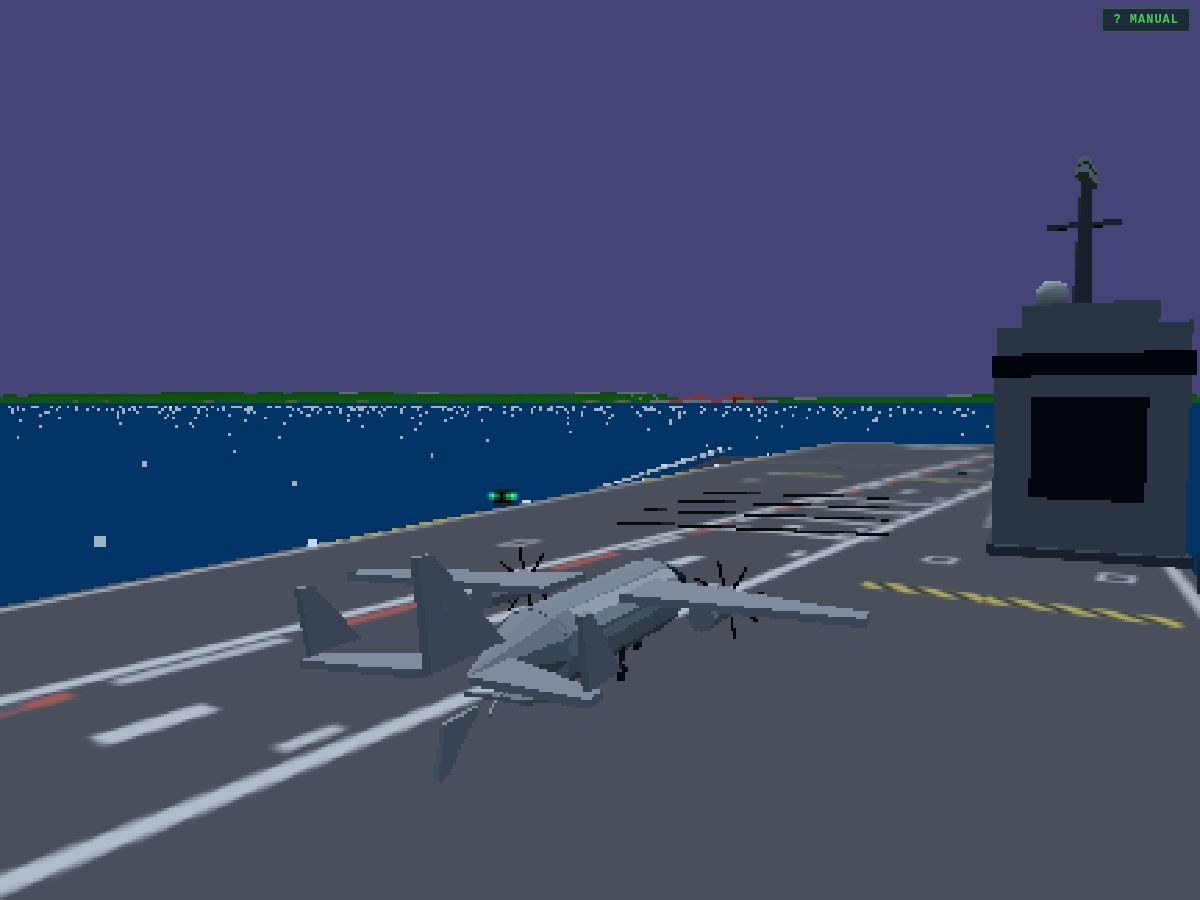
McDonnell Douglas AV-8B Harrier II — the day-attack jump jet the Marines flew off Tarawa-class decks and tiny forward strips:
By the numbers: 14.1 metres long, 9.25 across that big anhedral wing, a Rolls-Royce Pegasus vectored-thrust turbofan good for about Mach 0.9 — and zero knots straight up, which is the party trick.
Modelled as she sits: the bicycle landing gear with wing outriggers, the LIDS rumble strips under the intakes, the tandem cockpit hump, and the four nozzle fairings along the belly. In the gallery she turns on the floor next to the Sea Harrier’s American cousins; she’s the star of M11’s close-escort work.
Print your own: the STL is in the print bay — 150 mm on the build plate, five dollars, prints flat with the gear down. She balances on the outriggers; ask us how we know.
The Hawkeye’s orbit used to be a lazy 28-kilometre wheel parked over the east bay — fine for scenery, wrong for coverage. SCREWTOPS 601 now flies a proper station: a twenty-mile by twenty-mile oval centred on the middle of the map, still at angels two-three (23,000 ft), one lap about every fourteen minutes at 140 kt. From up there the radar picture genuinely covers the whole chart — carrier waters to the inland edge — which is what an AWACS is for. Ride along with J until you find her; the rotodome still turns, and she still calls the picture, the bogies and the civil traffic exactly as before.
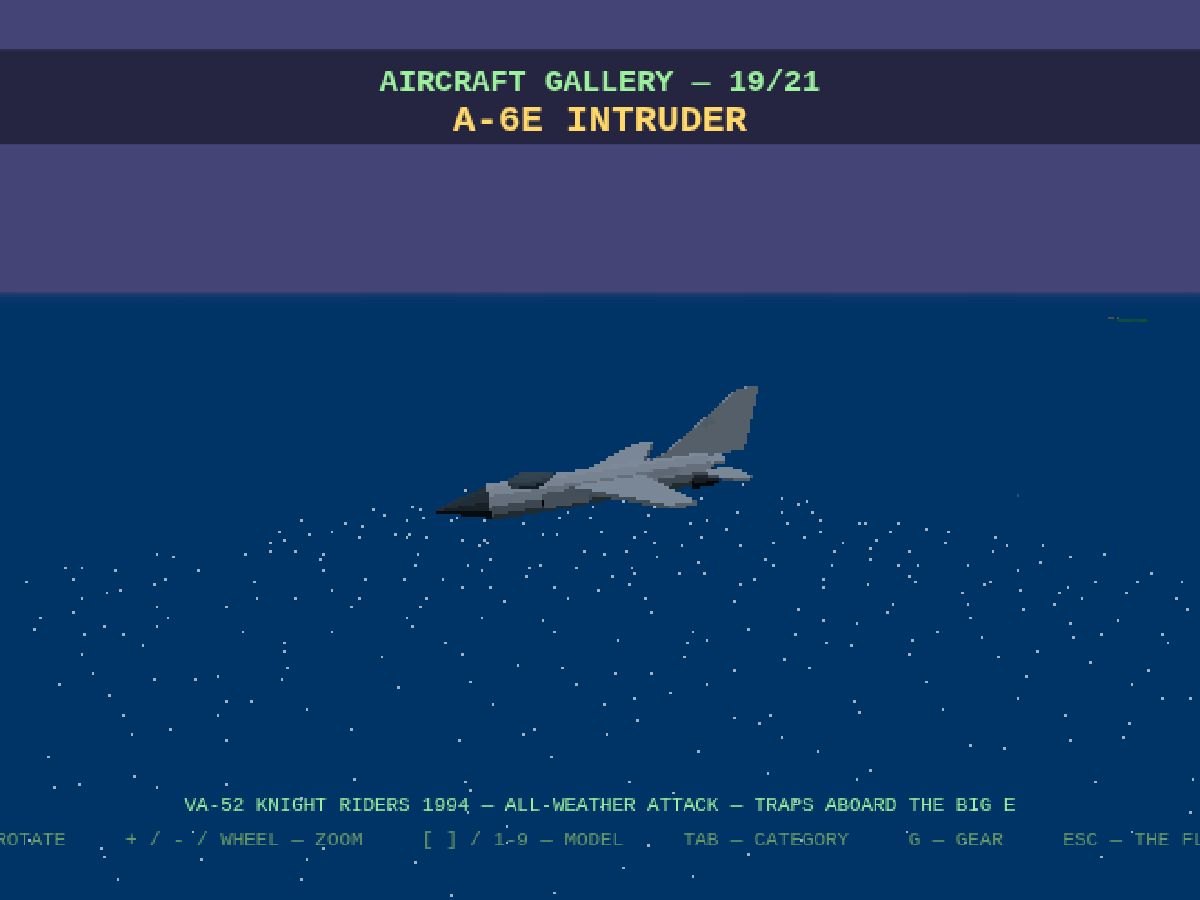
The first of three shipmates reporting aboard this push is the fleet’s all-weather truck: an A-6E Intruder of VA-52, the Knight Riders — tail code NL, modex 501, straight off the 1994 Pacific cruise. Ours answers to KNIGHT 501. Her card:
Crew: two, side by side — pilot left, bombardier/navigator right and a half-step back. The wide framed greenhouse is the Intruder’s face.
Powerplant: two Pratt & Whitney J52 turbojets, about 9,300 lbf each, buried in the fuselage with cheek intakes. No afterburners — the A-6 was all about hauling bombs through weather, not speed.
The kit: DIANE attack radar in that dark nose, and on the E-model the chin TRAM turret under the radome — the little ball our model carries. The fixed refuelling probe spears up off the nose: you can’t mistake the silhouette.
1994 squadron: VA-52 Knight Riders, NAS Whidbey Island, Carrier Air Wing 15 — the Pacific fleet’s Intruders in their final seasons. VA-52 stood down in April 1995; only the Sunday Punchers flew the type longer.
Dimensions: 54 ft 9 in long, 53-foot span, rated for 18,000 lb of ordnance — the medium-attack muscle of its day.
In the bay: KNIGHT 501 parks on the Big E’s starboard row, taxis to Cat 2, launches off the bow, flies the pattern and traps back aboard — around the clock. Friendly blue on radar and the map (N), spectate-able with J, and a printable STL on the store.
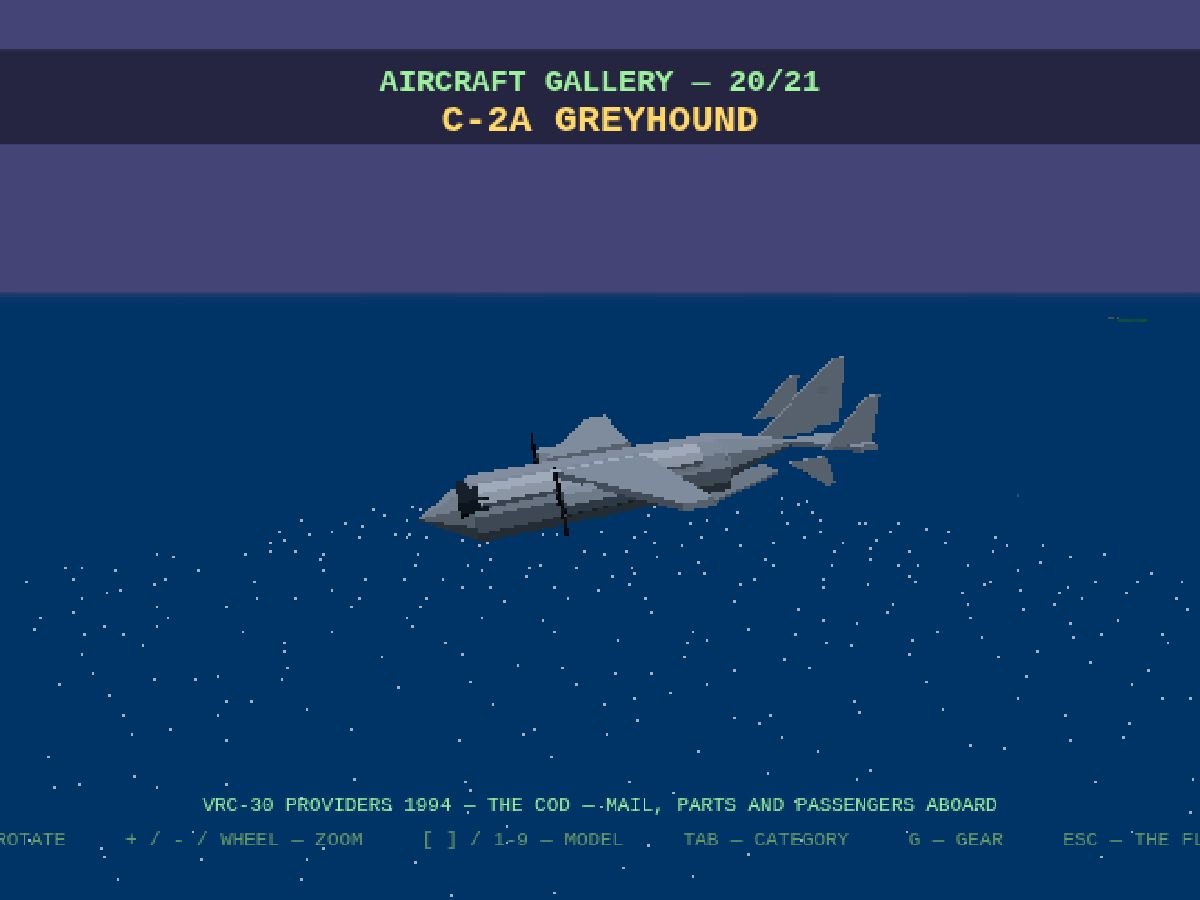
Second aboard is the hardest-working airframe in the battle group — the Carrier Onboard Delivery bird, a C-2A Greyhound of VRC-30, the Providers: tail code RW, modex 30, answering to PROVIDER 30. Mail, parts, passengers — if it matters, the COD brings it. The card:
Powerplant: two Allison T56-A-425 turboprops, 4,600 shp apiece, swinging four-blade props — the same engines and wing as the E-2 Hawkeye, minus the rotodome.
The airframe: where the Hawkeye carries a radar, the Greyhound carries everything else — a fat cargo hold with an upswept tail and a rear loading ramp. The quad tail (centre fin, two outboards, ventral) is an E-2 hand-me-down.
Capacity: 10,000 lb of cargo or 39 passengers, launched and recovered from the boat like any fighter in the wing.
1994 squadron: VRC-30 Providers, NAS North Island — the Pacific fleet’s only COD squadron that year (VRC-50 decommissioned in ’94), and Det 1’s first cruise ran June to December 1994 aboard Kitty Hawk. Period-perfect for our bay.
Dimensions: 56 ft 10 in long, 80 ft 7 in span — the biggest thing that traps aboard with us.
In the bay: PROVIDER 30 flies the same deck cycle as the bombers — watch a twin-prop COD catch the 3-wire and tell us the Navy isn’t a flying club. Printable STL on the store, ramp and all.
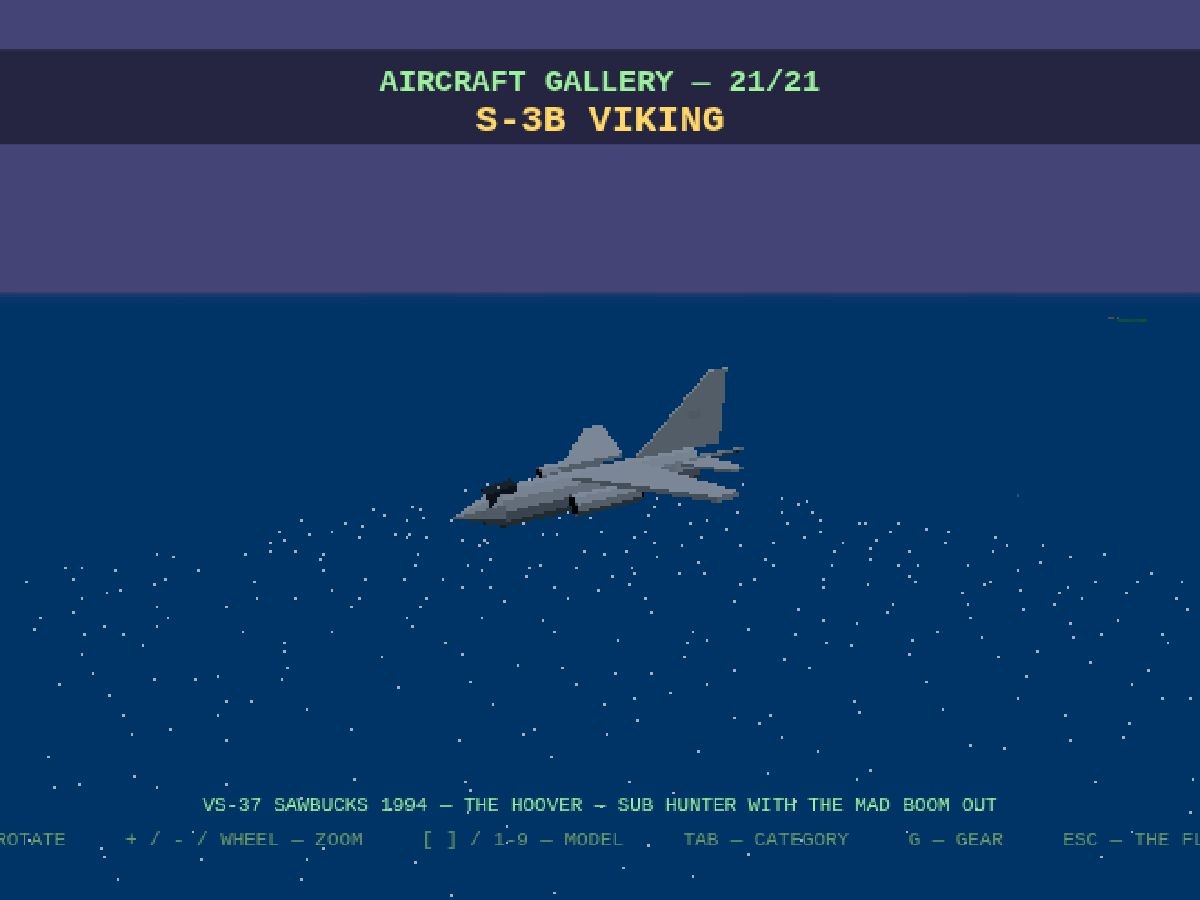
Third aboard is the submarine’s worst day: an S-3B Viking of VS-37, the Sawbucks — NL 700 on the tall fin, answering to SAWBUCK 700. They call the real jet the Hoover for the sound of those two big fans. The card:
Crew: four — two pilots up front, tactical coordinator and sensor operator behind — in a cockpit more airliner than fighter.
Powerplant: two GE TF34 turbofans, 9,275 lbf each, in pods slung under the high wing — the same engine family that powers the A-10.
The kit: sonobuoys by the dozen (the chute dots on our model’s belly), a magnetic anomaly detector in the tail stinger, and room in the bay for torpedoes. The boom out the back gives the profile away every time.
1994 squadron: VS-37 Sawbucks, NAS North Island, Carrier Air Wing 15 — on their final cruise that summer and autumn, which included a famous October week keeping tabs on a Han-class submarine. VS-37 took the 1994 Battle E and stood down 1 March 1995.
Dimensions: 53 ft 4 in long, 68 ft 8 in span, carrier-based from first flight to retirement.
In the bay: SAWBUCK 700 flies the deck cycle off the Big E — launch, pattern, trap, park — boom out, hook down. Blue on the scope and the map, spectate with J, printable STL on the store.
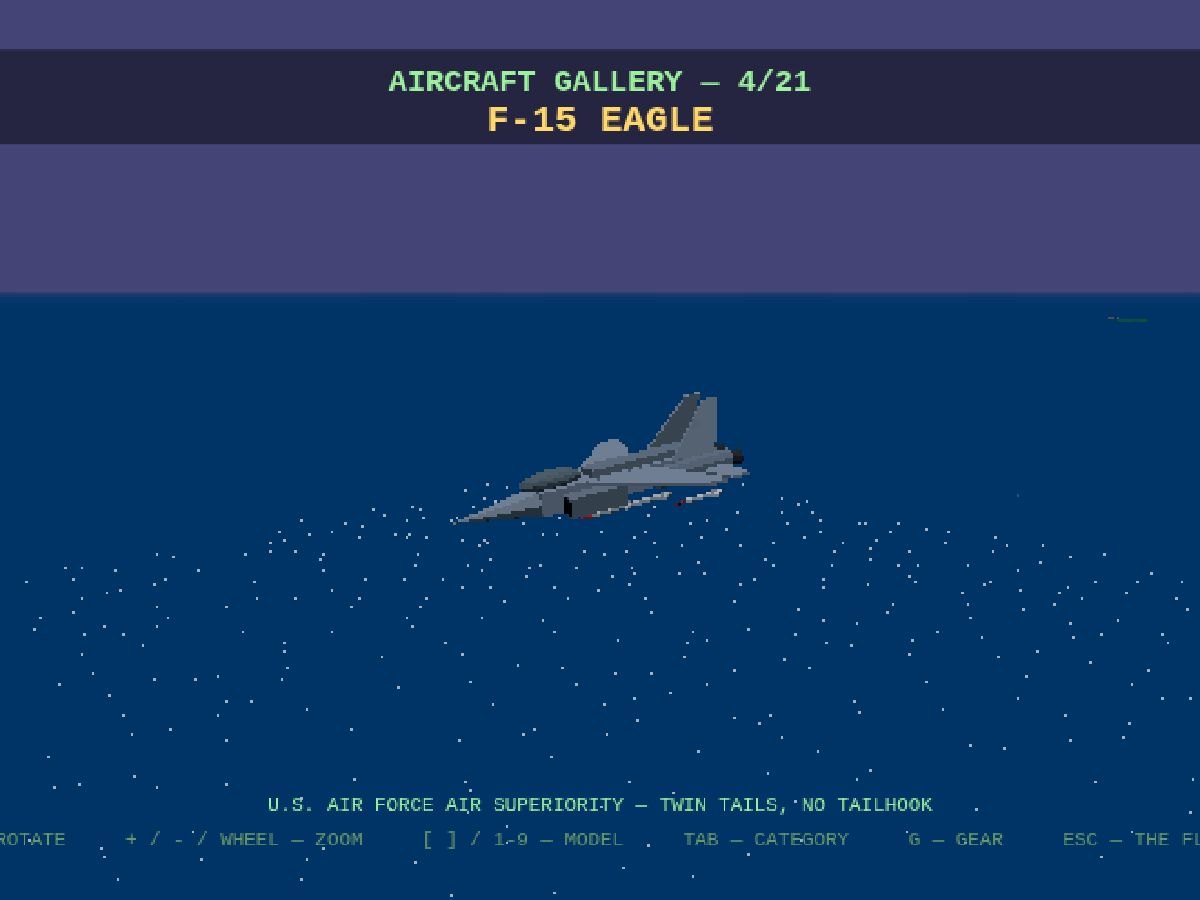
The Air Force heard the Navy was having all the fun and sent over its champion: the F-15 Eagle is now on the flight line as a player mount — press 4 at the plane select. Two things to know up front: it has never lost an air-to-air fight in real life, and it has no tailhook. The card:
Powerplant: two Pratt & Whitney F100s, about 23,800 lbf each in afterburner — the thrust-to-weight that made “not a pound for air-to-ground” a flex.
Performance: Mach 2.5 class, 9 G capable, with a wing so big the jet lands itself when the pilot runs out of ideas. Ours keeps the manners and loses none of the rocket ship.
The record: 104:0 in air-to-air combat by the mid-90s across all operators. We have not nerfed it. Much.
The look: twin tails canted outward, wide flat centre body, canted intake boxes — compass-ghost grey with subdued USAF titles and FF on the fins.
The load: four AMRAAMs on the fuselage corners, Sidewinders on the wings, and the 20mm Vulcan with 500 rounds.
In the bay: runway starts only — SFO, Oakland, Moffett, Alameda — because no tailhook and no catapult bridle means no boat. The plane select will tell you so if you ask nicely. Gallery page 4, printable STL on the store.
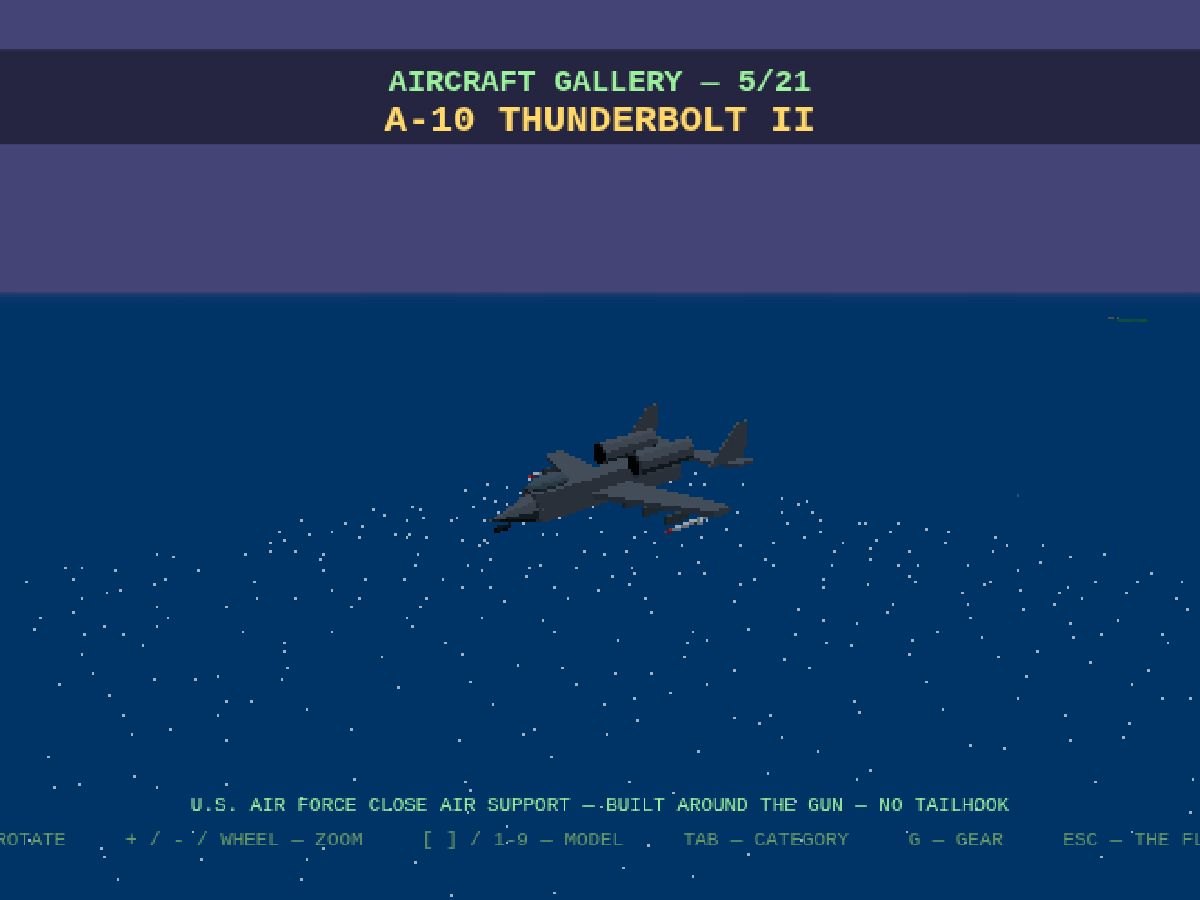
And the second Air Force arrival needs no introduction — only a long pause for effect. The A-10 Thunderbolt II, the Warthog, joins as a player mount on 5. It is slow. It is honest. It is built around the largest gun ever bolted into an aeroplane. The card:
The gun: GAU-8 Avenger, seven barrels of 30 mm at up to 4,200 rounds a minute. Ours carries 1,150 — the real combat load — and it is the default weapon, as it should be.
Powerplant: two GE TF34s, 9,065 lbf each, hung on the aft shoulders where ground fire struggles to reach. The podded fans and twin tails make the profile.
The tub: the pilot sits in a titanium bathtub — 1,200 lb of armour — because the Hawg’s office is low and angry.
The wing: long, straight, thick, built for slow loiter over the fight — the opposite philosophy to the Eagle, and proud of it. Stall speed low enough to read headstones.
1994 colours: gunship grey with DM on the fins — the 355th Wing out of Davis-Monthan — and a pair of Sidewinders for self-escort, because even the Hawg carries a knife.
In the bay: runway starts only, no hook, no bridle, no boat — the Air Force way. Try the low pass down the estuary. Gallery page 5, printable STL on the store.
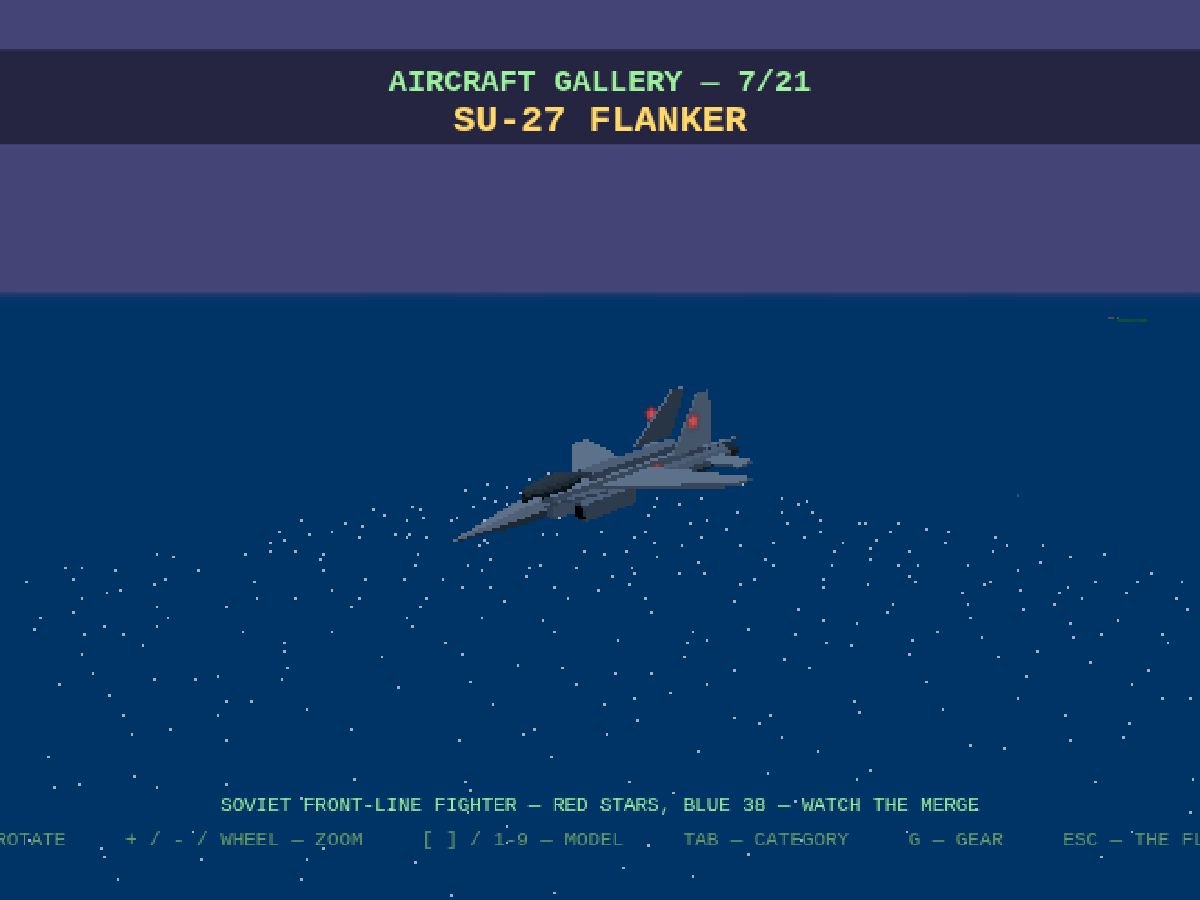
The MiG-29 has been asking for backup, and the Soviets have answered: the Su-27 Flanker is in the game — red stars on the fins, blue 38 on the nose, and a very long memory for grudges. It has no missions yet. It is simply out there, waiting. The card:
Powerplant: two Saturn AL-31Fs, about 27,500 lbf each in afterburner, widely spaced with the famous tail stinger between the nozzles.
The shape: long drooped nose, big blended wing with leading-edge extensions, twin canted tails on the engine nacelles — one of the most elegant fighters ever drawn, and one of the largest.
The party trick: Pugachev’s Cobra — a full-poststall pitch past vertical that the big Sukhoi simply shrugs off. If you see one do it in the merge, you are already behind.
1994 colours: Soviet-era grey-blue with red stars and a blue bort number, the same generation of markings our Fulcrum wears — front-line PVO kit before the roundels changed.
Dimensions: 71 ft 10 in long, 48 ft 3 in span — twelve feet longer than your Hornet, and it turns like it hasn’t heard.
In the bay: a bogie for missions we have yet to fly — it spawns and fights like the MiG. For now, find it on the showroom floor (page 7), watch for the stars, and print one from the store if you want a head start studying it.
The flight deck is no longer a quiet place to be left alone with your thoughts. The Enterprise now works her 1994 Pacific air wing around the clock — three period squadrons flying a continuous launch–pattern–trap–park cycle whether you are watching or not:
KNIGHT 501 — the VA-52 A-6E Intruder — SAWBUCK 700, the VS-37 S-3B Viking, and PROVIDER 30, the VRC-30 C-2 Greyhound, park on the starboard row, taxi the safe lane to Cat 2 (Cat 1 stays yours), and get flung off the bow in turn.
They fly the pattern like professionals: climb off the bow, the break, a port-side downwind at 850 feet, base, and the final gate — then down the 3.5° groove to the angle deck and the 3-wire. Rollout, taxi clear, park, and go again.
The radio knows the script:CAT 2 — YOU’RE AWAY on the shot, BOLTER, BOLTER if the wires are missed (they go around, honestly), and TRAPPED ABOARD when the hook takes. The feed calls the 3-wire by name.
Discipline, even ambient: the air wing holds a lap if you are on final, and only one jet works the groove at a time — the rest stack politely in the pattern. Taxi routes respect your spot on Cat 1.
Everywhere a friendly should be: blue contacts on radar with their callsigns, named on the tactical map (N), and spectate-able with J — ride the COD down the groove from the LSO’s seat sometime.
Why 1994 matters: all three squadrons were the real Pacific operators that summer — VA-52 and VS-37 in CVW-15, VRC-30 Det 1 flying its first cruise — researched, liveried, and parked on the wrong carrier entirely, as tradition allows. Missions involving these airframes come later; the flightpaths are already here.
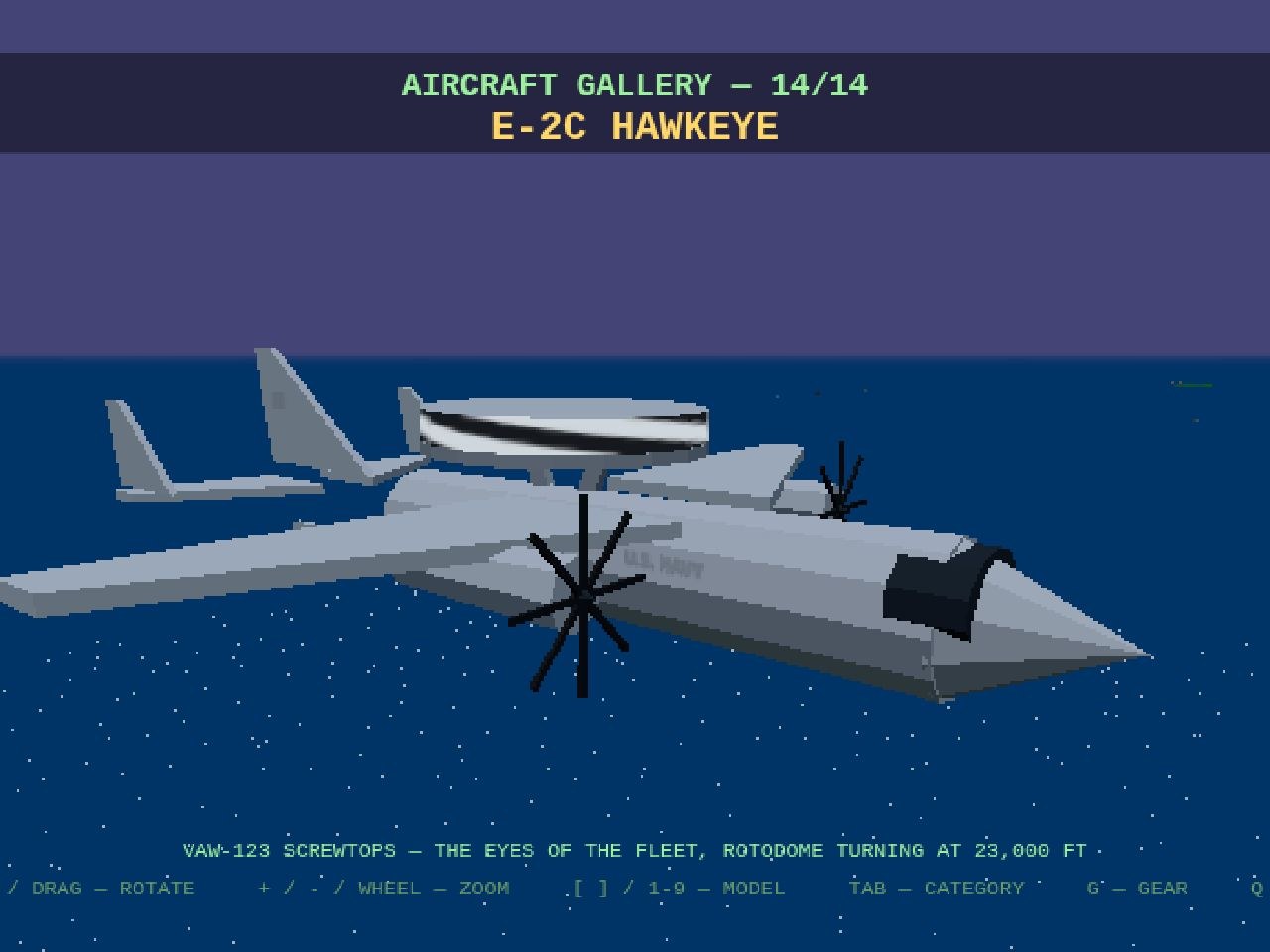
Two small but satisfying fixes this push. First, a structural one: a sharp-eyed pilot noticed the E-2C’s aft fuselage section was simply not there — the quad tail hung four metres behind the hull with nothing in between. Her tail cone is riveted on now, and the printable STL, the single-model zip and the Complete Fleet all got the corrected geometry. Second, a personnel matter: we finally know who’s riding in K-MAN’s front seat. Meet the gunner:
Clarry G is Alameda born and raised — close enough to the old Naval Air Station to fall asleep to the sound of Hornets trapping on the Enterprise. He decided at age nine he was going to fly. The Navy, in its wisdom, said no: one eye a half-line short on the chart.
So he went Army. Re-mustered as an aerial observer, then front-seat gunner on the AH-64 — the seat where the shooting actually happens. The chain gun under the Apache’s chin slaved to his helmet: where Clarry looks, thirty millimetres of attention follows.
The name: Clarence, formally — but only his mother and the pay office use it. What the G stands for is a matter of unit policy, which is to say he won’t tell you. The crew answer to it anyway. K-MAN, the callsign, comes from his grandfather’s old ham-radio handle, and Clarry wears it like a borrowed jacket: proudly, and slightly too big.
He knows the city by roof. A thousand feet up on the twelve-point wheel he calls “the paper route,” Clarry can name every helipad, crane and water tower downtown — and claims he can read license plates on the Bay Bridge. Nobody’s verified it. Nobody’s disproven it either.
He’s winning the bet. Standing wager with the cruiser’s Seahawk crew, NAVY 701: first to spot the P-3 coming off its inspection pass calls it on the radio. Clarry is up forty dollars and insufferable about it.
And he keeps a mascot. Zip-tied to the sensor turret: a rubber chicken, name of Clarence Jr., officially listed in the aircraft’s log as “ballast.” If you zoom in on the gallery model — well. Some details are for the crew to know.
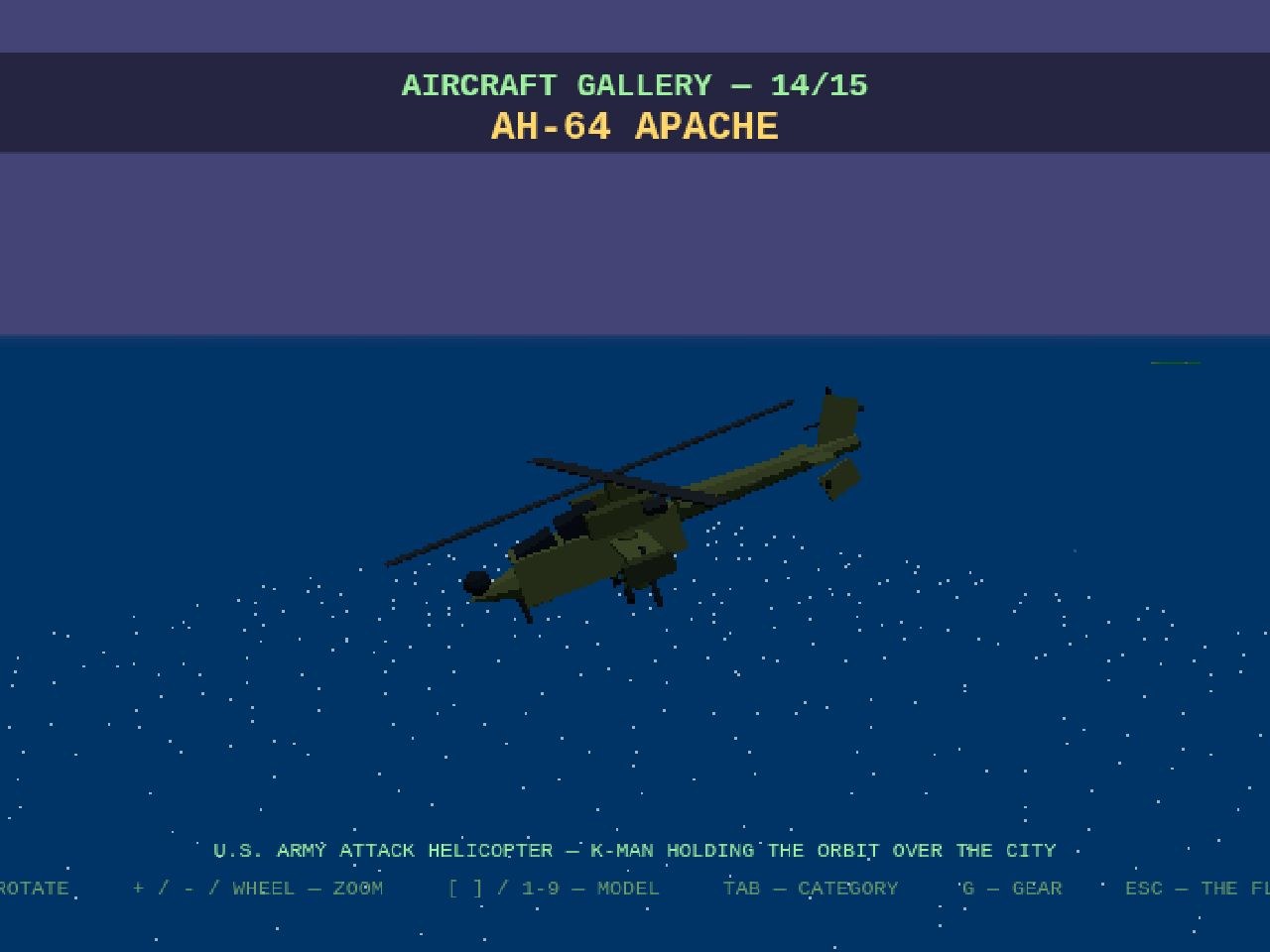
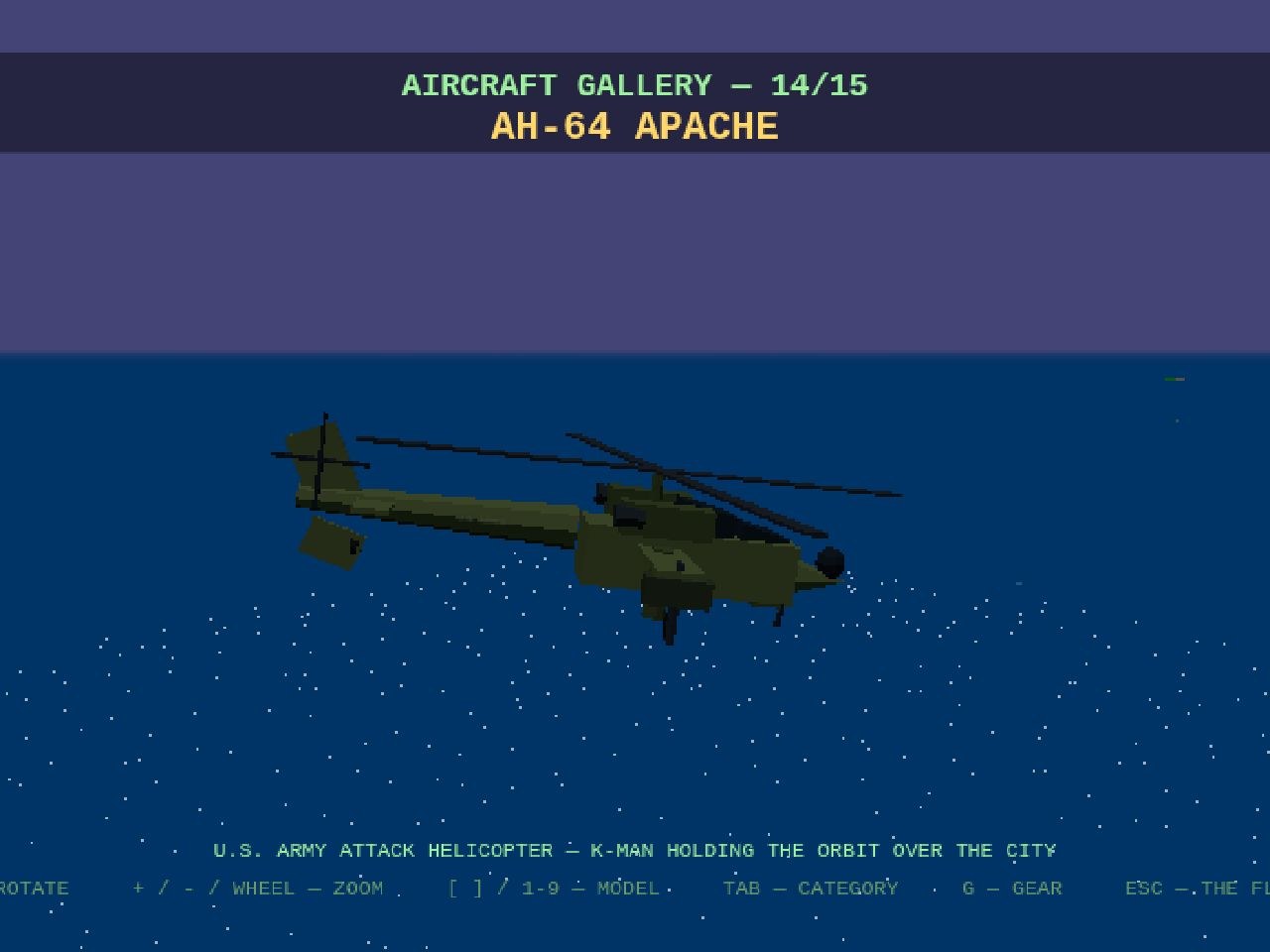
The bay’s airspace just got a little more dangerous — and it isn’t even Navy. An AH-64 Apache of the U.S. Army now holds a continuous orbit over the city, callsign K-MAN, olive drab against the dusk. If you see twin stub wings and a chin gun checking you over downtown, that’s him. His card:
Crew: two, in tandem — gunner in the front seat, pilot in the raised rear seat. K-MAN’s front seat belongs to CLARRY G — meet him in the next entry. The stepped glass is the Apache’s silhouette.
Powerplant: two GE T700 turboshafts, about 1,900 shp each, turning a 48-foot four-blade rotor.
Performance: 182 kt flat out, ceiling over 20,000 ft, and it fights — hard — down to nap-of-the-earth.
The kit: the 30mm M230 chain gun under the chin (the little turret under our model’s nose), Hellfire missiles on the stub pylons, and rocket pods inboard. Ours carries all three.
Dimensions: 58 ft nose to tail, 48-foot rotor — smaller than the Seahawk’s footprint, meaner by the pound.
In the bay: K-MAN flies a twelve-point wheel over downtown at a thousand feet and shows up on the tactical map (N) as a green square with his callsign. He’s on gallery page 14/15 — or find him on the showroom floor and click to zoom in. Printable STL on the store, as always.
Three refinements this push, one of them thanks to a sharp-eyed squadron historian with a diecast model:
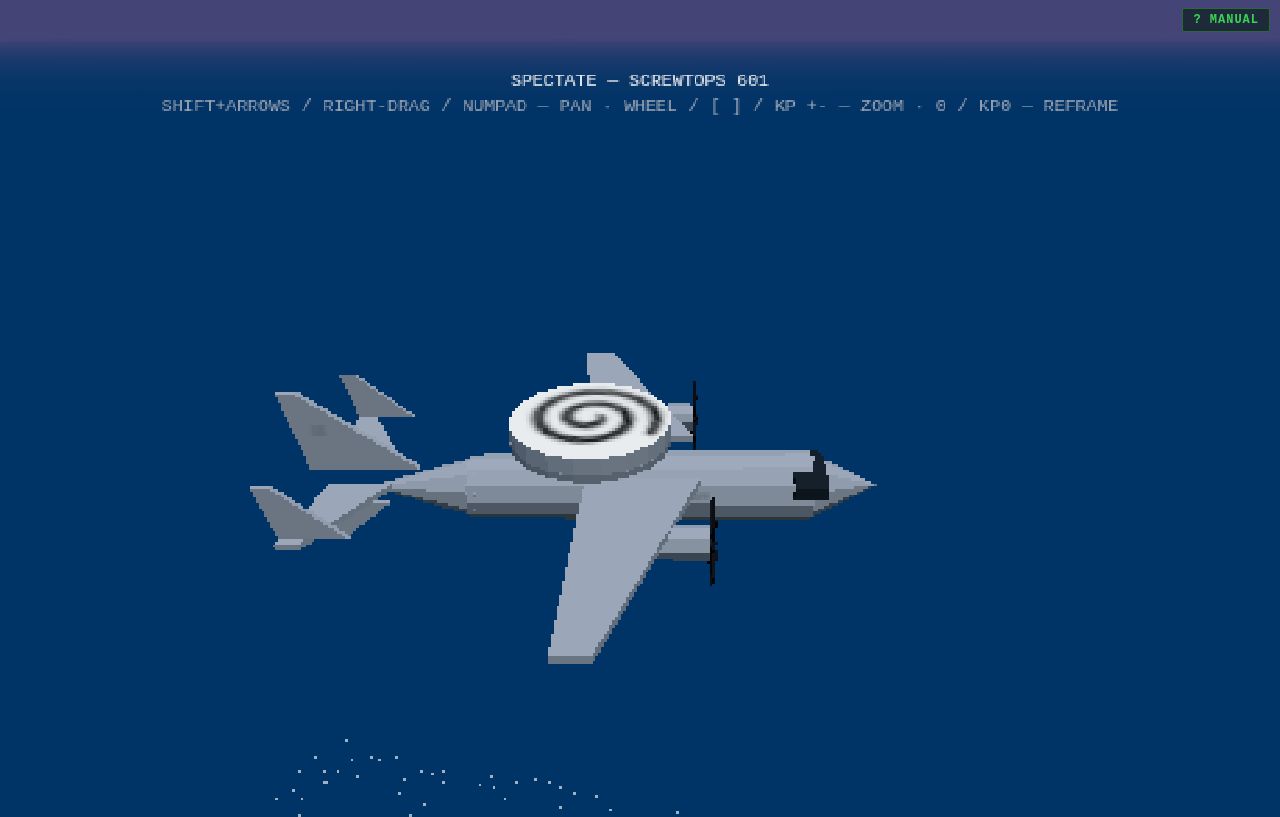
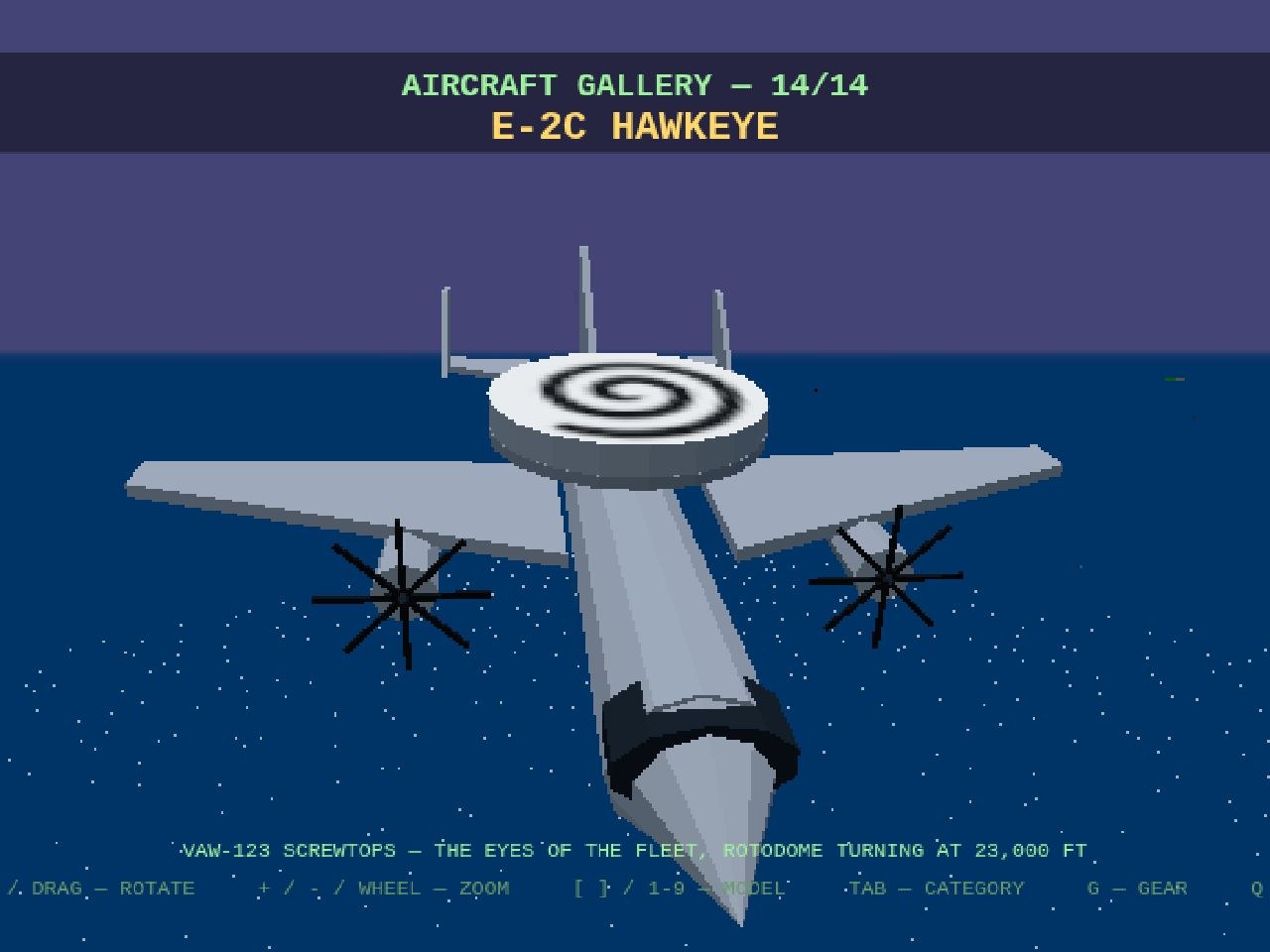
The Screwtops spiral, done right. Our first attempt wrapped a barber-pole around the rotodome’s rim — wrong bird. The real VAW-123 mark is a bold black pinwheel on the dome’s flat faces, hub to rim, two turns of corkscrew. Repainted to match: as the dome turns overhead, the swirl screws exactly like the squadron’s namesake. Top and bottom, so you can read it from below too.
Missile view. The O key now rides the newest round in the air — Sidewinder, AMRAAM or Phoenix — with the full spectate camera: SHIFT+ARROWS or right-drag to orbit it, wheel or [ ] to zoom, 0 to reframe. O again cycles every round in flight, then hands you back your cockpit. When the round resolves — splash or miss — the view lets go on its own.
The map learned everyone’s name.N now draws the whole air picture with callsigns: hostiles in red, the wingman and helicopters in green (rotorcraft get square markers — NAVY 701 on the cruiser circuit, SHUTTLE ONE and TWO working the pads), the P-3 and SCREWTOPS 601 in cyan, and every airliner in white with its flight name. One glance tells you who’s who in the bay.
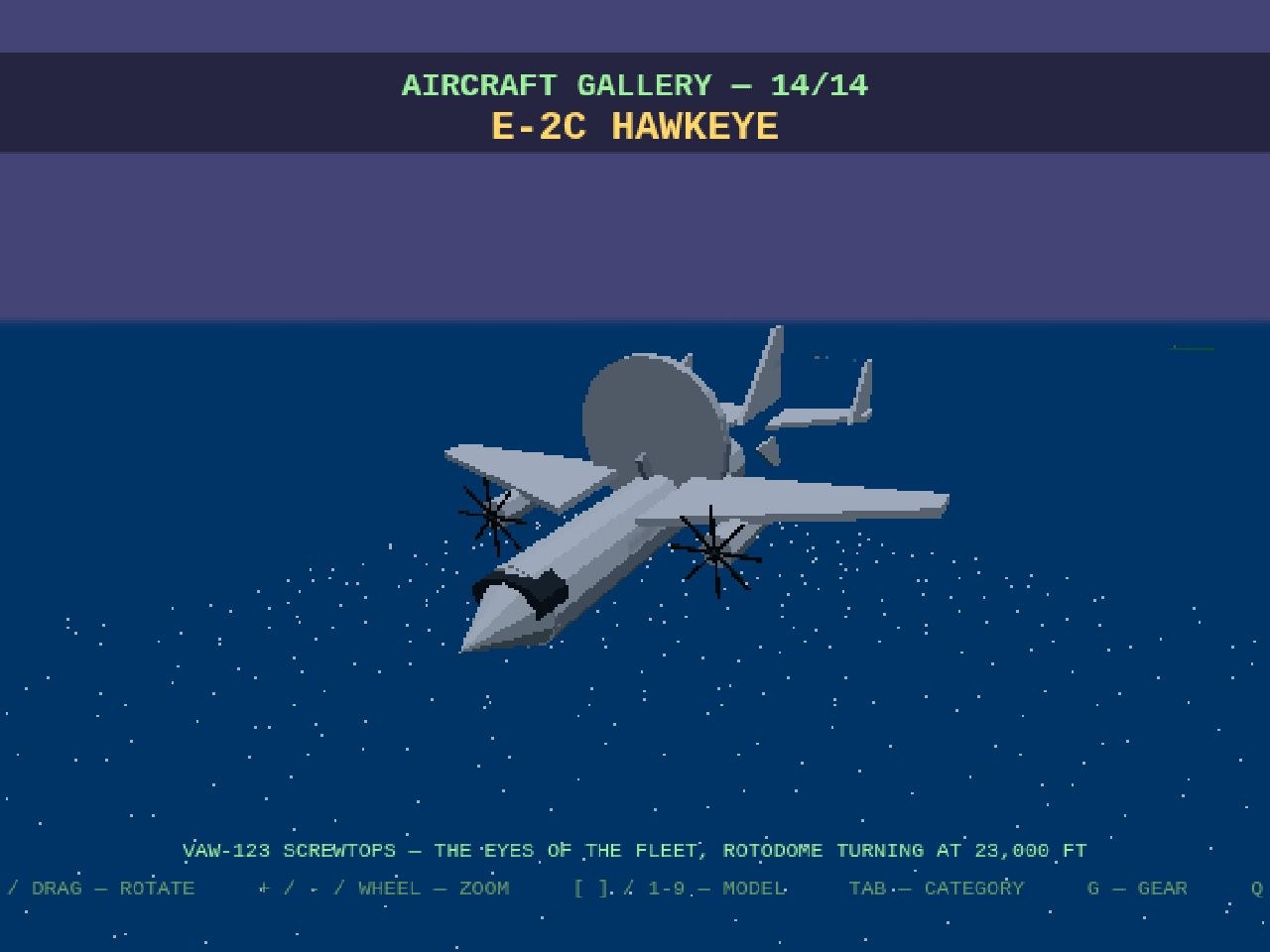
She’s the newest silhouette over the bay and the highest flier in the pattern: the Grumman E-2C Hawkeye of Airborne Command and Control Squadron 123 — VAW-123, the SCREWTOPS — now wears her squadron mark, the black corkscrew around the rotodome. The dome itself got its geometry sorted this push: a horizontal pancake on its twin struts, spinning about its vertical axis exactly as the real radar does. Her card:
Crew: five. Two pilots up front, three mission specialists in the back — radar officer, control officer, radar operator — the team that talks the fighters onto the bandits.
Powerplant: two Allison T56-A-427 turboprops, 5,100 shp apiece, driving four-bladed props. Max speed around 350 kt, but her living is the loiter: five to six hours on station.
Dimensions: 80 ft 7 in span, 57 ft 9 in long — and the rotodome spans 24 feet, bigger than some fighters’ wings.
Ceiling: 34,700 ft. Range: about 1,460 nautical miles. High enough and patient enough to see the whole theatre.
The kit: AN/APS-145 radar in the dome — tracks thousands of contacts out past 300 miles, friend or foe, sea level or stratosphere.
The squadron: VAW-123 “Screwtops,” established 1967 out of Norfolk — hence the black barber-pole spiral painted around the dome rim, three turns of pure squadron pride. It spins with the radar.
In the bay: she orbits at angels 23 and works the radio the way a real Hawkeye does — BOGEY with clock code, miles and angels; CIVIL TRAFFIC conflicts; FRIENDLIES round-ups; a PICTURE every couple of minutes. Bullseye is Alcatraz. Find her on gallery page 14/14, or spectate her wheel with J.
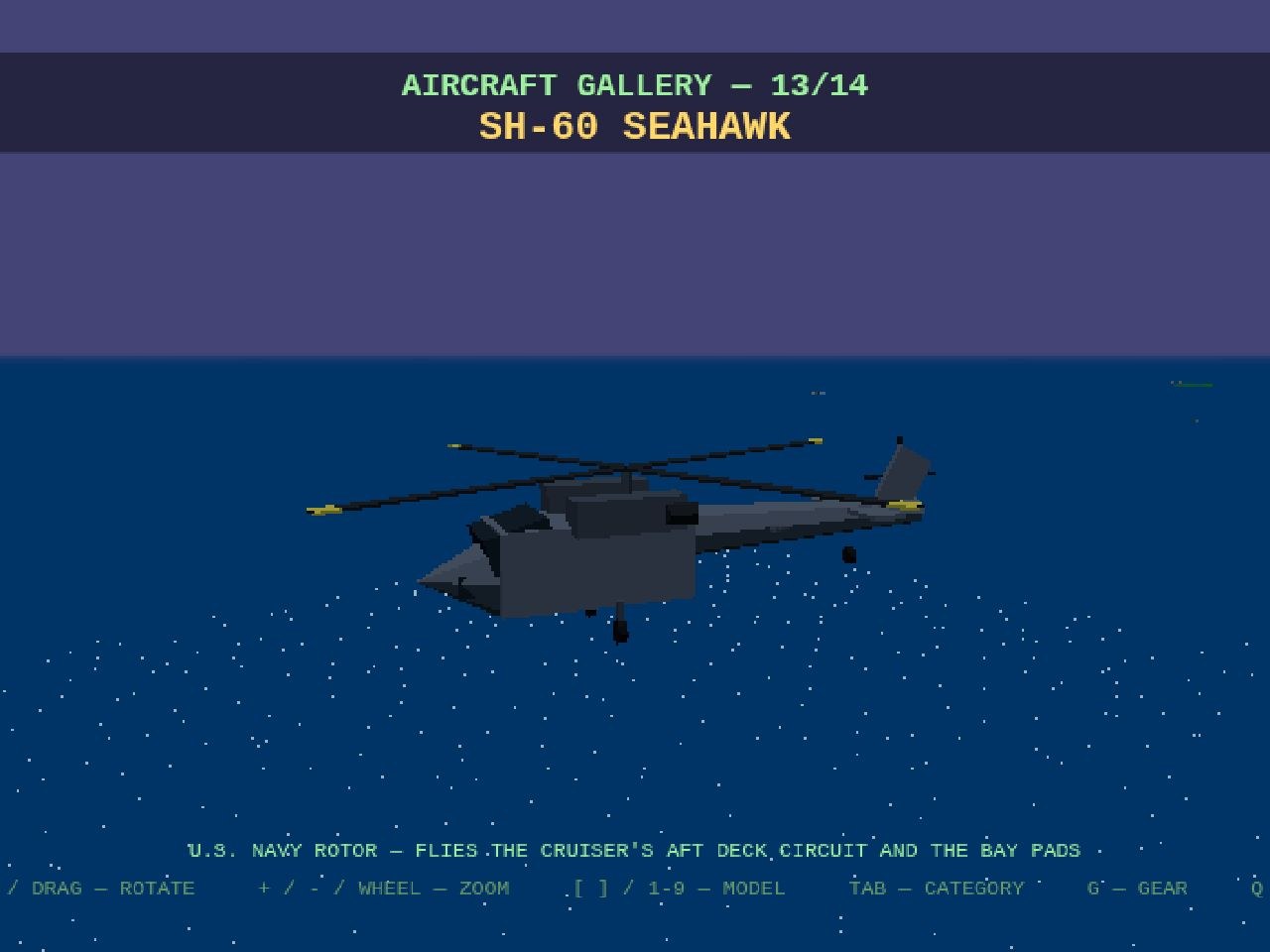
The thump you hear crossing the cruiser’s wake is her: the Sikorsky SH-60 Seahawk, the fleet’s shipboard helicopter, and the first rotor in Hornet Bay. She spools up on the guided-missile cruiser’s aft deck, flies a four-leg circuit of the group, and puts it back down on a deck that’s still making 15 knots — while two of her sisters shuttle the bay’s five new helipads. Her card:
Crew: three to four — pilot, co-pilot, and sensor/rescue crew in the back.
Powerplant: two GE T700-GE-401 turboshafts, about 1,700 shp each, turning a 53 ft 8 in main rotor.
Performance: 180 kt flat out, 146 kt cruise, with a service ceiling near 12,000 ft and about 450 nautical miles of legs.
Dimensions: 64 ft 10 in nose to tail — compact enough for a frigate’s deck, big enough to haul a torpedo and a winchman.
The kit, by variant: sonobuoys and a MAD bird on the SH-60B, dipping sonar on the SH-60F, Mk 46/50 torpedoes for the kill — plus plane guard, SAR and VERTREP, because somebody has to pick up what the fixed-wings drop.
In the bay: full rotor spool-up with the blur disc fading in past 62% rpm, a moving-deck approach that chases the ship’s own motion, and pad bookings on the shuttle routes — SFO, Oakland, Moffett, Alameda and the SF Heliport. Gallery page 13/14; spectate the circuit with J.
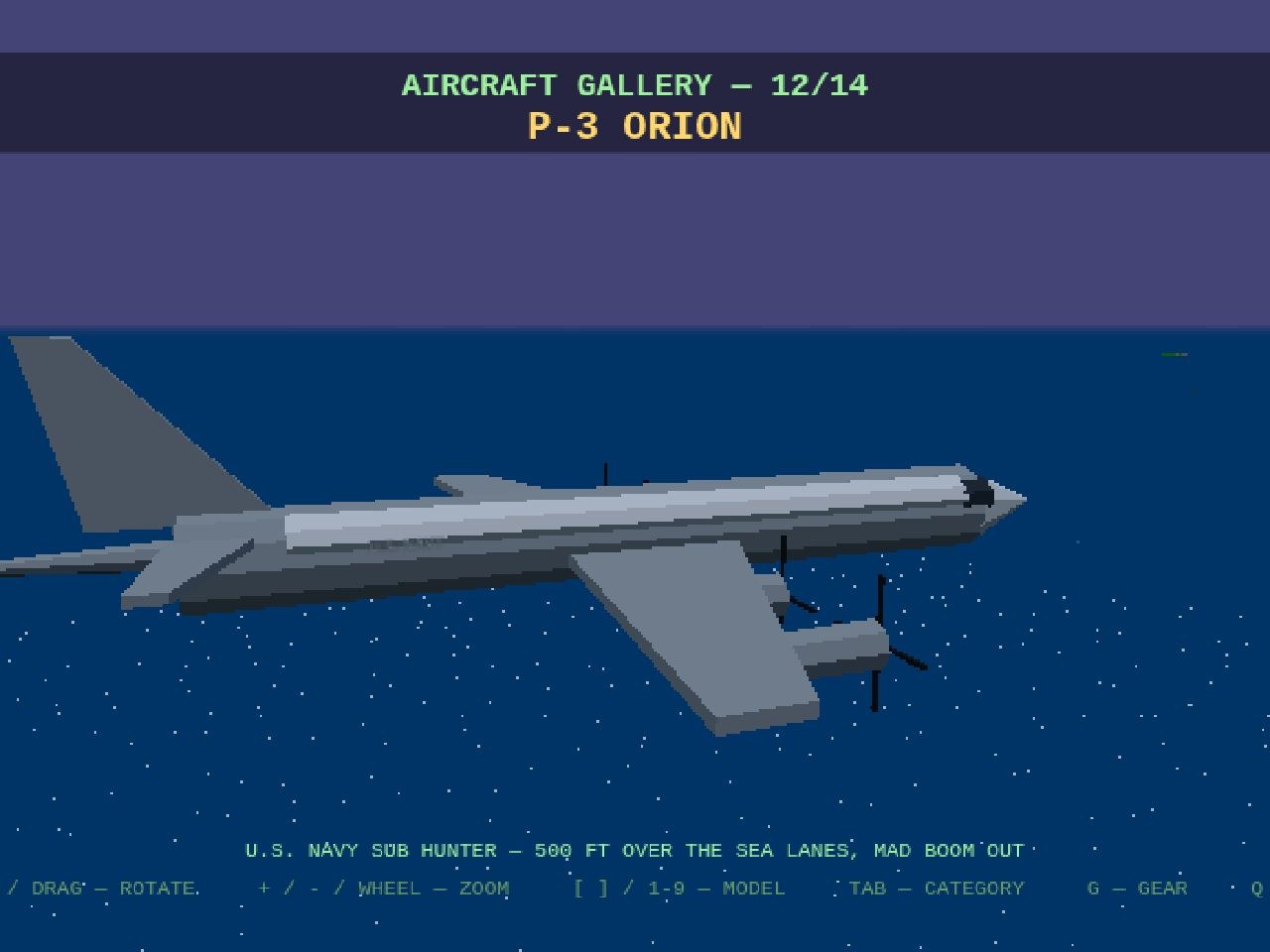
Out to the west of the carrier group, low and slow and endlessly patient, flies the Lockheed P-3 Orion — the Navy’s maritime patrol workhorse since 1962, derived from the Electra airliner and hunting submarines for over sixty years. Ours works an 11×5 km oval at 500 feet and breaks off now and then to eyeball a surface contact up close. Her card:
Crew: eleven — two pilots, a flight engineer, and a full sensor and ordnance team down the back.
Powerplant: four Allison T56-A-14 turboprops, 4,600 shp each — the same engine family as our Hawkeye, twice as many of them.
Performance: 411 kt max, but she earns her pay at 180–200 kt, 500 to 1,500 feet, ten hours on station.
Dimensions: 99 ft 8 in span, 116 ft 10 in long — the biggest aircraft in our gallery that isn’t an airliner.
Ceiling: 28,300 ft. Range: about 2,380 nautical miles.
The kit: the magnetic anomaly detector in the tail stinger — the MAD boom you can see on our model — sonobuoys by the dozen, Mk 46/50 torpedoes and Harpoons in the bay and on the wings.
In the bay: radar-visible but nobody’s target, she announces every visual inspection pass on the radio — 400 metres abeam the contact at 300 feet, then back to the oval. Gallery page 12/14; spectate the hunt with J.
The pattern over the bay just got crowded — in the best way. One push brings five new regulars to the airspace, a fix for the Tomcat’s manners, and a voice for the Phoenix:
You no longer launch alone. Every mission sortie now catapults you with an assigned wingman — VIPER TWO — off the deck 2.6 km behind you, joining on your right wing (90 m abeam, 70 m back) as you climb out. He covers a 12 km bubble around you, takes the shot when he has it — real AMRAAMs, real kills — and when a bandit gets on his six he jinks and calls for help: you’ll hear him on the radio and see TWO: DEFENSIVE! flash amber on the HUD.
You can task him. The backquote key (`) opens the wingman orders card: ATTACK MY TARGET, COVER ME, FORM UP, RETURN TO BASE — 1–4 issues the order and he executes to the best of his ability, acknowledging on the radio. (The comma key, our first choice, turned out to be the rudder. He’s a good wingman, but he can’t fly two planes.)
The cruiser’s helicopter actually flies. An SH-60 Seahawk spools up on the guided-missile cruiser’s aft deck, lifts, flies a four-leg circuit around the group, then comes home and lands on a moving deck — the approach math chases the ship itself, steaming at 15 knots. Five new helipads — SFO, Oakland, Moffett, Alameda and the SF Heliport downtown — host shuttle helicopters running pad-to-pad across the bay.
A P-3 Orion works the sea lanes. Twelve kilometres west of the group she flies an 11×5 km oval at 500 feet, MAD boom out, hunting submarines — and every couple of minutes she breaks off to make a visual inspection pass 400 m abeam of a surface contact, announcing each run on the radio.
SCREWTOPS is on station. An E-2C Hawkeye from VAW-123 orbits the bay at angels 23, rotodome turning, and calls the fight the way a real Hawkeye does: BOGEY with clock code, miles and angels when a hostile closes; CIVIL TRAFFIC when an airliner conflicts with your altitude; a FRIENDLIES round-up and a full PICTURE every couple of minutes. Bullseye is Alcatraz — check in and she’ll tell you so herself.
Housekeeping for the Tomcat. Her swing-wings now sweep the right way — aft, hugging the fuselage, not forward like a duck (a rotation-sign bug, caught and fixed) — and the contrail tips follow the gloves as they travel. The Phoenix found its voice too: selecting AIM-54 now gets the same spoken callout as Sidewinder, AMRAAM and guns. All three new birds are in the gallery, which now hangs fourteen aircraft.
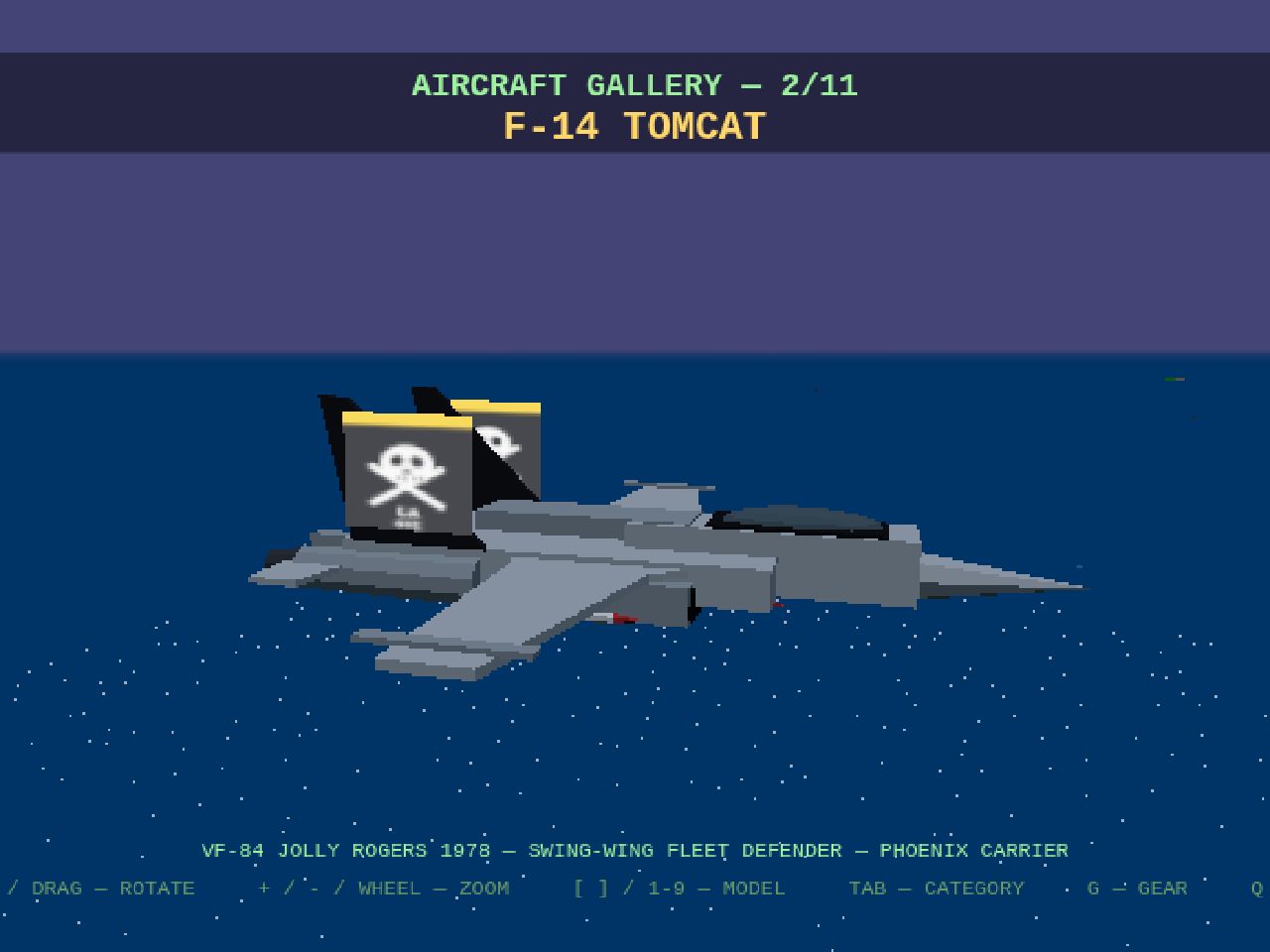
The flight line just grew a third mount, and she’s a big one. The Grumman F-14 Tomcat — fleet defender, swing-wing icon, and the only fighter ever to operationally sling the AIM-54 Phoenix — is ready for catapult shots off the Big E, wearing the 1978 VF-84 Jolly Rogers scheme: gull grey over white, black tails with yellow tips, skull and crossbones on both rudders, AJ on the modex:
She’s fully carrier-qualified. Cat 1 holdback and stroke off the bow, tailhook and wires back aboard — the same boat ops as the Hornet, with the Tomcat’s heavier, thirstier twin-engine personality (and a higher ceiling: those TF30s breathe up to 50,000 ft).
The wings sweep on command.S works the swing-wing: 20° spread for the pattern, 68° swept for the dash, easing over about two seconds just like the real box. The flight model morphs with the geometry — drag drops, stall speed climbs, roll sharpens, the G limit rises — and the HUD calls out the sweep angle as it travels. She even oversweeps to park, wings hugging the fuselage on the deck.
Four AIM-54 Phoenix in the tunnel, two Sidewinders on the glove pylons. The Phoenix is a different class of weapon from anything else in the bay: fatter, faster, and fired from far beyond the horizon — radar-guided all the way, FOX 3. It rides the rails from 1.2 out to 90 kilometres.
The AWG-9 reaches out. The Tomcat’s radar adds a 100 MI tier on top of the usual 40/10/2 — R cycles the lot, and the scope, the lock logic and the Phoenix’s envelope all honour the big radar’s legs.
She’s a squadron purchase. Plane-select 3 asks for the unlock code once; the Tomcat DLC in the Hornet Bay Store delivers it instantly for $8, and the jet stays in your logbook for good. Squadron founders fly her free, of course.
The printable joins the fleet. Her STL — wings spread, four Phoenix kept in the tunnel, skull and crossbones on the tails — is in the 3D Print Bay for $5, and THE COMPLETE FLEET bundle now packs all 23 models.